Maintenance and aeronautics: preparing for recovery thanks to a modern CMMS


Maintenance plays a major role in the aeronautical industry, both for manufacturers and their subcontractors as well as for civilian or military organizations that operate aircraft, such as airlines.
However, the sector of aircraft construction not having always been a volume production, like the automobile for example, it has not reached the same industrial maturity or the same level of robotization and digitalization. Instead of multiplying the number of factories, manufacturers must therefore find a way to make them more efficient, especially in a context of increased competition.
Optimizing the maintenance management is part of the tools for improving the productivity thanks to technological advances and new solutions available on the market. THEMobility Work CMMS application thus allows manufacturers in the aeronautical industry such as saffron to modernize their maintenance management to make it more efficient and less expensive, and to be in a position to adopt Industry 4.0 methods.
The complex challenges of aircraft manufacturing
The impact of cycles on the aeronautical sectors
The aviation industry is facing variable cycles. Before the crisis linked to the Covid-19 pandemic, the pressure on aviation production was growing stronger, boosted by a constant increase in passenger traffic around the world. With the crisis, air traffic has been greatly reduced, causing a very sharp drop in activity for both airlines and aircraft manufacturers who have experienced a considerable reduction in the number of orders. For some specialists, as early as 2024, the sector will return to higher growth than before the pandemic.
The aeronautical industry is organized into sectors : for example, major manufacturers order screws from one subcontractor, motors from another, etc. Consequently, these cycles affect a large number of subcontractors who must adapt to them. So, as pressure on deliveries increases among large manufacturers, it also increases across the entire supply chain, especially on smaller businesses.
Risky strategies
In a period of growth in production, they are developing strategies to anticipate future orders and to be able to deal with them. For example, they constitute buffer stocks. But these methods are risky, as the Covid-19 crisis has clearly shown: the slightest reversal of the situation has dramatic consequences and can put a factory out of work if stocks no longer run out.
To be in a position to best adapt to the sometimes unpredictable cycles it faces, the aeronautical industry therefore has a strong interest in modernise its production methods, which includes managing the maintenance of its production tools.
Maintenance management in aeronautics
The production tools used by the aeronautical industry are varied: riveting machines, assembly tools, assembly tools, reference frames, shapes, templates or tests, overhead cranes, etc. These are oftenprecision equipment, which therefore require perfectly controlled maintenance.
Switch to Industry 4.0 to anticipate the resumption of aeronautical production
A period of decline in activity such as the one we are currently experiencing is conducive to the implementation of new tools that allow gain in productivity and above all to prepare for future pressure on the production chain. Indeed, this cannot be resolved by an incremental increase alone. The production activity should not only be more important, it should also be organized differently.
New tools for better organization
The establishment of new ways of organizing the means of production, thanks to new digital technologies, whether hardware or software, makes it possible to create disruptions in productivity and to move to Industry 4.0. Connected tools and Big Data, in particular, make it possible to make factories more “intelligent” and to adopt “smart manufacturing” or “intelligent production”.
With the implementation of such tools, ramp-ups can be more easily supported by factories by increasing the operational efficiency and flexibility of all production chains.
IoT at the heart of the aeronautical industry 4.0
Aircraft manufacturing companies are often organized into 3 distinct parts : the ERP, which corresponds to administrative management, the MES, the production organization system, and the workshop, which is the heart of the factory, where the parts are manufactured. Too often, these 3 parts are not linked together. Therefore, when an incident occurs on one of these silos, it must be quarantined and the entire production chain is slowed down until the entity concerned resolves it.
The transition to Industry 4.0 makes it possible in particular to connect these different groups of activities. In practice, this is reflected in the installation of sensors throughout the production chain and the implementation of IoT (Internet of Things). These sensors make it possible to constantly send data on the state of production and therefore of machines and equipment, but also on the inventory management, for example.
Thanks to the data transmitted by the sensors, the activity of a 4.0 factory can be analyzed in real time, which makes it possible to react immediately to possible problems. The use of quarantine systems and unwanted production stoppages are thus much less numerous, which greatly favors productivity.
Adopting 4.0 CMMS to move to industry 4.0
To be able to use the maintenance data transmitted by IoT sensors, it is essential to use a Adapted CMMS, that is to say operating in SaaS mode. Thanks to cloud storage and a Big Data focus, a new generation CMMS like Mobility Work indeed makes it possible to analyze all this data in real time and tointervene before breakdowns or malfunctions by identifying anomalies in the operation of a machine. This operation is that of the predictive maintenance, the most advanced maintenance strategy to date.
Adopting Mobility Work mobile CMMS has advantages even for companies that do not yet use IoT sensors, as shown perfectly. The example of the Safran site in Loches. By using this solution, the maintenance department of this factory can now analyze its maintenance data, manage the schedule of regulatory controls, which are very important in aeronautics, or even set up preventive maintenance plans. It also makes it possible to considerably improve the management of spare parts stocks, which represents, as we have seen, a major challenge for companies in the aeronautical construction sector.
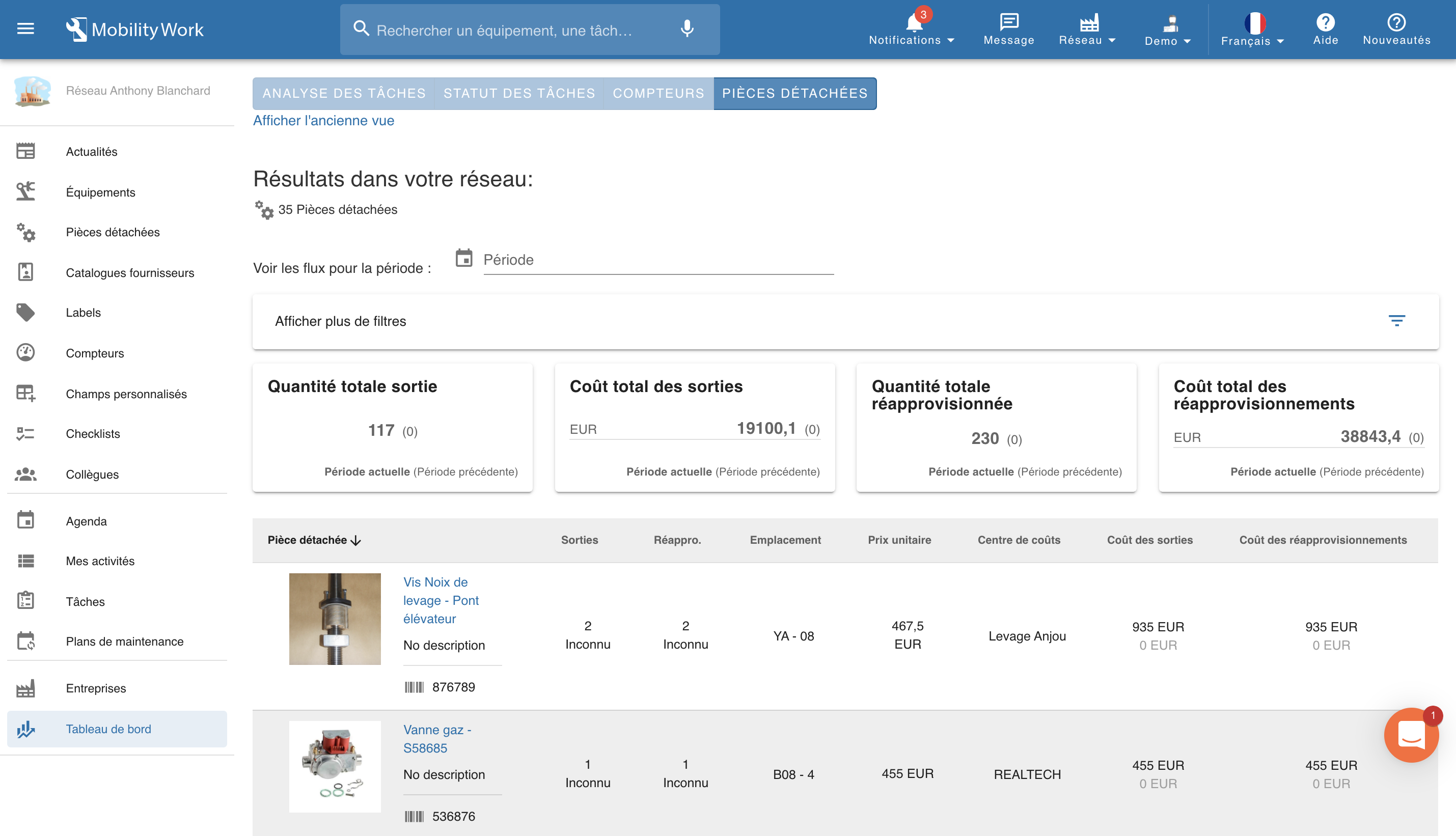
Improve the management of your spare parts stocks thanks to Mobility Work CMMS
CMMS is therefore a valuable tool to help aircraft construction companies adapt to the variable business cycles to which they are subject. The current period of reduced production is favorable for implementing new technological tools that will allow them to be fully prepared for the resumption of production.
Any questions?
Contact us to discover the first CMMS that can be deployed in 3 weeks.