My maintenance journey #4: Julien Audrain

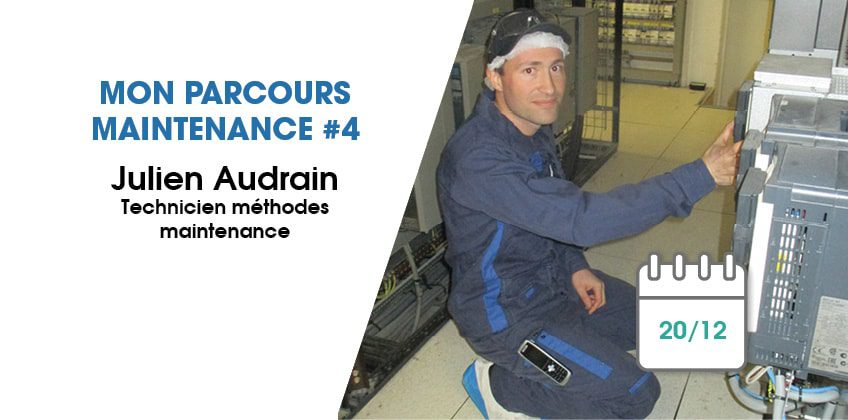
Mobility Work highlights maintenance jobs and their sometimes atypical careers. For this new episode, Julien Audrain, maintenance methods technician in Brittany, at Armor Proteines, took part in the game. Through its seven sites located throughout the Grand Ouest region, the company (a subsidiary of a leading group in the dairy industry) has specialized in milk cracking for nearly 35 years. It has bet on innovation to stay up to date with the latest technologies and diversify its offer.
Julien Audrain was kind enough to tell us about his background and explain the reasons for his motivation to work in the industrial maintenance sector: family heritage, development prospects, promising opportunities... According to him, this universe is full of resources and offers interesting opportunities.
Mobility Work: “Can you introduce yourself and tell us about your academic background?
My name is Julien Audrain and I am a methods technician at Armor Proteines (in Ille-et-Vilaine). My career started with a vocational baccalaureate in Fougères, with an emphasis on electrical engineering and electricity.
During this training I did various internships in the field of industrial and building electricity. During one of them, I was offered a work-study position on the condition that I obtained my bachelor's degree. So, with the Chamber of Commerce and Industry of the Pays de Fougères, I was able to go for a BTS industrial maintenance work-study program at the Armor Proteines company from 2007 to 2009.
After this BTS, the company wanted to hire me as a maintenance technician. Since 2017, I have been replacing the method technician who retired. I am therefore still in the same structure and have completed a real career there, from my vocational baccalaureate through an apprenticeship in BTS to get to where I am today.
How did you come to work in the field of industrial maintenance?
I have always liked manual work, DIY... I must say that my father is a maintenance manager and that my grandfather was a carpenter so I have almost always been immersed in this manual environment. At the same time, I was very interested in the industrial world and the opportunities it offers.
What do you think are the strengths and weaknesses of your BTS?
As for the strengths, I would be tempted to talk about alternation. It really helped me to have a clear vision of what the world of work was like before officially entering it. Students have a good first approach at school but things are different and necessarily much more concrete on the ground. We are better aware of the interaction with maintenance technicians, the working methods, the processes used to dismantle the machines... It is still much more telling than on paper or on video.
Perhaps the only real weak point would be that the theory learned in class cannot always be applied in the field, depending on the business sectors (agri-food, metallurgy, etc.). Indeed, students learn industrial maintenance, but it is still a very broad field whose application varies according to the industry and the possibilities in the workplace.
In my opinion, there is no real strong or weak point, it is above all a very good experience, which makes things concrete. You have to know how to seize opportunities: to use my example, I was immediately able to be hired after my BTS. If I had followed a continuing education course, I would certainly not have found it so easily, especially as employers often ask candidates for at least two to three years of experience, which I was able to acquire precisely through my training.
Beyond that, I imagine that students who want to continue their studies after a BTS work-study program to, for example, pursue a bachelor's degree or an engineering school are sometimes tempted to enter the job market directly because they have had a real first approach.
How do you explain why young people are less and less attracted to this sector?
I think it's a whole lot. Parents are even more likely today to direct their children towards long studies, to want to see them work in offices, because this is synonymous, in the collective imagination, with a better professional situation.
This preconceived idea is all the more true since, when we think of industrial maintenance, we always imagine a technician in blue, dirty with grease and oils... We should rather imagine them as employees who must use their thinking skills to improve processes, working conditions, methods used and who are ultimately a real support for production!
Technicians must certainly be able to repair a machine as quickly as possible, but they must also know how to juggle various stakeholders: quality, safety... The profiles of maintenance technicians, method technicians and even maintenance managers are constantly evolving and much more complete than one might think.
Discover the episode dedicated to Marc-Antoine Talva, CEO of Mobility Work
What is the main difficulty you faced during your school career?
In fact, I did not encounter any particularly penalizing difficulties. Where I encountered some obstacles during my BTS was when I found myself with people who had a bachelor's degree in mechanical maintenance and therefore acquired knowledge when I came from a different background. I had to catch up on these subjects, but it's a double-edged sword situation since I was very comfortable using electricity thanks to my high school diploma, unlike the others.
As a general rule, each person has difficulties on some subjects, and facilities and real advantages on others. The key is choosing the right path at the start.
Why did you choose the apprenticeship path?
I decided to turn to this path during my vocational baccalaureate, when I was directly offered an apprenticeship position. In addition to all the advantages mentioned above, the prospect of receiving a salary every month while you are 18 and still in school is very attractive, you have to be honest. This makes it possible to gain autonomy and maturity.
What is the main difficulty encountered when you were in business?
Overall, everything went very well and I had a real good experience because instead of being assigned to one person when I arrived at the company, I was truly integrated into the service, gradually I was let to work independently. Indeed, I was able to observe different working methods, see how everyone worked, learn by myself... I had no unpleasant surprises compared to everything I had heard about the world of work, on the contrary, I was very well prepared for it.
Do you have any final advice for those who wish to opt for an industrial maintenance sector?
I think that we should not stop at the prejudices that often circulate about first-level industrial maintenance but rather have a long-term vision. If a maintenance technician wants to evolve, it is entirely possible to give himself the means and to succeed.
When you opt for industrial maintenance, the range of possible activities is very vast: you can choose to focus on new works, the design office... This environment is far from being closed; on the contrary, it offers a multitude of opportunities! In addition, there is a strong demand in all sectors and the industrial maintenance environment itself is quite open. There are a lot of opportunities to seize.”
Thanks to Mr. Audrain for his testimony. To be alerted to our next article dedicated to maintenance jobs and training, follow us on our social networks (LinkedIn, Facebook and Twitter)!
Any questions?
Contact us to discover the first CMMS that can be deployed in 3 weeks.