My maintenance journey #5: the automotive industry

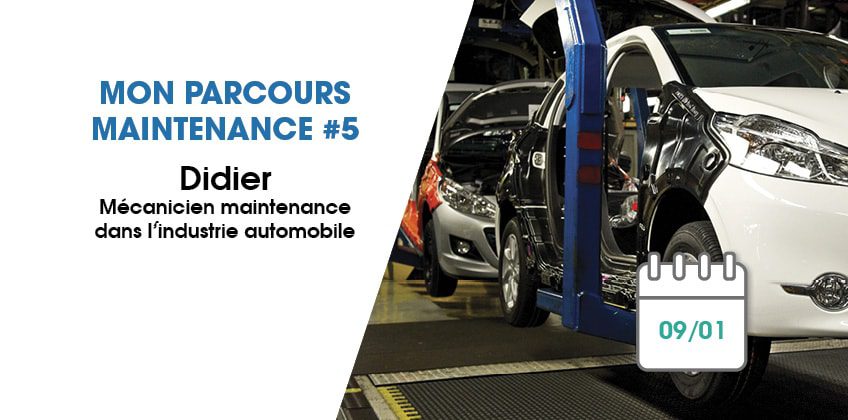
Mobility Work highlights maintenance jobs and their sometimes atypical careers. For this fifth episode, Didier, maintenance mechanic, comes back for us on recent developments in maintenance in the automotive industry.
Mobility Work: “Can you tell us about your career path?
I started as an industrial maintenance mechanic in the automotive sector over thirty years ago now. I spent almost all of my career in the same company that I still work in today.
What was your career path in the company?
During my 30-year career, I have been able to explore different maintenance sectors in the automotive industry.
I started out as a launch agent. In particular, I was in charge of managing supply flows: receiving orders, preparing, but also ordering parts according to orders and production requirements. At that time, our team specialized in the production of extractor hoods and fuel pumps. I stayed in this position for three months before joining another group entity.
In the years that followed, I had the opportunity to discover many sectors of activity. I was first assigned to sewing machines, the ones used to make the outside of car seats. It is a meticulous job that is carried out face to face with the machines. I stayed in this position for four years.
Then, I joined the team in charge of cardboard maintenance for two years. Cardboard production applies in particular to structures found in door panels, for example. The parts are solid and must meet a set of quality criteria.
From cardboard maintenance, I moved on to cabling. There, we took care of all the automotive cables, from the dashboard to the trunk. For eight years, I was involved in the length cutting of wires, cables and harnesses.
Finally, I joined the assembly team, whose task is to assemble the various parts of the car produced by external companies.
Have you noticed any specific features specific to these services?
Of course, they are not the same applications. Each time, you have to know the machines and the techniques. But it's exciting because you're constantly learning and specialising.
We do not always intervene on the machines ourselves: when a failure or defect is noticed, the technicians report it and the information is sent back to a dispatcher. He is responsible for distributing tasks and transmitting the intervention to the most qualified maintenance technician.
What transformations in maintenance jobs have you seen in your sector of activity over the last 30 years?
Technologies have transformed the industrial maintenance landscape. In recent years, production and maintenance staff have declined significantly in favor of automated machines.
Twenty years ago, most companies in the automotive industry were looking to invest in robotics. Today, it seems that they are making a U-turn and that they want to put humans back at the center, to free themselves more from mechanical or electrical infrastructures. I think they see this as a major economic advantage, because in the end, spare parts and repairs are more expensive for them than humans. This is a fairly recent trend, but I have the feeling that businesses are looking to simplify their machine park because The cost of industrial maintenance has gradually become higher than that of production.
Another element that can be addressed would be the outsourcing of human resources. Businesses increasingly tend to use third party organizations and outsource their industrial maintenance operations, which was not the case before. For them, it is probably a way to make up for the reduction in staff.
At the contractual level, this means that it is the service providers who bear the responsibility in the event of a stoppage of production. For example, if maintenance is carried out in-house, equipment downtime will result in significant losses for the company. Conversely, when maintenance is carried out by a third party, the third party is responsible for the losses caused.
Has this paradigm shift that you are talking about changed anything in your daily life?
One of the elements that impressed me the most was undoubtedly the organization of the workshops.
At the beginning of my career, we used to work on individual machines. Each technician, each mechanic was responsible for maintaining and maintaining the proper functioning of their equipment. All operations were carried out on a small number of stations by technicians, production was organized by groups of autonomous islands. Individual machines were gradually replaced by production lines. The tasks are divided, the operations executed in a chain.
Our industrial maintenance routines have had to adapt accordingly : we have abandoned minor maintenance for larger manufacturing and assembly machines. We no longer have to manage the same rooms, both in terms of size and functionality, which requires other skills on our part.
It also has an impact on the manufacturing process itself. When production is organized in islands, we have the possibility to prepare the parts, to repair the equipment in the workshop if necessary, and only the machine concerned is affected by the maintenance operation. Today, we have to intervene directly on the production line. The entire chain is immobilized during the maintenance operation and the manufacturing process can suffer from this downtime.
As a maintenance technician, how do you use digital tools?
We use tools to manage our stocks, in particular. This is very practical when you have to go out or find parts using references.

Access all the information on your spare parts from the equipment sheet in your Mobility Work application
We also use sensors integrated into the equipment, which allow us to stop production lines if necessary and thus organize our maintenance interventions accordingly.
As we have seen in the press in recent years, the automotive industry has been hit by a major crisis. has this had an impact on your job?
Industrial maintenance routines are aligned with production rates and methods. Some production sites have been redesigned, the number of production lines has decreased, certainly in order to reduce costs. Maintenance needs are therefore logically no longer the same.
Staff numbers are gradually being reduced, departures are being replaced less and less. The average age of the staff is increasing and there is little turnover. Recruitments are mostly done internally, in particular through a transfer system.
What future do you see for maintenance jobs?
In my opinion, the job of maintenance technician as we know it today will undergo profound transformations. Each manufacturer now seeks to manage the maintenance of its products and equipment, to limit the use of service providers.
At the same time, we are witnessing the emergence of a new facet of the profession. More and more technicians now operate in an “itinerant” manner. These technicians are seconded for specific corrective or preventive maintenance interventions, for example for computer operations such as automated programs.”
Thanks to Didier for his testimony. To be alerted to our next article dedicated to maintenance jobs and training, follow us on our social networks!
Any questions?
Contact us to discover the first CMMS that can be deployed in 3 weeks.