The 5 levels of maintenance according to Afnor

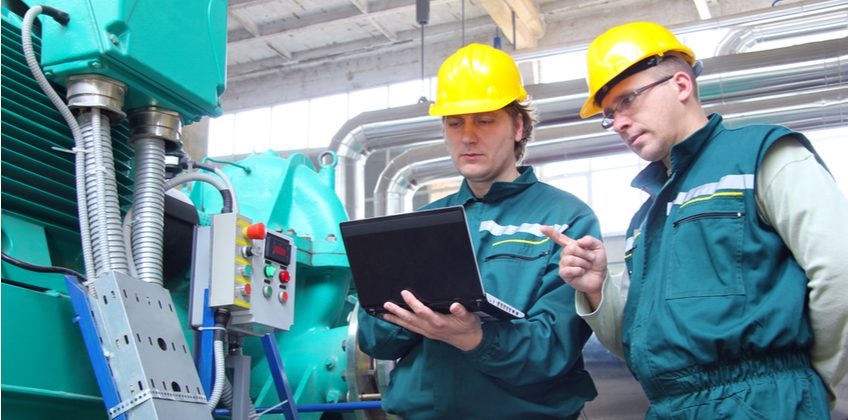
A good knowledge of the different levels of corrective and preventive maintenance makes it possible toimprove the management of interventions on the machine park. To do this, the easiest way is to refer to the Afnor standard X 60-010 (1994), which defines 5 levels of industrial maintenance, depending on the complexity of the interventions to be carried out. This classification is very useful in particular for deciding whether an operation can be carried out internally or if it is necessary to use qualified external service providers.
What is an Afnor maintenance level?
The purpose of the concept of maintenance level is to preserve as much as possible a fleet of industrial machines, both in terms of the value of the equipment and in terms of performance and safety. A good practical application of the various maintenance levels allows optimal maintenance to be carried out.
That's why Afnor defined, in the X 60-010 (1994) standard (1994), then with the NF X 60-000 (2016) standard, 5 maintenance levels. Each level thus corresponds to a degree of complexity of the corresponding maintenance interventions.
Thanks to this classification, it is possible to determine the level of expertise required and the resources which will have to be implemented to carry out an operation. It also makes it possible to assess whether an intervention can be carried out internally or if it is necessary to use qualified external service providers.
What are the different levels of maintenance?
There are 5 levels of maintenance, ranging from the simplest interventions to the most complex ones. Corrective and preventive maintenance actions correspond to each level.
First level maintenance
Level 1 maintenance corresponds to simple interventions, necessary and carried out on easily accessible elements. These are therefore operations that do not require dismantling or opening the equipment, and that can be carried out by the operator himself or by a non-specialized operator.
For these interventions, few spare parts or consumables are used. They do not present no particular security risk if the essential instructions can be consulted, for example on an explanatory note or visual instructions.
Examples of first-level corrective maintenanceExamples of first-level preventive maintenanceReplacing several lightbulbsRoundInterventions on scrapers, mud flaps, rubbersLubrications Meter readings Check to check the fouling of a filter Light test
Level 2 maintenance
2nd level maintenance corresponds to not very complex interventions, whose procedures are simple to follow. Moreover, the replacement of parts during these operations does not require the overall dismantling of the equipment concerned.
These interventions must be carried out by a qualified technician who has undergone training on safety and risks. They are therefore generally entrusted to a medium qualified technician.
Examples of 2nd level corrective maintenance examplesExamples of 2nd level preventive maintenance Replacing components: fuses, belts, air filters, etc.Checking parameters on a machine in operation using measurement tools integrated into the equipmentReplacing braidsReplacing braids Simple adjustments (pulley alignment, motor alignment, etc.) Verification of the functioning of the circuit breakers (sensors, circuit breakers, fuses), etc.
Change of spare parts (rail, slide, roller, roller, rollers, rollers, chain, fuses, belts,...)
Descaling of runoff surfaces (cooling tower) Short-term greasing Changing a filter that is difficult to access
Level 3 maintenance
Maintenance level 3 corresponds to interventions considered complex. They must therefore be preceded by a diagnosis and identification. They can be carried out on site or in a maintenance workshop, and must take into account the equipment as a whole, because the modification of an element can have consequences on its general functioning.
Level 3 maintenance interventions must be carried out by specialized technicians using the tools indicated in the machine maintenance instructions.
Examples of level 3 corrective maintenance examplesLevel 3 preventive maintenance examplesDiagnosticsVerification and adjustments involving the use of measurement toolsTroubleshooting a leak on a cold groupPreventive maintenance visit on bottlenecked equipmentChange of standard spare parts (PLC card, cylinder, pump, pump, engine, gear, bearing, etc.Checking the ignition of a boiler and checking the combustion).
Level 4 maintenance
Level 4 maintenance interventions are complex and highly important operations, which require particular technical expertise.
They must therefore be carried out by a technician or a team of specialized technicians with a specific qualification, and also supervised by a specialized manager.
These interventions are carried out in workshops providing appropriate tools, documentation and measurement benches.
Examples of corrective maintenance at level 4 Examples of preventive maintenance at level 4 Changing valves on a compressorChange of valves on a compressorVibratory analysisChanging a cable head at low voltageOil analysisRevision of a paint pump in the room MaintenanceInfrared thermographyInfrared thermographyRepairing equipment using an automatic programming suitUse of tools such as an oscilloscope with data interpretation
Level 5 maintenance
Level 5 maintenance includes complex actions carried out by the equipment manufacturer or by an approved company by this one. The actions to be carried out are similar to manufacturing actions.
Examples of level 5 maintenance interventions include the reconstruction or repair of equipment or the bringing of equipment into compliance with new regulations.
Maintenance levels and CMMS
The use of an efficient and ergonomic CMMS makes it possible toeasily adapt interventions to the maintenance level to which they correspond. With a last-generation mobile CMMS, it is possible, for example, to associate Checklists to each piece of equipment, as well as all the technical documentation necessary for the work of maintenance technicians.
In addition, a community-based CMMS allows easy access to all the technical documentation provided by machine manufacturers and industrial suppliers, in order to: have the elements necessary for level 3 and 4 maintenance interventions. It also facilitates putting in contact with approved manufacturers or service providers to carry out level 5 maintenance actions.
Any questions?
Contact us to discover the first CMMS that can be deployed in 3 weeks.