Maintenance manager: Job sheet no. 2

Maintenance manager: job description and definition
Immerse yourself in the heart of the maintenance ecosystem and highlight its talents and opportunities: this is the mission that Mobility Work has set itself! We are launching a brand new “Job Brief” series that invites you each time to discover or rediscover a maintenance profession: definition, missions, daily life and testimony... For this second episode, Eric François presents his experience to us up to the position of maintenance manager that he now occupies at Peugeot Japy Technologies, a subsidiary of Farinia Group specializing in automotive equipment. With him, we discuss the specificities of a fleet of numerical control machines.
Mobility Work: Can you tell us about your background?
I've been working in the industry for 24 years now, but I haven't always worked in “pure” maintenance so to speak. Following a BTS in industrial maintenance, I got a job as a convenience store. After this first experience, I was able to progress within several teams and departments of the company I was working for at the time.
This is how I joined the maintenance methods department, where I was responsible for setting up preventive maintenance plans and strategies, the codification of spare parts, etc. I then moved to the position of maintenance coordinator and took the lead of a team of ten people.
Afterwards, I joined the methods department as an assistant downstream project manager. At that time there were major infrastructure operations in the factory where I worked: buildings were destroyed to rebuild others, assembly lines were changed, etc.
After which I was assigned to the new works department, responsible for maintaining the entire electrical and high-voltage infrastructure of the site. Then, still part of the new works team, I devoted myself to the masonry infrastructure part.
My career then led me to the general methods department, where I was able to work on new vehicle projects. I represented industrial management on the project team. In other words, I participated in the industrialization of new vehicles, in the implementation of the operations necessary for the production of the new vehicle.
I then moved to industrial maintenance as a maintenance unit manager where I managed a team of around twenty people. After that, I became a group manager. I was then in charge of the machining department, the painting service, the maintenance and the general upkeep of the site, as well as the new work.
Two months ago, I made a turning point in my career when I joined Peugeot Japy Technologies as maintenance manager. This is a great opportunity because there is restructuring work to be done here.
What does the job of maintenance manager consist of?
The main objective of the maintenance manager is to guarantee the availability of production resources and infrastructures on the site, to meet customer requests, while respecting safety regulations. To do this, his role is above all to coordinate maintenance teams, but he may also be required to intervene. Concretely, I supervise the organization and planning of industrial maintenance operations: preventive and curative maintenance and resource management.
However, the case of Peugeot Japy Technologies is a bit particular. The site's production is divided into “profit centers”: a profit center corresponds to a workshop intended for a customer. However, each profit center manages its industrial maintenance operations independently. As head of the general maintenance department, I am primarily responsible for the infrastructure and maintenance methods: the implementation of preventive maintenance operations, the management of spare parts, among others.
What are the qualities of a maintenance manager?
As part of my school education and my years of experience in industrial maintenance, I received several training courses on the basics of communication and management. The natural evolution of my career led me to the position of maintenance manager that I now occupy at Peugeot Japy; to get there, I had to learn as I went, “on the job”.
In addition to these training courses in management and communication, I think that the maintenance manager must demonstrate certain natural skills. In my opinion, any maintenance manager must be responsive, analyze and manage troubleshooting priorities, know how to manage pressure (whether resulting from a failure in the workshop or otherwise) but also staff and staff training.
What are the particularities of CNC machines?
More and more industries are engaging in a transition toIndustry 4.0. Numerical control machines ensure digital continuity throughout the production chain, and thus respond to the desire of companies to modernize their industrial production facilities.
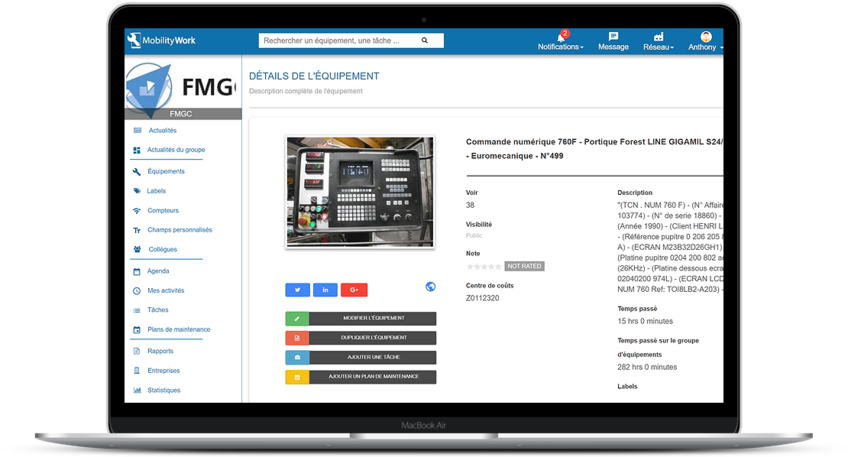
All information relating to the equipment is available from its dedicated sheet in the Mobility Work maintenance management application: description, image, documents, preventive maintenance plans, etc.
In other words, numerical control makes it possible to automate the operation of a machine within the production chain. It is composed of one or more microprocessors allowing technicians to program the machine: tool axes, table axes, tool change systems, feeding, unloading parts, etc. Thus mastering the various functionalities of the machine allows us to adapt production to customer needs.
Numerical control machines offer several advantages for businesses, first of all in terms of machining: they facilitate the manufacture of complex shapes that are difficult to produce with traditional manual controls, and also offer a certain degree of production flexibility and greater machining precision. Then, in terms of industrial maintenance, numerical controls allow operators to gain efficiency and manage several machines at the same time (thanks to the automation of a production unit). Numerical controls also most often have a digital display through which maintenance technicians can easily analyze the condition of the machine and monitor diagnostics and maintenance operations.
However, it is essential to train your maintenance teams so that they know how to adapt to new technologies and numerical controls, so that they master their specificities and automations.
What challenges do CNC machines represent for maintenance managers?
Peugeot Japy Technologies has a large number of CNC machines. Above all, we have machining equipment: lathes, broaching machines, then hardening machines, rolling machines... The equipment is quite diversified according to the tasks to be carried out.
As part of general maintenance, we do not intervene on these machines on a daily basis. In the team, we have experts whose role is to help the people in the workshop if they encounter difficulties during maintenance operations. The profit centers, which we mentioned earlier, manage breakdowns and maintenance interventions with their respective teams.
We are currently working with service providers who help us execute preventive maintenance plans and achieve site production goals. During the production process, the operator checks the manufacture of the parts, the proper functioning of the machine, makes the necessary adjustments to correct any defects and intervenes manually on the machine if necessary.
The operator must therefore know how to read and interpret plans, know the materials used and how they are transformed during cutting, master control tools, have computer programming skills (hence the growing need for training), and respect productivity and quality standards.
How do you use CMMS tools on a daily basis?
The person in charge of deployment of Mobility Work CMMS on our site is part of my team. For my part, I am currently participating in meetings organized in workshops, during which I ask production teams to create tasks in the Mobility Work CMMS tool.
During my previous experiences, I was already using a CMMS tool. Adapting to Mobility Work's new generation CMMS is going well. I think it's a pretty interesting tool. I particularly appreciate the visual aspect of this CMMS; being able to consult photos and illustrations of the equipment is very practical when you are new to a site. The same goes for downloading documents from Mobility Work. It's something I didn't have before. It is a real plus to be able to download an electrical diagram or plans, for example, at the foot of the machine.
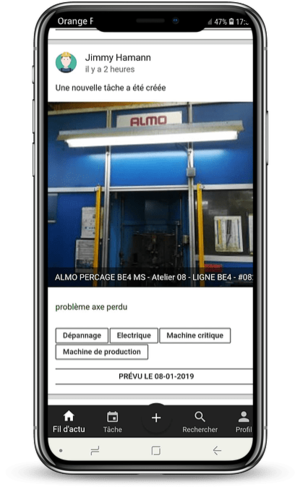
All the news relating to current interventions are available from the news feed of the Mobility Work mobile application, available on iOS and Android
To get the most out of it, however, it is necessary for everyone to make good use of it. Production teams need to create a task to report breakdowns, so that the maintenance technician can create his activity and postpone his intervention via the CMMS. This then allows us to follow the evolution of failures using the dashboard, to analyze the Pareto headaches (i.e. the first causes of incidents) and to work on the machines that present the most problems.
We are currently trying to optimize the use of Mobility Work CMMS and to set up a new process to link all spare parts in stock to the machine. It's a long process. For now, we are working on entering the documentation associated with the machine, but to go further we would have to add all the spare parts available on the machine. Thus, maintenance technicians in the process of troubleshooting it would have direct access to it, thanks to the store's article code, and could even make supplies directly with Mobility Work CMMS.
Faced with the rise of new technologies, do you think that industrial maintenance jobs will change in the coming years?
I think so, especially with the industry of the future. Little by little we are seeing things coming our way. In my previous company, new technologies were not as present as here, at Peugeot Japy Technologies, which wants to network equipment. In my opinion, this can lead to a fairly interesting development.
Our job will also change, and will evolve towards complementary skills. I think everyone will have to master the various automations, that the maintenance teams will have to have a good knowledge of networks, which was not their responsibility before, it seems to me.
What advice would you give to young people who want to embark on this path?
I would advise them to take the time to take a personal interest in it, to be curious and to follow different topics.
There is a lot to learn in the field of industrial maintenance, there are completely different technologies for those who want to learn. Concretely, in the field, when responding to a failure, you must take the time to analyze it, study and know the means of production. I think it's rewarding.
Finally, I would also advise them to be very interested in the new technologies that represent the future of our industry.
Are you interested in maintenance management and want to know more in order to increase your productivity and save money?
Any questions?
Contact us to discover the first CMMS that can be deployed in 3 weeks.