Predictive maintenance or predictive maintenance? Explanation and definitions


In the age of globalization, we are witnessing a intensification of interactions between countries and languages in different contexts of exchange (economic, political, technical, scientific, cultural, social) that favored the emergence of translation and other linguistic phenomena. This is the case for the predictive maintenance and predictive maintenance.
Predictive maintenance and predictive maintenance: definition
Origin of the debate
Accentuated by technological advances, these linguistic adaptations, while necessary, are often overlooked. The United States, a leading figure in this technological surge, is regularly behind the initiative of terminological proposals that will be used in innovative sectors. The emergence of these new technologies is often faster than the upgrading of local/national terminology. It is currently the flow of this technological wave that dictates the number of terms to be adapted or borrowed: thus, the least technologically advanced countries are more prone to terminological imports.
Explanations and definitions
The various sectors of industry, and in particular maintenance, are strongly affected by these various linguistic phenomena. It should also be added that there is no real consensus on the definition or use of terms. : definitions and uses vary from one technician to another, from one site to another or from one company to another, despite the introduction of CMMS and other standardization tools. In this case, they are often technical terms that are rarely used or not used in current vocabulary, or that have a different meaning in current practice; these terms are thus more difficult to fix in a lasting and official way.
One of the most striking examples relates to the concept of “predictive” or “anticipated” maintenance; this type of maintenance involves predicting failures before they occur. The term most frequently used is “predictive maintenance”: very widely used by maintenance professionals, it is however an inappropriate use, modelled on English. In fact:
- in French: predictive, adjective. definition: who predicts, who makes it possible to predict; to announce as having to happen by “clairvoyance”;
- In English: predictive, adjective. synonyms. prognostic, prognosticative.
Since maintenance is not a fortune-telling science, it makes it possible to predict, not to predict. The expression “predictive maintenance” is therefore erroneous, and does not exist.
Why is this debate happening?
If the “predictive”/“predictive” debate sows discord within the community of maintenance professionals, it is because certain approximations can sometimes be particularly harmful: they can cause a lack of communication and have serious consequences for the company. Good terminological precision and a clarity of vocabulary in maintenance are therefore necessary in order to improve communication between the actors in the factory and to allow:
- the expression of clear and specific ideas;
- improved communication within the company (between technicians, departments, departments, factories, factories, companies, groups, etc.), to compare data and to share analyses, data and important files;
- indicators that are consistent and understood by all actors in the company.
Interaction facilitated by community tools
The new generation of CMMS will be community based
With the emergence of community tools such as Mobility Work, the next-gen CMMS and the first social maintenance network, technicians from all over the world are invited to collaborate and exchange their expertise, best practices and opinions. These exchange platforms represent great tools to improve the management of your maintenance (chat, maintenance social networks, etc.), but also involve a potential increase in linguistic approximations.
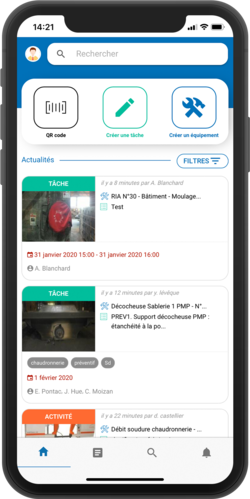
All the news relating to interventions, predictive maintenance and ongoing predictive maintenance are available from the news feed of the Mobility Work application.
Online communities
Online communities active on blogs or social networks also represent valuable discussion platforms for maintenance professionals (for example, “communities”). Industrial Maintenance ”,” Maintenance Expert/Engineer/Schedule/News/Jobsor Lean Manufacturing & Kaizen ” on LinkedIn). Maintenance technicians, although working in different countries or sectors of activity, are often required to work on similar machines, and therefore regularly encounter the same problems; it is therefore easier to understand each other when faced with identical situations encountered and shared.
Faced with this phenomenon, a certain flexibility is recommended: in fact, while the concept of “predictive maintenance” is inappropriate as explained above, it is very frequently used by maintenance and industry professionals. A certain margin of inaccuracy is therefore acceptable in certain cases in order to maintain dialogue between the various actors in the company or in the community of maintenance professionals. In addition, foreign maintenance technicians are sometimes also confronted with the same linguistic problems: we thus find the same example in Spanish, between “mantenimiento preventivo” (preventive maintenance) and “mantenimiento previsional” (predictive maintenance). Moreover, we often note common roots between the different languages to designate key terms in the maintenance sector.
Are you interested in maintenance management and want to know more in order to increase your productivity and save money? Try our CMMS application for free for 7 days, and improve your maintenance management today!
Any questions?
Contact us to discover the first CMMS that can be deployed in 3 weeks.