Maintenance strategy: corrective or preventive?


The choice of maintenance strategy is crucial for any industrial company. It must be adapted to its needs and its human and financial capacities while allowing it to be as competitive as possible. Between corrective and preventive maintenance strategy, the pros and cons have evolved as technology advances. What is the most effective today?
Corrective maintenance
Corrective maintenance consists in intervening on a machine following a failure, in order to repair it and restore its normal functioning.
Corrective maintenance or curative maintenance?
In the French-speaking world, there are certain subtleties concerning the concept of corrective maintenance. Thus, the concept of curative corrective maintenance, which is a subdivision of corrective maintenance, is often abbreviated to “curative maintenance.” On the other hand, among English-language authors, this distinction is unknown, and the term “curative maintenance” is synonymous with “corrective maintenance” and is opposed to preventive maintenance.
The subtleties of corrective maintenance
Moreover, this maintenance category can be further refined. We can thus distinguish the palliative maintenance, which aims to troubleshoot or temporarily repair a failure, curative corrective maintenance, which aims to permanently repair the sources of breakdowns.
We can also differentiate between immediate corrective maintenance, which occurs as quickly as possible after a failure, and deferred corrective maintenance, which postpone the repair if it is not urgent or if it has already been scheduled at a later date.
What is the easiest maintenance strategy to adopt?
Corrective maintenance has long been the main maintenance strategy used to maintain industrial machinery. Even today, it seems to many SME managers or maintenance managers to be the easiest to set up.
For a long time, this characteristic of simplicity was real. Given the few technical or computer solutions for considering another type of maintenance, simply intervening on the machines in the event of a failure or malfunction was, of course, the easiest method to use.
When did the first appear CMMS software (Computer-aided maintenance management), preventive maintenance strategies have begun to be applied. However, the high cost, complexity and cumbersome nature of these software represented such disadvantages that corrective maintenance remained, for many factories, the method most suited to their capacities and needs.
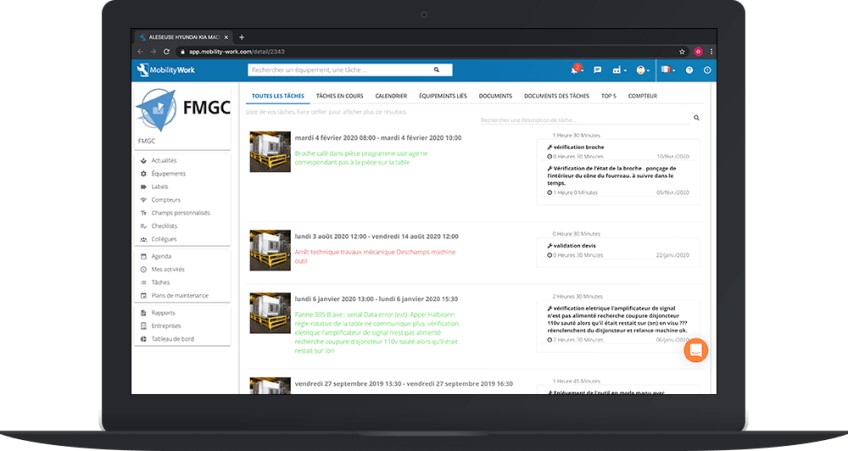
Enter all maintenance activities in the CMMS to keep a history of all the interventions carried out by the teams
A limited method
Today, this observation is no longer valid. Indeed, the appearance of new CMMS solutions based on the considerable technological progress of the last decades has changed the situation, by making preventive maintenance much easier to access.
Corrective maintenance has thus lost most of its comparative advantage. In fact, apart from its relative ease of use, this maintenance strategy has numerous faults. On the one hand, it poses a problem when acquiring new equipment. Incidents are generally frequent. in this case, and no material or human resources are mobilized before a failure occurs. On the other hand, the lifespan of the machines is not optimized by intervening only in the event of a failure, which means more frequent interventions and parts replacements.
In addition, in factories that apply a corrective maintenance strategy, breakdowns are generally greater, which means higher repair costs. Finally, this maintenance method requires have a larger stock of spare parts to be able to deal with all possible breakdowns, which again results in additional costs.
To reduce these sources of expenditure, more and more businesses are choosing to turn to preventive maintenance, which has many advantages while being now easy to adopt.
Adopting a preventive maintenance strategy thanks to CMMS
Preventive maintenance is used by a growing number of industrial companies to improve the performance of their equipment and thus reduce maintenance costs. To do this, they rely on next-generation CMMS tools.
What is preventive maintenance?
THEAFNOR defines preventive maintenance as follows: “Maintenance performed at predetermined intervals or according to prescribed criteria, and intended to reduce the probability of failure or the deterioration of the functioning of an asset or the deterioration of a service provided.”
One preventive maintenance strategy adopts a proactive approach and takes into account several criteria to anticipate equipment malfunctions:
- regulations concerning machines, to comply with current standards (for example in the pharmaceutical industry or in aeronautics);
- user feedback and reports on the operation of equipment;
- the recommendations of manufacturers, in particular to be able to enforce warranty or quality assurance in the event of a failure.
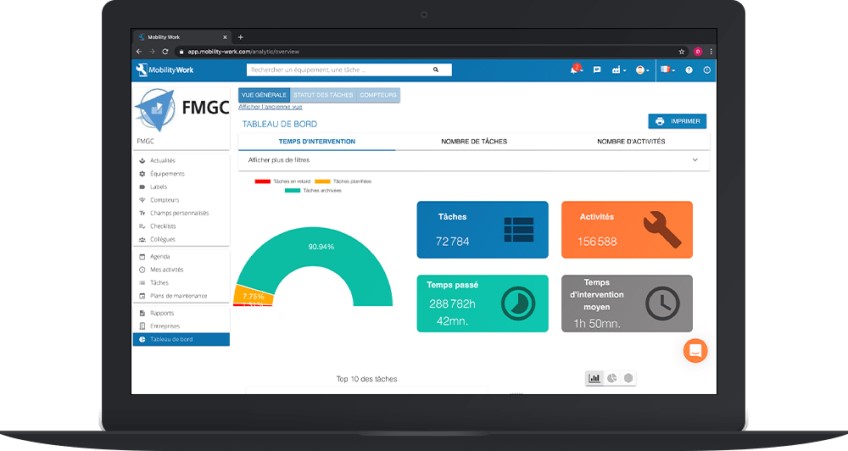
Find an analytics tool in Mobility Work CMMS to analyze all your maintenance data and adapt your strategy
Systematic or conditional preventive maintenance
Such a strategy can be divided into two main areas. La systematic preventive maintenance is established according to a schedule or periodicity of use. La conditional preventive maintenance is based on the condition of the equipment, that is to say its real condition, thanks to continuous monitoring or at regular intervals, and a direct connection with it. The degradation of a machine is thus measured using sensors, a self-diagnosis system or the measurement of the wear of parts. It is particularly efficient and profitable.
The benefits of a preventive maintenance strategy
The main direct advantages of a preventive maintenance strategy, especially compared to corrective maintenance, are:
- The reduction of frequency of breakdowns ;
- The reduction of machine downtime periods ,
- A better security ;
- one lifespan of equipment increased;
- an improvement in the productivity.
Towards predictive maintenance thanks to CMMS 4.0
In addition to these considerable direct benefits, the adoption of a preventive maintenance strategy with a last-generation CMMS makes it possible to gradually move towards predictive maintenance (sometimes called “predictive” after English) which is now the most efficient method.
While this can be similar to conditional preventive maintenance, the NF EN 13 306 X 60-319 standard defines it as follows: “predictive maintenance is carried out according to the forecasts extrapolated from the analysis and evaluation of significant parameters of the deterioration of the property, in particular thanks to sensors installed on the machines and connected (IoT), Internet of Things, Internet of Things).”
This maintenance strategy is therefore only possible by equipping yourself with a last-generation CMMS compatible with IoT such as Mobility Work, for example. Thanks to the sensors installed on all machines, the system of direct connection to them by QR code from any mobile device with the application, the use of Big Data and community resources, Mobility Work makes it possible to predict future equipment malfunctions with great precision.

Thanks to the counter tool in your Mobility Work CMMS, collect values that will allow you to improve your maintenance planning
The needs for spare parts, the schedules of maintenance teams or even periods of production stoppage can thus be organized with maximum precision and a minimum of negative consequences on plant productivity.
While a corrective maintenance strategy may remain, in the case of some TPEs, the most adapted to the characteristics of a factory, preventive maintenance is now the most recommended for most businesses, including SMEs. The appearance of new CMMS tools such as Mobility Work in fact makes all these advantages much more accessible than with traditional CMMS, and even makes it possible to commit to predictive maintenance.
Any questions?
Contact us to discover the first CMMS that can be deployed in 3 weeks.