Mobile CMMS: why choose a new generation software?


Mobile CMMS is the latest generation of industrial maintenance methods. Choosing a mobile CMMS software makes it possible to go beyond the limits of all the methods existing until now and to revolutionize the management of machine maintenance within a company.
The limits of maintenance without mobile CMMS software
Industrial maintenance can be managed without specific software, in various ways, the limits of which always end up being an obstacle to business activity and profitability.
Level 0 of industrial maintenance
Some companies still manage the maintenance of their equipment “piecemeal”. Parts are replaced when a machine proves to be faulty, but no follow-up of this activity is carried out, no spare parts inventory is organized, no tasks are planned.
This method — or rather this lack of method — has two major drawbacks. On the one hand, it causes significant productivity losses, since the machines remain stationary until the part arrives. On the other hand, no monitoring of maintenance operations is possible, and maintenance operations are not streamlined at all. It is therefore impossible to anticipate or plan interventions or to have an overview of the wear and maintenance needs of the machines.
“Paper” maintenance
Monitoring machine maintenance operations on paper documents represents a first step towards organized management of industrial maintenance. The written recording of each intervention allows a minimum of follow-up and traceability.
However, access to the “intervention workbook” or “intervention sheets” - which only exist in a single copy kept in one place - and their readability are limited. This does not facilitate either a good traceability of interventions or the smooth transmission of information among the teams concerned. Finding the description of a specific task is then an obstacle course.
Excel or Access CMMS
The spread of computer science and the appearance of Excel software allowed the introduction of a first form of computerized maintenance management in some companies. They use spreadsheets to record all maintenance operations carried out.
While this method considerably improves the monitoring of interventions and especially the consultation of the actions carried out, it remains limited in terms of access to information and operational planning.
The use of the Access software represents, on this last point, a certain amount of progress. In fact, it makes it possible to plan preventive and regulatory maintenance operations on a calendar basis. On the other hand, its limited capacities make it unusable as soon as the database in which the interventions are recorded reaches a certain size.
Moreover, whether one chooses Excel or Access, the sharing of information is limited by the characteristics of these software, which cannot be consulted and used on a network.
Advantages and disadvantages of traditional CMMS software
The adoption of software specifically dedicated to maintenance management makes it much simple and effective but also has major drawbacks.
What is a CMMS software?
One computer-aided maintenance management software is a computer program designed specifically to manage and streamline the maintenance of equipment within a company. Most of these programs have the following functions:
- equipment management (inventory, location, etc.);
- maintenance management (corrective, preventive, intervention requests...) );
- management of the safety of installations before maintenance interventions;
- inventory management;
- management of spare parts or services purchases and the purchasing cycle;
- management of maintenance personnel and planning;
- cost management (workforce, purchases, rental...) );
- key performance indicators.
The advantages of industrial maintenance management software
As we can see, software specifically designed for industrial maintenance allows - in theory - for a company to manage the maintenance of its equipment much more easily thanks to advanced functionalities. In concrete terms, the main benefits expected from this maintenance management method are as follows:
- better productivity: centralized and organized monitoring and planning of interventions make it possible to reduce periods of machine inactivity;
- better control of costs: planning operations allows for more efficient maintenance and therefore a longer lifespan of equipment, as well as the forecasting and forecasting of future expenses;
- better traceability: by facilitating the recording and consultation of interventions, a CMMS software offers more transparency on their progress and better coordination of the actions of the various stakeholders.
The disadvantages of 1.0 CMMS software
In practice, this “old-fashioned” software is too often difficult and expensive to set up and use. They are cumbersome to set up, months of team training are necessary, the interface is neither user-friendly nor ergonomic. In the age of smartphones and ultra-intuitive mobile applications, the contrast is striking.
For maintenance teams and machine operators, these faults result in demotivation and a lack of involvement in the implementation and use of these tools that are supposed to make their tasks easier but which, in fact, can complicate them.
There is no shortage of examples of companies that wanted to implement software dedicated to industrial maintenance, but which were confronted with major difficulties. The adoption of such a solution raises both technical and practical problems, since the teams are unable to appropriate this potentially very useful tool but in reality very unergonomic.
The new mobile CMMS software
By applying the principles of everyday applications to maintenance management, these new solutions completely change the CMMS approach.
What is mobile CMMS?
Mobile CMMS software takes the form of an application that can be used on a smartphone or tablet. So it can be used from anywhere. It is essentially this possibility of “mobile” use that distinguishes it from conventional software, whose maintenance management functions it also uses.
However, an application like Mobility Work, which can be described as “4.0”, integrates numerous additional functions, inspired by the latest advances in new technologies and the new uses made of them in everyday life.
For example, this application uses the logic of Big Data to provide its users with an analysis tool based on data collected from thousands of anonymous and professional users who work with the same machines.
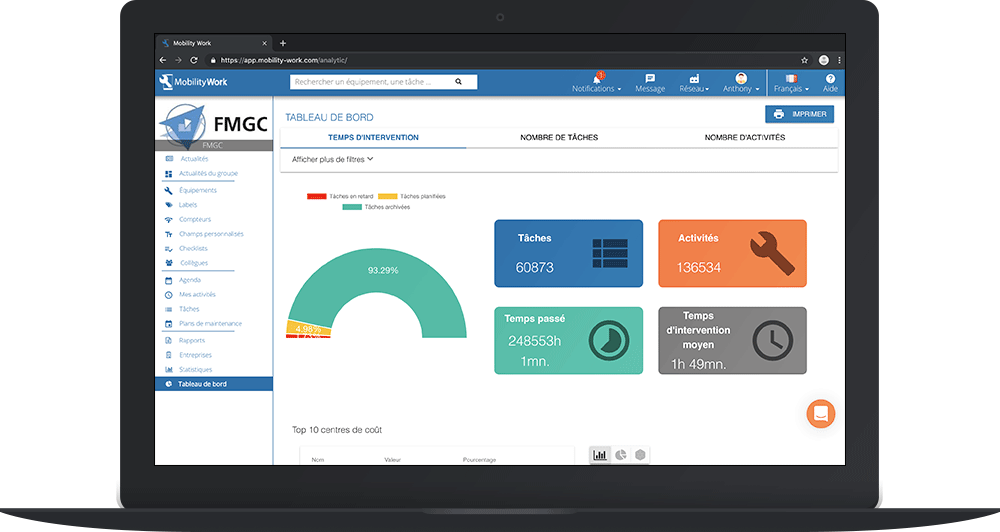
Find an analytics tool in Mobility Work to analyze all your maintenance data and adapt your strategy
In addition, its community operation inspired by social networks allows maintenance technicians and machine operators to exchange information and share their problems. And this both within a community within the company or industrial group and with users from other entities.
Finally, its ergonomics are designed to be as easy to use by a user, even a novice, as an everyday application.
The advantages of a 4.0 application
An application like Mobility Work therefore exceeds all the limits that other methods of managing industrial maintenance suffer from.
To begin with, installing and using the application is much easier than installing and using old-generation CMMS software. All you have to do is equip the machines with NFC chips or QR codes and install the application on mobile devices. No training is required as the use of the application is intuitive.

Mobility Work's mobile CMMS allows operators and technicians to be autonomous: checklists, creation of tasks, maintenance plans, notifications for each new activity...
In terms of motivating teams to take ownership of it, this advantage is far from being negligible. Indeed, any new tool can quickly be seen as a burden if it is difficult to access and if its use does not quickly demonstrate the advantages it provides to its main users.
In addition, recording maintenance interventions is very easy, since each operator can do it from their smartphone as soon as the intervention is complete, including by voice input. It can also view the maintenance history of each machine anytime and from anywhere.
In addition, the planning and forecasting of operations are much more effective thanks to the considerable database made available to users. For example, the Mobility Work maintenance management platform records a history of more than 5 million hours of maintenance carried out. La predictive or predictive maintenance is thus entering a new era.
Finally, community operation, by allowing the sharing of experiences and maintenance problems, facilitates and accelerates the resolution of the difficulties that operators may encounter in maintaining machines.
Any questions?
Contact us to discover the first CMMS that can be deployed in 3 weeks.