UX SERIES 8: Mobility Work at Saint Gobain Sekurit

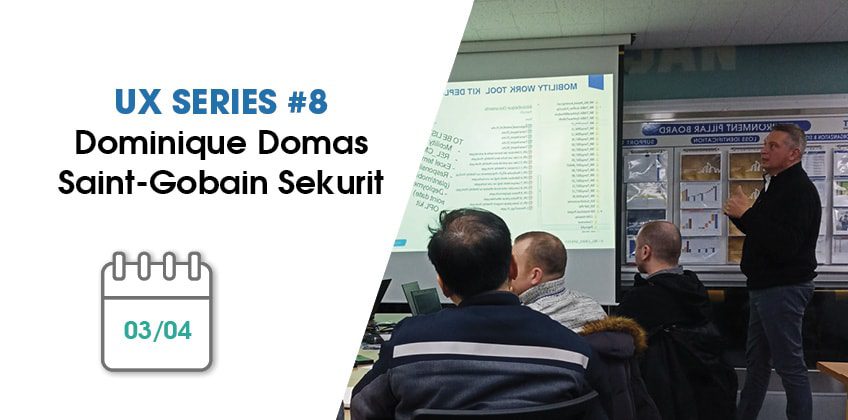
“Mobility Work CMMS stands out from other very restrictive tools that limit the possibilities of customization”
Dominique Domas is in charge of the reliability and maintenance activity at Saint Gobain Sekurit, and works at the company's headquarters, Saint Gobain Sekurit International. Its scope of activity covers all Sekurit factories specializing in the automotive glass business (windscreens, side windows, rear windows), i.e. 32 factories in 19 countries.
Its activity consists, among other things, in standardizing maintenance activities across the group's various factories, and in generalizing the exchange of best practices from one factory to another. Although the production tool is common, they currently operate independently in terms of maintenance. Mr. Domas tells us about the first steps in deploying the Mobility Work maintenance management platform within the group, and tells us about its objectives in terms of harmonizing good maintenance practices.
How did you find out about Mobility Work CMMS?
Dominique Domas : I got to know Mobility Work thanks to NOVA External Ventures, an internal team in charge of building partnerships with start-ups and incubators around the world and aligned with the main strategic axes of the Saint Gobain Group. Among other things, we are indeed increasingly interested in Industry 4.0, smart devices, smart glasses, etc.
More than by the site, I was really convinced by the presentation made by Mr. Marc-Antoine Talva (CEO of Mobility Work), which allowed us to scan all the prerequisites essential to maintenance: the possibility of doing preventive and corrective measures, knowing how to manage spare parts, structuring all the data... It was this presentation that convinced me to take the plunge and test the tool in practice.
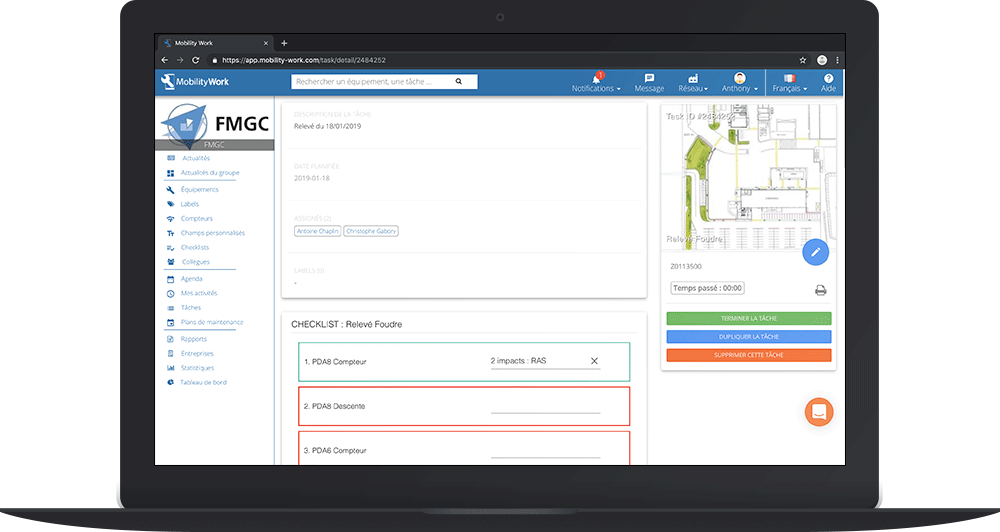
With our maintenance management platform, use checklists to manage your priorities and organize your working days
Is the CMMS tool already in place in your company?
For the moment, the activity is still in “project” mode and Mobility Work is currently in the evaluation phase within Sekurit. The first phase of the project consisted of deploying Mobility Work on one of our French sites, in Aniche, then following that, testing the network mode, which is one of the main promises of Mobility Work CMMS. We thus wanted to be able to quickly connect several factories, here the scope of extension being two other factories in France. Since the Saint Gobain Sekurit group is an international group, the idea is to extend the project to other factories in the world, particularly in Asia, in all European countries and in South America.
The deployment of the Aniche plant began in June 2017, not without difficulty. There are several reasons for this, including the fact that our previous CMMS was very structured but not widely used, and that our specifications were not clearly defined from the start. This deployment took longer than expected because we needed to find our way around it from a structural point of view, which is not in itself the fault of the tool. Mobility Work is very open, and does not force this structuring, which is why we ourselves must have clear ideas about how we organize ourselves.
We just deployed the two other French sites at the beginning of 2018, and we are in the midst of an expansion phase. We have just joined China during the month of March, and our factories in the Czech Republic and Sweden should also be deployed soon. We hope to have the project validated in all of these factories by the end of May (active project and positive feedback from users), we will then be able to develop Mobility Work as a standard within Sekurit.
What do you think are the advantages of the application?
Following Aniche's experience, we were led to develop a new structure, i.e. a deployment standard. Being not subject to any constraints from the Mobility Work tool, it was very interesting for us. These standards therefore currently allow us to speed up deployments. This structure takes the form of an Excel file that corresponds, in a very personalized version, to the data import framework provided by Mobility Work at the beginning of the project, which we considerably enriched to obtain a deployment standard in the Sekurit group. It also allows us to control deployment time much better.
This is one of the major advantages of Mobility Work CMMS: this initial freedom requires the company wishing to carry out a test to structure itself, while the tool does not at the same time pose any limits to this structuring. Mobility Work stands out from other very structuring tools that require very restrictive intelligence behavior, and which limit the possibilities of personalization according to the company's own needs.
As far as the feedback from maintenance technicians is concerned, there are two types of populations: some of them are not used to using smartphones and tablets and were used to very stable tools, which provided them with a certain comfort, and thus have more difficulty getting used to this very open system; now that they have gotten used to it, things are going better. This category will still tend to return to the office, to report mid-day or full day.
On the other hand, some populations are more used to digital tools, and thus fill in tasks or reports orally using the voice input tool. This CMMS indeed involves a change in behavior, which we did not necessarily expect. This was a surprise for us, but a pleasant surprise: it makes it possible to obtain a more relevant, more lively, more dynamic analytical tool, which we did not have before. We are now working in real time. Mobility Work also involves a change of tools, as technicians were used to working on a fixed PC. It is a different tool system: smartphones, tablets, etc., which were not traditional tools for daily maintenance.
What is the feature that you use the most?
The most relevant in my opinion is the possibility of creating a task using a mobile tool, and recording it by voice in order to generate a report, which is extremely practical. This is a feature that we did not have before and which necessarily involves changing behavior, but which is attracting the interest of technicians.
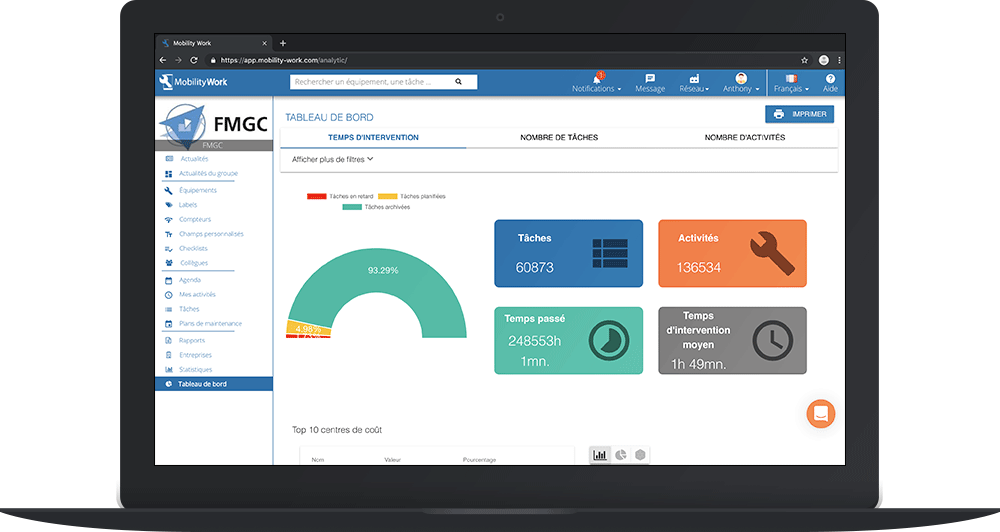
In Mobility Work CMMS, you can easily access tables and graphs to allow you to analyze all your maintenance data
Personally, I mainly use the analytical tool, which has recently evolved to become a real-time tool. The Sekurit Group, and in particular the automotive branch, is committed to a continuous improvement process (WCM); the structuring I was talking about at the beginning makes it possible to obtain much more powerful analytics, because it is structured in the same way in all factories, which was not the case before. It is a tool that interests us a lot, and that allows us to see in a very macroscopic way what is the state of health of the maintenance of our factories in real time, or even delayed by one hour.
What functionality would you like to have?
Initially, the evolution of the analytical tool I mentioned above, but I also hope to see a fundamental evolution coming: this is the advantage and the disadvantage of not having limits in terms of structuring. Today, for example, a factory reasons in terms of losses. Within Mobility Work, the loss is identified based on the time spent by the maintenance team on the machine. On the other hand, we cannot know how much of this time affects production, which represents the real loss within a factory. This is not only the time spent on the machine by technicians, but also the time during which the machine did not produce, as the machine may well be broken and continue to produce. So this is a feature that I would like to see more complete within Mobility Work CMMS.
Are you satisfied with the responsiveness of the Mobility Work team?
I have two answers, linked to two different themes:
In the event of a problem (i.e. in case of application malfunction), the support team is very responsive, and that's all you can expect from a startup.
As for requests for evolution and new functionalities, I would talk more about organization and prioritization to manage the schedule of deployments and evolutions. We have visibility on current topics and can easily communicate with the team.
In conclusion...
The automotive sector is very demanding, and I am very demanding myself. I believe in this project, and I hope that in the face of the arrival of many new customers, mostly large groups, the satisfaction will remain the same and that the team will be equipped to absorb the growth and all these new customers.
Thanks to Mr. Domas for agreeing to give his testimony; user feedback is at the heart of our approach, and helps us improve our product on a daily basis.
Are you interested in maintenance management and want to know more in order to increase your productivity and save money? Schedule a free video with our team to help you better manage your maintenance!
Any questions?
Contact us to discover the first CMMS that can be deployed in 3 weeks.