Mobility Work CMMS and the culture of change


” Mobility Work CMMS is a digital maintenance application built not from the management needs of maintenance managers, but from the work actions of technicians and workers. ”
Fabien Thomas, a teacher appointed by ITII Pays de la Loire (Institut des Techniques d'Ingénieur et de l'Industrie) and seconded to the École Centrale de Nantes, is responsible for training all courses on human beings, organization and work provided to alternating engineering students. Based on his experience and thanks to his knowledge of Mobility Work next-generation CMMS, he explains how the tool can promote a certain culture of change within the various structures that use the mobile application, between new perspectives for the future and cultural upheavals in the company.
How did you find out about Mobility Work CMMS?
I got acquainted with Mobility Work CMMS during the first year of the company's existence. Marc-Antoine Talva (CEO of Mobility Work) was hired in the foundry where he completed his apprenticeship and was assigned the first mission as project manager on the implementation of a maintenance ERP. Deploying the tool proved to be a completely time-consuming failure.
During a trip to a forum in Hanover, he had a click and conceptualized his product. He then adopted a very simple philosophy: instead of saying that a tool was not working and that the teams were going to get used to it, he said to himself that he could certainly do better by himself.
You attended several Mobility Work CMMS presentations, how did you perceive the reaction of the public in relation to the cultural change that this implies?
Indeed, and I would say that some environments are more resistant than others: more often than not, mechanics has a lot of trouble accepting to upset its processes. To use the example of blacksmithing and foundry, the environment in which Mobility Work was born, the big concern is competitiveness, because it is a market that has been abused by Asian competition: manufacturers therefore adopt the behavior of survivors.
But precisely, because they are at the foot of the wall, even more than others, it is perhaps a good reason for them to take the plunge because it is time to take risks. This is the whole paradox: it is certainly those who are the most reticent who also have the most reason to take the plunge into the big bath of managerial and organizational letting go proposed by Mobility Work.
What impact can the implementation of an application like Mobility Work have on corporate culture?
The first impact of solutions such as CMMS that I see concerns the relationship to hazard. One of the points of corporate culture that we encounter most often in the industry is accepting a form of “letting go” in the organization and in the methods of coordination, something that is very difficult, especially for the oldest and largest companies.
This relationship with “letting go”, this relaxation of procedures (working in silos, maximizing managerial control) and the acceptance of a certain degree of empowerment on the part of field operators represent the first cultural shock favored by Mobility Work.
The application was born from a very transgressive gesture on the part of Marc-Antoine Talva: using open software components, adopting “Google” types of development by itself, not consulting his hierarchy, and launching a test phase without first consulting the maintenance managers of the factory in which he worked, by sympathetically bypassing them and speaking directly to the technicians.
Its ambition was to build a digital maintenance application based not on the management needs of maintenance managers, but based on the work actions of technicians and workers. In other words: we rely on the operational needs of field technicians based on the feedback they give and the information they provide. And it is only subsequently that management needs are deduced from the sum of information that is retrieved from concrete maintenance acts, which is completely the opposite of an ERP.
Therefore, Mobility Work requires the abandonment of the postulates that set the principles of ERP (and I would have to add many other aspects typical of ERP to be complete). However, to agree to no longer reason in ERP, you literally have to brutalize your management, which could have made contact with some customers complicated. The control function must first be completely abandoned in order to be recovered in another way.
What change can you perceive between the Mobility Work approach and that of a traditional ERP?
For me, there is a fundamental difference: ERP was conceptually defined based on the needs of managing resources, people and capital by those responsible for strategy and organization. The center of gravity, and the starting point for defining ERP specifications, is the figure of the managerial decision maker.
The aim of an ERP is therefore to offer a centralization of management decisions and dashboards, and to reduce to the payroll the industrial operating standards required by the provision of indicators. Everyone is asked to fill in the information requested by management.
It seems to me that an ERP throws as much data into the shadows as it wants to make it appear in parallel. The more fields you put on some items, the more blind you are to some others. And above all, where does ERP intelligence come from? It comes from management decisions, arbitrations that are made by the top hierarchy, since it is the executive managers who take control of the data. All with this paradox: the biggest contributors to an ERP are the operational ones, but those who have authority and a decisive use of the ERP are the decision-makers, who do not have the same goals as the biggest contributors. So the intelligence of the ERP is dependent on a centralized, pyramidal process, and which is achieved through a lot of information loss.
Mobility Work CMMS from this point of view is not an ERP in my eyes, because the intelligence of the application comes from the users themselves, i.e. the more intelligent the “average” users are, the more intelligent Mobility Work is. Indeed, as their skills are exploited, the more the information is freely filled in by people who know their job, the more relevant and detailed it is, the more the application becomes, due to its size, potentially rich in terms of intelligence and exploitation of data.
We have already exceeded 3 million hours of maintenance in Mobility Work; when we exceed this threshold, we are able to do Big Data, which can greatly exceed what an ERP provides. Especially since, (in any case concerning Mobility Work) the strength of Big Data processing is that if we imagine requests in free format, the more competent and trained you are, the more precise they will be, and the more precise they will be, and the more the system will send you an extremely precise and precise answer.
Intelligence comes from the user, not from the system. The system requires intelligence, and intelligence will be restored to the extent of those who use it. It is completely the opposite for ERPs: with them, it is the computing power of the database and the algorithms that run that will dictate their intelligence and become very restrictive. Business decision makers have in fact asked for a dashboard that is in fact only a corporate vision, a framework for reading the company that is neither free nor open.
What is the impact of the arrival of a new generation of technicians on the life of the company? Do you think it is easier for younger generations to use this application?
Still based on the feedback from the test phases, I would say that my opinion is mixed. There have apparently been technicians who, due to a certain lack of skills in the digital field and their enormous disappointment with old ERPs, never become real contributors to the Mobility Work network. The use of Mobility Work CMMS will remain low for them. But on the other hand, there were a lot of senior profiles, aged 50 and over, who were very happy or even relieved to come across this CMMS. For them, there was a spontaneity of use, and especially an experience of direct feedback of personal interest that motivated them in the application. As they became aware of the direct gain Mobility Work brought to their daily work, they were motivated to learn more and more. Some people, basic technicians, are no longer even ordinary users but become real bloggers, who post all the time on the news feed. Their level of expertise increases when they come into contact with the digital application... provided that the management chain leaves this opportunity to develop.
I'm coming back to SMEs: many of them that had aging tools quickly took over Mobility Work precisely because of the way in which you can very quickly measure the returns and the usefulness that you get from them, and I would even add that you have them almost selfishly, for yourself. The strength of Mobility Work is that it makes it possible to overcome the digital competence barrier of its users.
In theory, there may be the formation of fractures among users of social networks, as well as phenomena of leadership and division in the community. These issues were studied and revealed, among others, by two CNRS researchers (Paola Tubaro and Antonio Casili). However, in the context of professional use and the network that Mobility Work constitutes, it seems to me that we do not perceive it. There is always this criterion of usefulness for yourself, at work, which you cannot really touch and which most often causes strong adherence. You find your way around as long as you get a return in proportion to the effort you make towards CMMS, whether you are a major contributor or not.
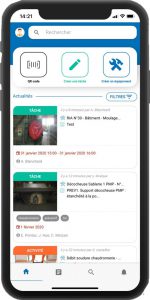
All the news relating to ongoing interventions are available from the news feed of the Mobility Work mobile application, available on iOS and Android.
The philosophy of Mobility Work is to say: “I'll install Mobility Work on your laptop for you, let me know if you're interested and we'll talk again.” There is no injunction as we encounter with some large ERPs. In reality, the fewer injunctions, the more the person wants to try. The injunction can create resistance to change. So the fact that, in its concept, Mobility Work is not put in place by a top-down injunction makes it possible to consider a more profitable situation for all. In fact, we see that some customers deploy Mobility Work vertically and through managerial injunction, which in my opinion is a total contradiction.
As you pointed out, Mobility Work overturns the hierarchy and gives power to operators. How is this development perceived by management?
I have never seen a maintenance manager come and complain directly, maybe that will happen in the future. One thing is certain, the first users of CMMS reflexively adopted a quantify-self approach when testing the first versions of Mobility Work, exactly like people who wear a connected bracelet: what have I been doing for 3 months, for 6 months... Field users looked at themselves in the Mobility Work mirror, and it was apparently very rewarding for them to see the amount of work done back by the application. They went looking for this information as they entered.
So, rather than being an element of frustration for managers, field operators have access to the registration of their expertise, to the price of parts, as well as to the social network to which they belong, in which there are 30, 40, 60 contributors. More than a threat element, I would rather say that it is a very good chance of motivation and involvement to be exploited for managers and managers. In addition, to use the term of a consultant I work with, it is a very good chance of well-being at work. The social effect can be positive - I say “may” because managers still need to take control of it. Mobility Work can potentially have a positive social effect of valuing and recognizing work. The system is transparent about what everyone does and how they contribute to the network.
The transmission of knowledge is becoming more and more complicated in business, what is your opinion on this issue?
Indeed, we note that the SMEs most resistant to the adoption of any ERP whatsoever are those that have more easily opted for Mobility Work CMMS. The set-up was more fluid for them. Accepting the fact that field workers were in a position of expertise and influence on the conduct of maintenance caused less tension. In other words, the smaller the structures were, the better they took advantage of the knowledge transmission levers offered by Mobility Work. And vice versa: the bigger and more rigid the structures were, the more likely they were to require adaptations, or even an overhaul of the code.
There is a very common initial reasoning in methods of management and industrial organization: to crush hazards and improve the productivity of capital if decision is centralized and if production operations and production management operations are divided into separate sequences (vertical division of labor). This completely models the way in which companies exploit their skills and the knowledge they have internally (i.e. pyramidally and in silos, by competence theme).
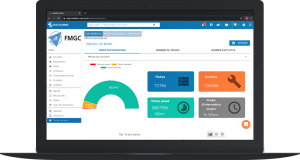
The forecasts of the Mobility Work application analytics tool are based on data collected from thousands of users working on the same equipment.
When you are in front of Mobility Work, you are faced with a digital tool that suggests that the optimization of the use of your resources (and ultimately their productivity) comes from the intelligence of the work actions of those who keep them in good condition. In other words, the more precisely the operators enter details, the more intelligence CMMS produces, which is itself exactly proportional to the skill level of the operators who handle the application. That is to say that the application is as intelligent as those who use it are trained and competent in practice. With Mobility Work, skills at work are called upon in a global manner, and not divided into thematic sections. So at the end of the argument, we can say that software provides a more efficient opportunity for the transmission of skills than what centralized and technocratic models in industry offer.
More and more businesses are trying to work with startups, something that was unthinkable a few years ago, what do you think?
I think it's neither good nor bad, qualifications should be avoided. We can see that there are businesses that derive increased economic vitality from it, there are some for which it brings nothing. I did not see that there was a general formula. In my opinion, pragmatism should prevail, dogmatism and ideology are very negative for the industrial sector. There are entire areas where it is economically relevant to remain as they are, and for others, it is long overdue time to change their processes.
A startup is not a guarantee of an innovative approach. Historically, few startups have proposed real breakthroughs, mainly for structural reasons. Of the incredible mass of startups that are created every year in France, there are a lot of followers all the time. For a company that takes a step forward into the unknown, twenty-five follow.
So I understand that some businesses are not necessarily excited, because “startup” does not necessarily mean “jump” or “difference”; this is therefore already causing reluctance. Then, if a breakup is really proposed by a start-up, it still has to be adapted to a relevant economic moment of the company.
With listed companies, the report is necessarily ambiguous on the issue of innovation. They need to provide evidence of their competitiveness to financial markets across a range of indicators, including innovation. Otherwise, trust can be eroded, undermining a number of industrial goals. So when a company also represents a safe haven for investors, it becomes very critical for it to give guarantees concerning its stability, the absence of hazards and at the same time its innovative nature, because we try to square the circle to maintain the level of expectations of investors.
These companies are in a kind of permanent contradictory injunction, which means that they will be very encouraged to take the plunge in innovation, if only because they see that their neighbors of the same size have contracted with Mobility Work for example. However, in terms of process management, they will remain very strongly focused on controlling and overcoming the hazard. In the end, you have structures that will block an innovation such as Mobility Work and that will never want to complete the process.
On the other hand, companies outside stock exchange financing channels are often much more flexible, and are probably the ones that will really learn deeply from an application such as Mobility Work CMMS and change their management of people and work with the most relaxation. I think in passing that it is still likely that these large companies will gain a few points of competitiveness, but there will be no real revolution in the way processes are managed.
Are you interested in maintenance management and want to know more in order to increase your productivity and save money? Schedule a free video with our team to help you better manage your maintenance!
Any questions?
Contact us to discover the first CMMS that can be deployed in 3 weeks.