Predictive maintenance: benefits for the oil industry


Predictive maintenance: use in the oil industry
The oil and gas sector is a complex and demanding industry. Indeed, professionals must work remotely from installations that are sometimes located in hostile environments, and it is becoming more and more expensive and difficult to extract energy. As a result, business leaders have been forced to look for new ways to maximize investments, reduce costs, and minimize risks.
The latest 4.0 trends in industrial equipment maintenance allow manufacturers to streamline their maintenance management. With condition monitoring data and predictive analytics, breakdowns can be anticipated and maintenance scheduled only when needed. With employee safety and the prevention of environmental accidents at the heart of its concerns, the oil and gas industry (as well as power generation and aerospace) was one of the first to adopt predictive maintenance routines. The return on investment is reflected in a reduction in unplanned downtime, increased equipment efficiency, as well as the automation of dangerous and expensive tasks.
What are the main benefits of early maintenance?
The oil and gas industry faces a number of challenges, which can be summarised as follows:
Reliability of equipment and safety of operators
For example, the failure or unplanned shutdown of critical equipment can cause spills and leaks whose consequences for the operator and the environment can be dramatic. As a result, daily inspections are often required, requiring additional equipment and causing higher costs.
Large-scale activities
An oil and gas project includes a vast network of equipment, facilities, and technicians. Very often, important events such as scheduled shutdowns require months of preparation, and must be the subject of impeccable organization and communication by the personnel involved.
In order to improve production efficiency, most businesses are turning to automation. Monitoring the condition of each piece of equipment in order to predict shutdowns and thus avoid damage is a fundamental requirement in the oil and gas sector.
An oil and gas operation can produce an enormous amount of surveys. However, making these surveys sufficiently relevant data in order to generate algorithms can be extremely tedious without the right tools and professionals. The deployment of a next-generation maintenance solution is therefore essential in order to manage predictive analyses. It involves storing, processing and evaluating sensor data, generated in real time and based on historical data, as well as maintenance data generated by industrial equipment. One CMMS such as Mobility Work also provides additional information on the efficiency of machines and processes.
Predictive maintenance strategies are nothing new in the oil and gas industry. Their implementation has already allowed professionals in the sector to reap a large number of benefits: increased investments, increased production revenues, etc.
The establishment of a reliable advance maintenance routine
Mobility Work is a maintenance management platform that offers functionalities inspired by Industry 4.0 allowing you to improve the productivity of your business, in addition to the traditional functionalities common to all CMMS solutions. Data concerning the condition of an equipment only makes sense if it is analyzed in context with other information: daily interventions, history, information on spare parts, past and future inspections, etc. A next-generation CMMS can be directly linked to all equipment sensors in order to collect relevant performance parameters. Rotating equipment, centrifugal pumps, gas compressors, and other specific equipment require specific monitoring techniques, including the collection of data from multiple resources, or very sophisticated analytical modeling techniques.
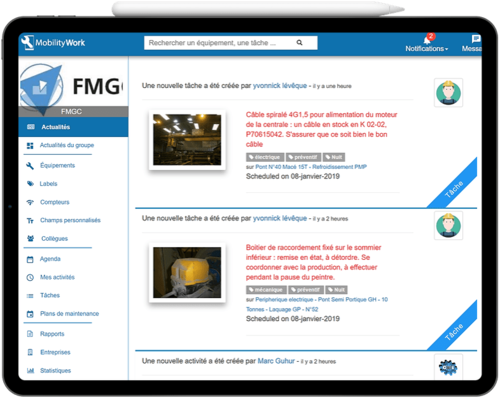
All the news relating to current interventions are available from the news feed of the Mobility Work application.
There are three types of anticipated maintenance: empirical, physical, and experiential. Their functioning is relatively similar, and is based on a set of reference measurements. If an asset does not meet these parameters, a failure is likely to occur. Each of these predictive maintenance solutions offers a different characterization of the standards. The empirical approach is based on asset history; the experiential approach uses data collected from similar assets; and the physical approach relies on engineering principles.
Each of these solutions has its own pros and cons, so the best approach is to combine all three in order to get the most accurate diagnosis possible. Mobility Work can adapt to each of these approaches.
Improvements are still possible
According to recent studies, only a very small amount of data collected by sensors on offshore oil platforms is ultimately used to make important decisions. In conclusion, data collection and dissemination techniques have successfully expanded in this industry sector, but there is still a high demand for tools to process this data and generate analyses.
A modern CMMS combined with predictive maintenance routines can certainly improve the current situation and ensure that the sector benefits even more from the data collected through sensors. Mobility Work is easy to use, and its adoption within the company is fast and effective. In addition, features such as equipment tagging and geolocation allow machines and tools to be monitored as part of predictive maintenance operations.

All the news relating to ongoing interventions are available from the news feed of the Mobility Work mobile application, available on iOS and Android.
The oil and gas industry was one of the first sectors to deploy advanced maintenance software, which significantly reduced downtime and eliminated failures. Businesses have taken the opportunity to adopt predictive maintenance, and are now benefiting from increased efficiency and reduced operating costs. It is also less difficult for them to deal with periods of crisis as well as potential financial risks.
The next-generation maintenance management platform Mobility Work supports oil and gas companies in setting up and managing effective predictive maintenance routines. Very flexible, this solution can easily be adapted to the specific needs of the sector. An ultra-efficient next-generation CMMS such as Mobility Work is essential to a successful predictive maintenance strategy, it ensures safety and achieves better performance.
Are you interested in maintenance management and want to know more in order to increase your productivity and save money?
Any questions?
Contact us to discover the first CMMS that can be deployed in 3 weeks.