Take stock of your old maintenance software

GMAO: What assessment should you carry out of your old software?
Maintenance services are being modernized with new CMMS software. In this world of exponential growth, businesses are looking to expand, increase their workforce and increase their production to occupy a place in an already highly competitive market. As demand is increasing, these businesses are constantly facing major challenges. They therefore decide to expand their infrastructures and to modernize their equipment if necessary.
These various developments, including Industry 4.0, are causing major upheavals for businesses and require a change in culture; it is therefore necessary to be able to work with effective and easy to implement tools in order to manage all this equipment. Indeed, technologies are evolving at all levels (mechanical, electrical, etc.), which is changing the traditional practices of industrial maintenance services. They must be able to react and adapt very quickly, using tools that are close to their daily lives. If this is not the case, the consequences can be dramatic, both on the pace of production and on the quality of the parts made. It is ultimately necessary to rethink an entire structure and its organization.
These developments are part of a context of growing desire on the part of consumers and customers to understand why each maintenance action was carried out: it is important to maintain very strict traceability. This is all the more essential in the context of controls, audits or certifications. The application Mobility Work perfectly meets these needs since it improves the coordination of the work of technicians while allowing managers to monitor the progress of the tasks to be carried out.
What is a CMMS?
Computer-aided maintenance management is a computer tool that allows a company to manage its various maintenance activities. Born in the 1980s, the first dedicated application had the main objective of meeting the needs of manufacturers and experts in industrial maintenance management. This method ultimately made it possible to drastically reduce related costs and to improve the availability and reliability of the machines.
The companies started from the initial observation that they had no way of monitoring the evolution of the health of their machines, that they had no follow-up of interventions or orders for spare parts, etc. Once implemented in the industrial environment, CMMS tools proved their worth and demonstrated that they were essential to the proper functioning of an industry. Based on this observation, other sectors have decided to adopt this method, such as hospitals, the army or transport, to name but a few.
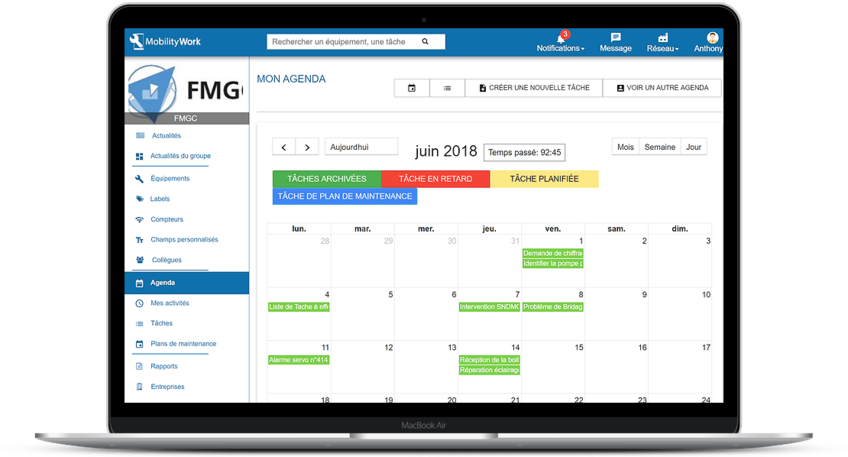
The calendar feature offered by Mobility Work allows you to plan all your preventive and predictive maintenance interventions.
A mixed initial observation
The project of a new CMMS stems from a problem known to many companies: how to modify the functioning of its maintenance department in order to be able to meet the various challenges (financial, managerial, organizational and industrial) and thus remain competitive?
Faced with all these challenges, the new maintenance software must respond to the various problems that a company faces on a daily basis. While radically changing the functioning of the maintenance department may initially seem problematic, better management of interventions and the use of an ergonomic tool adapted to the functioning of technicians should make it possible to calmly begin a whole new turn. This tool finally makes it possible to change the organization of work and proves to companies that they have everything to gain.
However, adopting a new maintenance management tool does not mean that you have overcome all potential challenges. On the contrary, some software is more of a hindrance than anything else as the functionalities and interfaces are obsolete.
Recurring problems with your current CMMS
Again, the problems caused by your current tool can have quite disastrous consequences on the production cycle, and users can be significantly slowed down in their progress. It is important to start from an observation and to carefully analyze the given environment before being able to propose solutions adapted to your needs and to the context in which you operate.
Traditional CMMS do not allow you to adopt an effective preventive maintenance routine. You cannot manage maintenance ranges, have no concept of equipment criticality or monitor information concerning your machine park. It is difficult to determine the condition of the equipment, to manage the warranties and industrial maintenance contracts, schedules, qualifications, subcontractors... If a technician works on a machine, he has no way of entering comments in the report, no one has visibility on equipment deposits, work permits are far from being managed properly and project management is generally carried out outside the tool.
In view of all these drawbacks, it is easy to understand that this is by no means a viable model. These numerous neglects can lead to quite serious consequences: recurrent production stoppages, accidents involving technicians or production, losses recorded, lack of visibility... In short, it is essential to completely review the working methods of the department in question in order to be able to improve the effectiveness of the interventions it provides.
Areas for improving the maintenance service
To counter these difficulties and provide an effective response, certain measures must be taken in order to meet the established objectives, such as: defining a codification to visually distinguish equipment, monitoring costs by load center and by equipment, monitoring the operating and stopping times of a machine, monitoring the operating and stopping times of a machine and thus obtaining a failure rate and therefore criticality (see our article” Towards an evolution of Pareto analysis ”), assign technical specification sheets to each piece of equipment, identify warranty periods in order to be notified when a corrective work order is created...
It is also essential to set up a module for managing the condition of equipment, to identify and plan preventive actions as well as projects, to set up very detailed preventive maintenance sheets, to define the resources and stock required on the maintenance ranges or to generate automatic logging phases depending on the type of intervention. Beyond these purely technical and logistical aspects, it is necessary to adopt a human point of view and understand the value of more modern tools: they make it possible in particular to keep the current qualifications of employees up to date or to identify vacation periods for all employees. For example, this makes it easier to plan and assign technicians to interventions. All aspects are connected and interdependent: good industrial maintenance also requires good management and organization of staff.
What are the consequences for maintenance services?
The positive effects are then numerous for this service, which is improved in coordination and planning. It can also better predict potential difficulties, so-called “last-minute” troubleshooting times are drastically reduced and we finally observe better productivity and a decrease in all planning work. Businesses are thus in a position to set up routines of preventive or even predictive maintenance, effective in the long term.
The improvement of the quality of work of this service therefore requires a change in its functioning as well as in the various working methods. The implementation of maintenance management software should therefore be able to meet this need. Indeed, it should allow you to control:
- the deadlines as well as the responsiveness of intervention (carrying out corrective interventions within the deadlines required by production, compliance with the schedules for carrying out preventive interventions);
- the various intervention costs (internal and external personnel costs, industrial supply costs);
- the reliability of installations (identify the equipment that is the most detrimental to reliability, change the content and frequency of preventive maintenance programs);
- unreliability costs;
- the process of managing the life cycle of equipment (controlling the beginning and end of the life of equipment by studying the various costs of production losses, maintenance costs, and depreciation of the equipment).
Choose your CMMS according to your needs
A number of criteria must be taken into account by companies in order to be able to choose the CMMS software that could best match their expectations. You will need to pay attention to the unique and recurring costs, take into account the reputation of your company, analyze the technical environment in which employees work and ask yourself the right questions: do you want to have the possibility of calling on technical support as soon as you need it? Do you want to have access to specific documentation? What features do you think are essential? Are you equipped with screens that are efficient enough to guarantee the best ergonomics? These are all questions that should form the basis of your thinking before you choose a new maintenance management system.

All the news relating to current interventions are available from the news feed of the Mobility Work application.
No aspect should be left to chance since future users will obviously not have equal computer knowledge. It is important to put yourself in their shoes and imagine software that is intuitive, easy to access and with simple functionalities. The objective of this whole approach is indeed to facilitate the work of an entire company so that the actions of technicians are perfectly coordinated and that errors are avoided as much as possible.
It is precisely in this line that the new generation maintenance management platform Mobility Work was created, which offers functionalities that are both simple and intuitive. Thanks to this application, you can have access to all the company's maintenance activity, manage your various tasks in the best possible way, communicate in a network with your colleagues, other departments or factories in your industrial group, your external service providers or other members of the community, check the industrial maintenance interventions carried out previously and thus ensure the smooth running of operations. With a CMMS tool that is so easy to use, processes are facilitated and the future of the company is assured.
Mobility Work helps you to easily evolve towards a form of maintenance 4.0 with a new generation tool that is mobile, intuitive and affordable. To discover our application, watch our presentation video.
Any questions?
Contact us to discover the first CMMS that can be deployed in 3 weeks.