Mobile CMMS: daily deployment

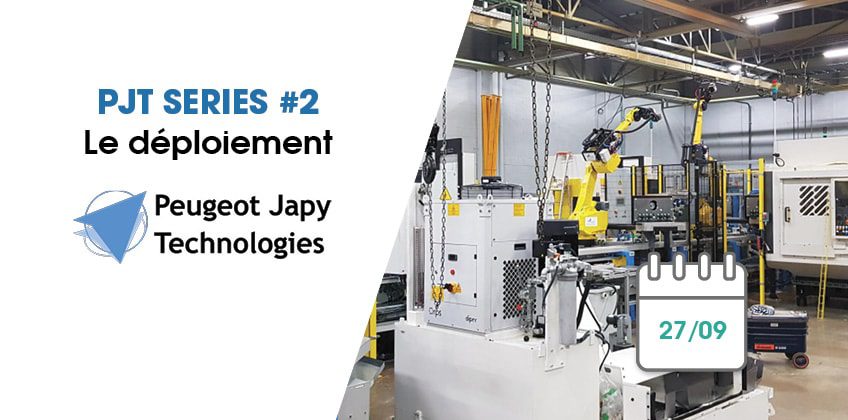
The Peugeot Japy Technologies factory, located in Valentigney (25), has recently adopted Mobility Work CMMS. But how did the deployment happen? What were the solutions provided by the tool? Were the teams ready for a new solution? To answer all these questions, we were able to talk to Yakub Pehlivan, who is in charge of deploying the tool in the factory.
“Before the arrival of Mobility Work CMMS at Peugeot Japy Technologies, I worked as Maintenance methods technician : I was in charge of creating preventive maintenance ranges, I established lists of emergency spare parts for machines, I worked closely with the preventive maintenance manager... Following the takeover of the factory by Farinia Group, I was offered to participate in the Mobility Work deployment project. Of course, I accepted and prepared the import frames on an Excel file, in which I was able to gather the list of machines, spare parts, the history of the old CMMS... Peugeot Japy is a slightly different case, so that Anthony Blanchard (maintenance expert at Mobility Work) immediately accompanied me.
How did the various teams welcome Mobility Work CMMS?
People of all ages work in the factory. We were very surprised to find that those who had the most problems with IT were the ones who best integrated the product: I did not expect it at all. We thought the younger ones would adopt it right away, but things turned out differently.
Initially, the technological aspect of the tool, the systematic use of smartphones and the mobile application impressed them as it seemed very new to them. The process being as follows: I am in the field to troubleshoot my machine, I scan my QR code, I look at the current failures on the equipment, I consult the documentation and spare parts etc., the technicians were a bit surprised to be able to do all this with a telephone. They were also surprised to have the possibility to directly dictate things to their smartphone to fill in their tasks.
Was the choice of smartphones wise?
I would admit that it depends on the user. Some technicians prefer to maintain certain old habits and use the web application instead, while others are completely on smartphones. It was necessary to shake up old ways of working, and I was confronted with people who, at first glance, did not see the point in changing the way things were done. They quickly realized that they were wrong.
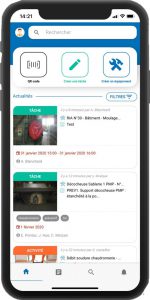
All the news relating to ongoing interventions are available from the news feed of the Mobility Work mobile application, available on iOS and Android.
We also planned to install touch screens, which have not yet been received but will be received shortly. One of them will be installed in the store to make it easier to remove parts and consult spare parts.
We also plan to install display screens in each workshop, including in the maintenance room. It will be possible to display the Mobility Work news feed.
This is the advantage of having several supports: each user can choose which interface suits them best.
Did you have to personally support the technicians?
Again, it depends on the technicians. When the product was launched, some initially needed my help in the first week to take the plunge, but they very quickly became independent. At the same time, other people had to be followed up longer: I often have to rectify their potential mistakes, remind them how they should proceed, tell them how to do things...
In any case, I note that the technicians are asking for more support on the mobile part since they have more questions. In reality, they were used to working only on fixed workstations and systematically compared the two interfaces.
What did Mobility Work CMMS bring you in concrete terms?
At first, I would say that the tool offers us much better monitoring of machine failures. If the technician uses it correctly, it greatly facilitates his daily tasks and saves him time, in particular thanks to the QR codes that allow all the information relating to the machine to be consulted in a few seconds.
Then, at Peugeot Japy, we have four different teams: morning, afternoon, night and even weekend. Mobility Work CMMS undoubtedly allows smooth communication between these teams since I can create a task in the morning and add an unfinished activity, which my colleague in the afternoon can see and finish. Information loss is drastically reduced.
What features do you use most often?
Since I release the maintenance indicators every day, I use the analytical function on a daily basis. In fact, every morning I have to go back in the news feed to the place where I left off the night before to correct the mistakes or pick up the missing information. Thanks to this, I have a much better monitoring of activities and I can report all the malfunctions in the analytics. I have to go through this because sometimes a task corresponding to a failure is created, but the technician forgets to add the troubleshooting label. However, all this information is essential to get the most out of the analytical tool. This is when we realize that the Peugeot Japy case is a bit different: we are gradually coming back afloat and must go back to basics.
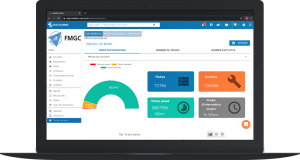
The forecasts of the Mobility Work application analytics tool are based on data collected from thousands of users working on the same equipment.
As for maintenance technicians, they simply create a lot of tasks that they then add to the activities and enjoy being able to see the hours worked in their day. It is true that they really appreciate the mobile aspect of the tool but that they go, at the end of the day, to a fixed station to have an overview of all the tasks carried out.
How did you review the organization of the maintenance service?
We can really say that CMMS has allowed to improve the organization of the maintenance service : we are witnessing a real sharing of information, which was virtually non-existent before. Technicians could spend hours retrieving information, now it's in the past: we are witnessing a profound upheaval since communication within and between teams has been revolutionized.
We are still encountering some occasional difficulties because we previously had an organization that was completely opposite to this one. For example, it can happen that a production person comes to ask a technician if the part he ordered has arrived while the information is already up to date in Mobility Work and clearly show that the part in question will be delivered within one day.
Some people do not yet have the reflex to search for what they need first in the Mobility Work application. It is sometimes a bit difficult to change all habits in such a short period of time when technicians were used to a given operation, it's almost an entire culture to resume!
Did you encounter challenges during deployment?
Yes, for example, some technicians were not used to entering their activities in the old maintenance software. They interpreted it as surveillance and thought that their manager really wanted to know everything they were doing. Others assumed that the tool was useless at all.
What is interesting is that those who mistook the tool for close surveillance are the same ones who quickly understand the value of CMMS. Obviously, when a technician is the only one on his team who does not use it and does not respect a standard, he quickly feels left out: he is forced to follow suit. In fact, by necessity and thanks to everyone's effort, everything is back to normal.
For my part, I encountered a very specific difficulty. When I am faced with a maintenance technician who refuses to use the tool, I do not have the role of manager. I am a technician, like him, and I have no hierarchical weight so it can become complicated. To solve this problem, I need the unwavering support of my managers throughout the deployment. Otherwise I feel that my efforts are not paying off and I feel discouraged. Supervisors really need to feel committed to a mission and make their teams understand that such a tool is essential. Fortunately, the machine starts up naturally and the managers are giving me more and more support.
How did people who were initially quite reticent understand that MW was not a surveillance tool?
It was through using Mobility Work that these people understood the usefulness of the product. Even the technician who said at the beginning that it would be useless does not think so at all. He knows full well that a good CMMS that brings together all the data is the real basis for successful maintenance. Since all technicians must fill in what they did during the day, they have no choice but to see that they find the missing spare parts, that they know the progress of an activity...
How did you overcome all of these challenges?
Since Peugeot Japy Technologies' situation was a bit different due to its takeover, we received real support from the Mobility Work team in order to successfully recover the factory. So I was lucky to receive valuable help from Anthony Blanchard, who really has experience in the field and who knows how to find the words to talk to maintenance teams.
It must be admitted that the most hermetic and reticent people at the beginning have nothing to complain about CMMS today, simply the factory situation was so complicated that the deployment came at a fairly critical moment. We are living in a situation that is certainly a bit difficult but far from being insurmountable.
What improvements do you think should be made to CMMS?
Overall, as soon as an improvement comes to my mind, I use the online support, directly accessible in the maintenance management tool, to get my comments back. I get answers quickly, which allows me to be more effective in the field and to be able to respond better to my colleagues.
What do you think of the support provided by Mobility Work?
I already want to say that having online support is a huge advantage. When I report a bug, I always get back to me within a few minutes. I thus communicate directly with Fabrice, the person in charge of customer support. Even if he does not solve my problem immediately, he informs me that he is taking my request into account, that he is informing me: we thus have the feeling that everything is well organized. During the day, or even the next day, he is then in a position to find a real solution.
As far as the Mobility Work teams were able to travel, I have no complaints, everything was only positive. I felt very supported and we all benefitted from optimal supervision, Anthony Blanchard and Marc-Antoine Talva (CEO of Mobility Work GMAO) were committed and unwavering support.”
Thank you so much to Mr. Pehlivan for his valuable testimony! Are you also interested in maintenance management and want to know more in order to increase your productivity and save money? Schedule a free visit with our team to help you better manage your maintenance.
Any questions?
Contact us to discover the first CMMS that can be deployed in 3 weeks.