Is predictive maintenance already a thing of the past?


Predictive maintenance: definition and examples
Predictive maintenance, the Internet of Industrial Things (IIoT in English, for Industrial Internet of Things) as well as the latest advances in the field of advanced technologies and analytics, such as machine learning (or machine learning in French) and artificial intelligence (AI), are transforming the industrial maintenance sector. After having opted for programmed preventive maintenance plans at the expense of reactive and corrective interventions, through the extraction of data to monitor the condition of the equipment and predictive algorithms, professionals in the sector are about to add a whole new string to their bow. Prescriptive technology is presented as the maintenance of the future: it relies as much on the concept of cognitive analysis as on connected objects to “prescribe” a certain type of behavior to the machine and bring it to optimal performance.
The prescriptive approach is part of the continuity of the development of predictive maintenance routines and is now considered to be the final stage in this evolution.
How is reactive maintenance used?
The corrective (planned or not) and/or reactive (only unplanned) are used when a failure or malfunction occurs on a machine, in order to bring it back to a normal operating state that allows it to perform its functions.
The patch can sometimes be used to describe scheduled interventions, identified as part of a program to monitor the condition of an equipment. Many innovative companies seek to reduce the number of these interventions by implementing planned preventive asset controls as well as predictive algorithms, in order to predict the occurrence of breakdowns. However, it is still essential to have both solid knowledge and field experience in order to be able to quickly repair a machine.
Reducing the risk of malfunctions
Unlike reactive maintenance, preventive maintenance plans involve carrying out regular and scheduled routine actions to eradicate unplanned downtime and the expenses associated with unexpected breakdowns. To implement them, it is essential that companies, and in particular those with a large number of machines, have a reliable and next-generation CMMS: they may encounter difficulties in keeping track of all the interventions carried out and of the documents related to the assets. Mobility Work, which is both a SaaS CMMS and the first social network for maintenance, helps companies modernize their entire processes.
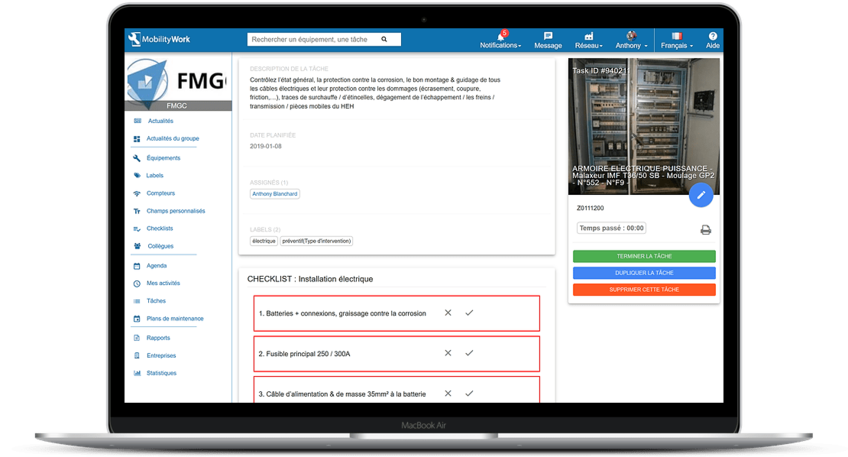
Access all documents (photos, videos, etc.) and checklists from the equipment sheet in your Mobility Work application
A typical preventive maintenance plan includes cleaning, parts inspection and replacement, lubrication, adjustments, oil changes, and many other actions that are based on a set of data provided by the manufacturer, intervention history, and asset behavior. The objective of preventive controls is to detect potential problems in order to correct them immediately, so that they do not cause any malfunctions.
One Mobile CMMS such as Mobility Work allows you to instantly access all the equipment data you may need in the field, as well as to gather all the intervention reports, which you can share with the entire team thanks to the integrated news feed. These reports help technicians who did not perform the intervention themselves to understand its origin, and to participate accordingly.
Preventive measures, which were still considered revolutionary a few years ago, are now well integrated and have even become the most common form of maintenance. The benefits it brings, such as its ability to extend the life of equipment, improve reliability and reduce costs, have since been widely recognized and appreciated.
More articles on CMMS and prevention on the Mobility Work blog:
5 levels of corrective and preventive maintenance you should know
Monitoring the condition of the equipment and predictive maintenance
Predictive maintenance is based on the real-time monitoring of the condition of the equipment, accessible thanks to the sensors it has. Among other things, the data generated takes into account a certain number of indicators such as temperature, vibration, cavitation or oil analysis, which make it possible to anticipate impending breakdowns. This data is already very useful on its own, but when combined with intervention history, spare parts information and all available reports, it has impressive potential. Recorded and analyzed in Mobility Work, they can be used to create predictive algorithms.
Even if predictive maintenance is still recent in the industrial landscape and its results are easily observable, its implementation within VSEs and SMEs remains uncertain because of the additional costs it generates. Today, sensors are no longer as expensive as they were a few years ago, but routines must be integrated by qualified specialized employees.
Despite these obstacles, if a company chooses to turn to digitization and Industry 4.0, it will not be able to ignore data on the condition of its equipment and on predictive maintenance. This approach is in fact at the very heart of the Industrial Internet of Things (IIoT), which wants objects to be improved in order to be able to better collect and store the data contained in their environment.
More articles on CMMS and predictive maintenance on the Mobility Work blog:
Case study: improving manufacturing processes through maintenance 4.0
Industry 4.0 and CMMS: tomorrow's maintenance
The fundamentals of predictive maintenance
IoT and CMMS: the new competitive advantage
Maintenance based on artificial intelligence (AI)
Maintenance routines are entering a new era thanks to prescriptivity and the introduction of flexible strategies, which allow technicians to intervene only when really necessary. The prescriptive goes even further than the provisional, since it makes it possible to highlight not only an imminent failure but also the reasons that lead to these potential malfunctions. In short, this approach consists in bringing together the available data and determining how the indicators and expected results should be oriented to eliminate any risks in the current production cycle.
In short, professionals are listening to artificial intelligence algorithms, which help them to adjust the expected results on an ongoing basis and to know what measures to put in place to control the behavior of an asset. Analyses will continue to be generated after an intervention to monitor machine activity. Prescriptive design makes it possible in particular to reduce costs and to provide assistance when critical decisions are required.
One could cite the example of a factory that decided to run a belt for 1,000 hours in winter compared to 800 in summer, because it took into account the environment of the machine and deduced that the temperature of the building would have a direct impact on the equipment.
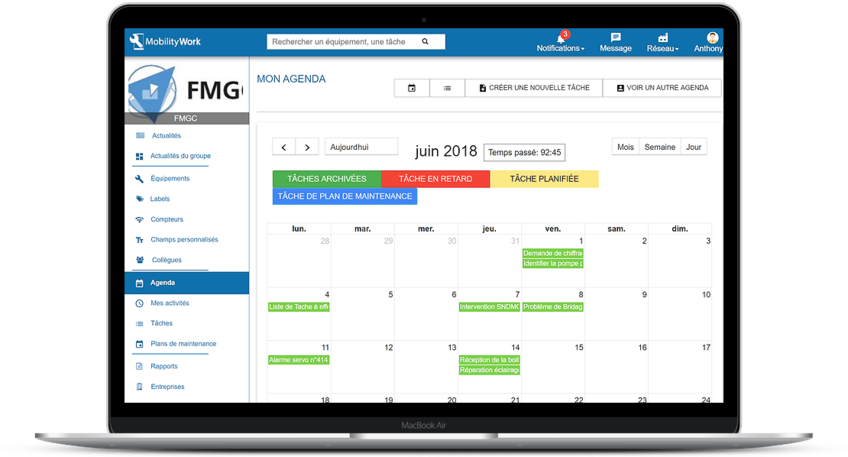
The calendar feature offered by Mobility Work allows you to plan all your preventive and predictive maintenance interventions.
Having a modern and flexible CMMS is a prerequisite for setting up a prescriptive maintenance routine. Mobility Work revolutionizes your routines and can store, organize and analyze your data, regardless of the form of maintenance you choose.
As with any new technology, deploying a prescriptive strategy can be quite a daunting task at first. Computer hardware, software and training costs, the size of the company and its approach to innovative technologies can all be obstacles to prescriptive design. But this approach, which is finally quite emerging, has enormous potential and promises the entire sector to enter the world of Industry 4.0.
Regardless of the company's position on the subject, Mobility Work always provides you with a solution. This new generation CMMS can easily adapt to the predictive maintenance program developed by a group to help the team improve and progress. Mobility Work evolves at the same time as your business and evolves its functionalities according to your needs.
Any questions?
Contact us to discover the first CMMS that can be deployed in 3 weeks.