Predictive, expensive but effective maintenance?


According to the definition of Reliability Based Maintenance (MTBF), predictive maintenance, also called conditional maintenance, makes it possible to avoid potential breakdowns by analyzing the current and real condition of equipment. Contrary to the preventive maintenance which is planned in advance, over predefined periods, and implemented on the manufacturer's recommendations, advance maintenance makes it possible to anticipate and prevent potential breakdowns by monitoring the machine in its real operating conditions.
Predictive maintenance: definition and examples
The preventive maintenance planning approach requires interventions at regular intervals. This does not always make it possible to highlight the exact condition of an equipment and sometimes leads to unnecessary maintenance operations. It is considered that equipment has a limited lifespan based on a predetermined number of factors recurring to this model. Thus, a part is generally replaced well before it risks breaking down.
Anticipatory maintenance, on the other hand, allows maintenance technicians to anticipate the exact moment of the failure, and to intervene only when there is a real need. It is then sometimes possible to plan repairs when the maintenance activity is the most profitable, that is to say that it has only a limited impact on production. The implementation of a predictive maintenance plan makes it possible to achieve significant savings, as well as to improve the productivity of a machine park.
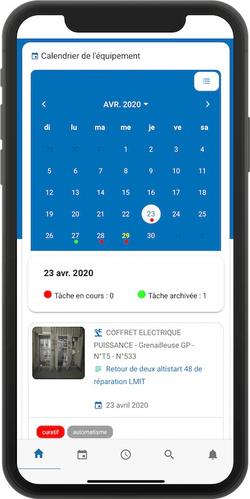
Access all documents (photos, videos, etc.), calendars, checklists from the equipment sheet in your Mobility Work application
What are the tools used in predictive maintenance?
Predictive maintenance requires the use of a wide range of techniques, first to predict the occurrence of a failure, and then to avoid the failure by planning and implementing a maintenance operation. The best technique will depend on the type of industry and the equipment involved.
For example, here are some of the most common predictive maintenance tools, used by one of our foundry customers.
Acoustic analyses and measurements
This technique uses ultrasound whose frequency is greater than 20,000 hertz in order to assess the condition of the equipment. The ultrasound emitted by the machines in operation makes it possible to quickly detect the presence of mechanical faults, leaks or electrical problems.
Infrared thermography
Thermography makes it possible to monitor the thermal profile of equipment using thermal sensors (infrared cameras). These tools can detect abnormal thermal changes, synonymous with a potential failure: hot spots, leaks, electrical faults... thermography has the advantage of not requiring any contact with the machines studied, which makes it possible not to interrupt their operation.
Vibration analysis
Vibration analysis is often used in addition to acoustic or thermal measurements in order to refine the diagnosis. The procedure consists of analyzing the vibrations emitted by the machine in order to detect and identify failures. For example, vibration analysis makes it possible to identify tightening errors, misaligned drive shafts or damaged belts. Many tools, often non-intrusive, such as accelerometers (acceleration or rotation sensors), laser vibrometers, digital recorders and spectral analyzers are capable of capturing the right vibrations and measuring them according to their amplitude, sound level (dB) and frequency (Hz).
Other early maintenance techniques
It is possible to combine different techniques in order to increase the accuracy of forecasts. Data from another source of information can also be added: machine energy consumption, production analysis, fluid or oil analysis, spectral analysis, etc.
Why is preventive maintenance more common?
Preventive maintenance is more widespread because it is easier to set up and less expensive than predictive maintenance. Predictive maintenance requires very expensive measurement instruments, and requires the intervention of a team of highly qualified technicians in order to correctly interpret the data and obtain the right information at the right time.
Predictive maintenance cannot be applied to all applications. In order to limit the costs upfront of a machine condition monitoring program, some companies limit this type of maintenance to the most essential applications.
How is predictive maintenance effective?
Although setting up a predictive maintenance program is an expensive undertaking, it is a profitable strategy in the long term, as it saves time and money on maintaining equipment. By monitoring a machine in operation, predictive maintenance highlights problems as soon as they occur and ensures that the machine will not be decommissioned until just before it breaks down.
This limits the number of hours of production lost, and prevents the occurrence of breakdowns, responsible for the unscheduled interruption of the equipment.
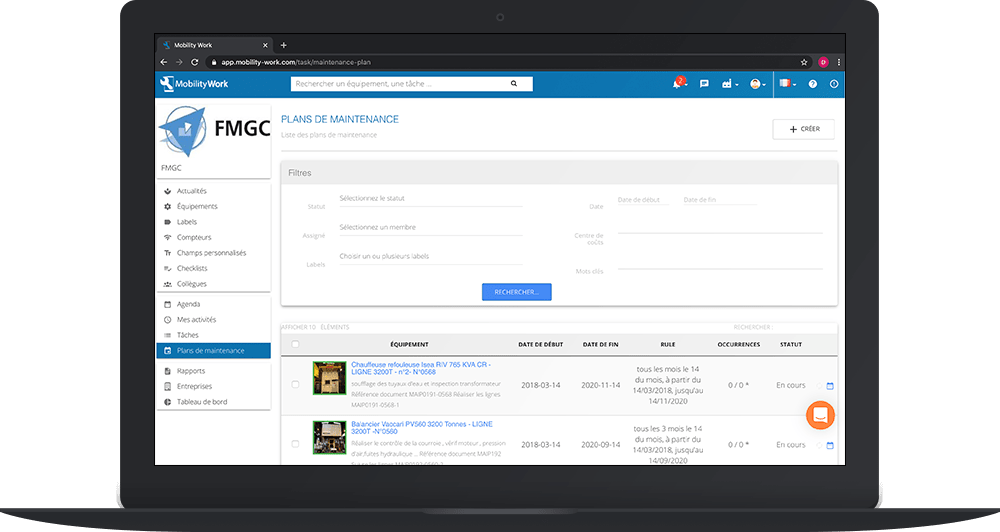
Mobility Work CMMS allows you to simply plan your maintenance interventions
Predictive maintenance or corrective maintenance
What are the fundamental differences?
- Fewer breakdowns and therefore fewer interruptions
- Better intervention planning, and therefore a better prepared team
- Better communication between production and maintenance services
- Better management of spare parts
Advantages of early maintenance compared to systematic preventive maintenance:
- Full use of the equipment
- Lower spare parts inventory
- Better monitoring of equipment, allowing the repair of operator errors or minor incidents that may result in greater damage
- Increased security, making it possible to prevent minor incidents in time (thermal incidents for example) and to prevent them from turning into more serious incidents
How do I set up an advance maintenance plan?
Setting up a predictive maintenance plan in a company with thousands of spare parts and equipment is far from being an easy task. The tool of GMAO Mobility Work makes it easy and reliable to find all the data relating to equipment in order to easily plan the implementation of a maintenance intervention.
It is possible to transfer all kinds of information (for example that collected by a sensor) to Mobility Work. Thus, the latter makes it possible to centralize all surveillance data and to analyze them almost in real time thanks to its analysis tool high performance. Maintenance interventions are automatically scheduled based on the results.
As a community tool, Mobility Work has become the first social network for maintenance, and now has more than 121,800 registered devices, and more than 212,270 maintenance operations entered. Mobility Work provides all members of its community with a considerable database, which is essential in a world as connected as ours.
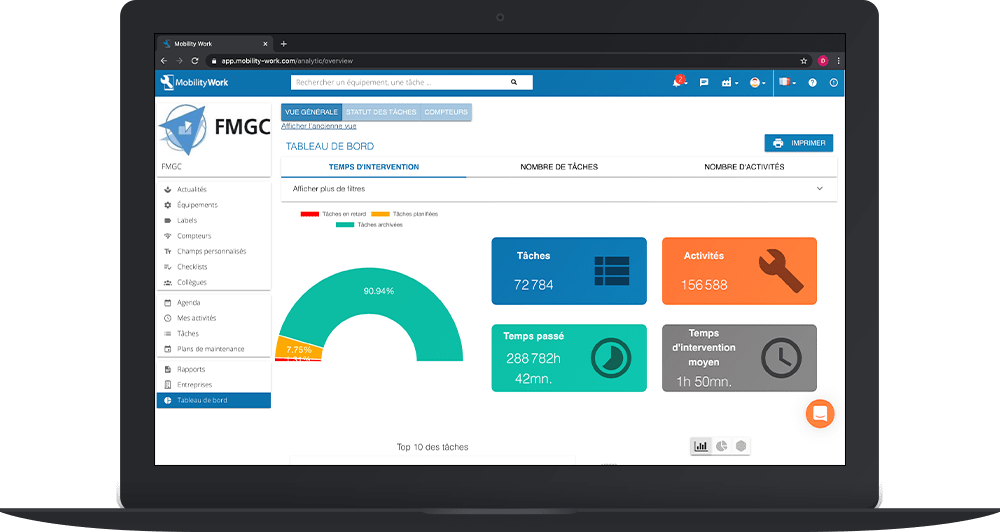
The forecasts of the Mobility Work analytics tool are based on data collected from thousands of users working on the same equipment.
Effective maintenance improves operational stability and reduces unscheduled downtime. Predictive maintenance is an essential component of every lean maintenance program. The correct implementation of maintenance techniques promises significant savings compared to conditional or preventive maintenance, because tasks are only carried out when necessary.
Thanks to the interactions between analysis and Big Data tools specific to predictive maintenance, the company's key equipment can be continuously monitored, diagnosed and much better maintained.
Are you interested in maintenance management and want to know more in order to increase your productivity and save money? Try our CMMS application for free for 7 days, and improve your maintenance management today!
Any questions?
Contact us to discover the first CMMS that can be deployed in 3 weeks.