Predictive maintenance: definition


Predictive maintenance: definition and operating principle
Industry 4.0 has revolutionized the manufacturing sector by giving businesses the opportunity to set up machine-to-machine (M2M) or machine-to-human (M2H) communication, as well as analytical technologies in order to be able to predict failures before they occur. In this context of digital transformation, the predictive algorithms favored by new generation CMMS are increasingly sophisticated and reliable. Proactive maintenance strategies have made it possible to considerably facilitate the management and maintenance of business assets, by optimizing the working time of the workforce, and by improving the lifespan of equipment.
How does predictive maintenance work?
The aim of predictive maintenance is to anticipate the occurrence of a failure on equipment, based on data relating to its condition. Predictive maintenance also includes carrying out regular maintenance activities, as infrequent as possible, in order to prevent breakdowns from occurring.
Predictive maintenance algorithms are based on data provided by various monitoring tools, such as vibration analysis or oil analysis. The difference between the expected condition of the asset and its gradual deterioration makes it possible to identify trends, and thus anticipate maintenance interventions.
In addition, advance maintenance makes it possible to monitor the condition and performance of the equipment during normal operation, in order to reduce interruptions related to daily operations.
Tools for monitoring the condition of equipment
Choosing the best technique for monitoring equipment depends on the needs of the business, as well as on the type of machines used by the company. The tool chosen must be extremely effective, but also provide sufficient alert time for future maintenance operations.
Below is a quick overview of the equipment monitoring tools most frequently used in predictive maintenance:
- vibration analyses are mainly used to detect misalignment, imbalances, mechanical looseness, or wear on a pump or motor.
- infrared thermography makes it possible to identify temperature differences in transmissions, gearboxes, bearings, etc.
- Oil analysis makes it possible to determine the condition of a lubricant and its possible contamination, according to the number and size of particles on an equipment.
- ultrasonic analysis is used to detect leaks in pipes and tanks, mechanical failures in moving parts, and faults in electrical equipment.
- Current analysis makes it possible to measure the current and voltage of the electricity that powers an electric motor.
There are other techniques for monitoring the condition of equipment, including shock pulses, fluid analysis, performance changes, stereophotography and non-destructive testing of materials (ultrasound, eddy current, endoscopic inspections).
Predictive maintenance and Mobility Work
Anticipatory maintenance can be considered as an essential feature of CMMS, or maintenance management software as an essential tool as part of a preventive maintenance program. Whatever your point of view, one thing is certain: when combined, predictive maintenance and CMMS offer a whole range of undeniable advantages.
Through the storage and analysis of equipment monitoring data, Mobility Work allows users to define the limits of acceptable values for each asset. It is thus possible to automatically generate work orders or notifications if the statements deviate from the predefined values.
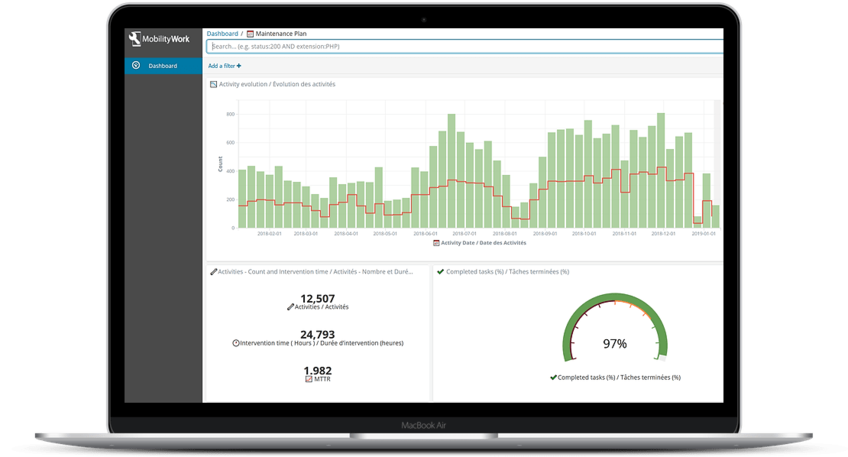
The Big Data tool in the Mobility Work application helps you make better decisions thanks to customizable indicators.
In addition, Mobility Work makes it possible to analyze all previous data, collected as part of maintenance interventions, reports and information relating to spare parts, in order to establish reliable trends and contribute to the analysis of the asset life cycle. Thanks to this information, CMMS helps to predict the interventions or replacements to be carried out.
To learn more about integrating monitoring data into CMMS, feel free to read our article: Advance maintenance and maintenance application: How to get better results?
Set up a predictive maintenance program
First, before setting up an advance maintenance program, it is necessary to understand its basic functioning and its relationship with the type of equipment to which it applies. Once the basic concepts of advance maintenance have been acquired, a strategy must be planned. The next step is to choose the most effective monitoring method and to acquire the equipment necessary for this implementation (sensors for example). Finally, the integration of data into your CMMS comes into play: it is indeed essential that any maintenance task or activity carried out be identified and entered in the CMMS, otherwise precise monitoring is impossible.
If you have followed all of these steps correctly, you will be able to limit all the corrective work and plan each maintenance activity. You thus have the possibility to adjust resources according to needs, and to reduce costs by simple management of activities.
It should also be noted that the implementation of an early maintenance strategy will potentially be accompanied by some occasional problems. Plan your work time accordingly, and give your team the opportunity to talk so you can avoid them in the future.
Finally, in order to understand the challenges associated with implementing predictive maintenance in your company, it is recommended to measure a few previously identified KPIs.
Relevance of predictive maintenance
The question of the relevance of this type of maintenance arises when identifying what types of equipment should the predictive maintenance program apply to. They are generally machines with a critical operational function, and which, thanks to regular monitoring, allow failure modes to be detected efficiently and at a lower cost.
Advantages and disadvantages of predictive maintenance
The initial costs generated by setting up an advance maintenance program are quite high: follow-up equipment and an experienced team capable of correctly interpreting all the data are essential. However, the benefits of predictive maintenance far outweigh financial considerations. If an early maintenance program has been properly implemented and works effectively, it will result in the following savings:
- Reduction in the time dedicated to maintaining equipment; maintenance is only carried out when the asset requires it
- Reduction in lost production hours, as predictive maintenance is performed while the equipment is running
- Reduced cost of spare parts.
Beyond these advantages, a good early maintenance strategy can make it possible to reorganize the entire company. Reliability should be considered as the core of the predictive maintenance concept, and makes it possible to reduce downtime and increase productivity as the machines continue to operate.
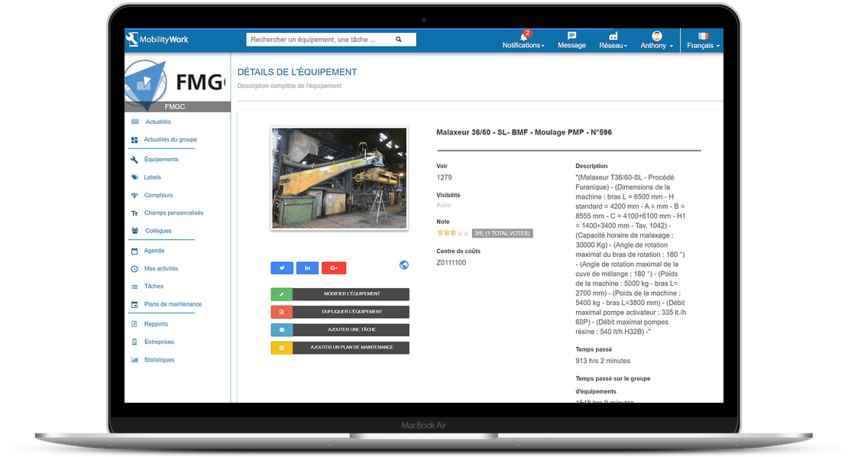
All information relating to the equipment is available from its dedicated sheet in the Mobility Work maintenance management application: description, image, documents, preventive maintenance plans, etc.
Early maintenance is fast becoming the next maintenance strategy critical to business success. Its long-term benefits make it possible to obtain significant improvements in the reliability of equipment, and to stimulate cost control. Thanks to a new generation CMMS such as Mobility Work, predictive maintenance will quickly become your most powerful maintenance tool.
Are you interested in maintenance management and want to know more in order to increase your productivity and save money? Schedule a free video with our team to help you better manage your maintenance!
Any questions?
Contact us to discover the first CMMS that can be deployed in 3 weeks.