Machine and bottleneck in industrial maintenance


Machine and bottleneck: definition and examples
Studying the criticality of your plant's equipment allows you toidentify potential bottlenecks and bottlenecks. These are the most critical assets on which the entire production chain depends: in the event of a failure, a bottleneck arises and production is interrupted. The objective of studying the criticality of equipment by the industrial maintenance department is to identify these machines, and to assist you in creating and deploying strategies for predictive and predictive maintenance.
Bottlenecks in a production plant occur when a key asset is no longer able to reliably produce the expected return. The objective of this industrial maintenance method is to categorize your equipment according to its importance, in order to limit potential breakdowns and to help you manage them in the best possible way. Studying the criticality of your assets should allow you to quickly identify the equipment to be monitored, as well as to improve the management of your spare parts.
Bottleneck: why identify it?
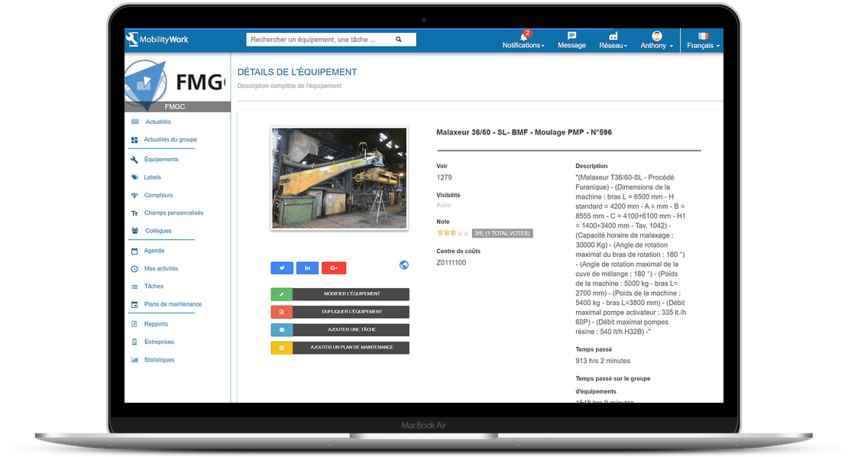
Each manufacturing process is composed of equipment of varying criticality, but which is not always well identified. A bottleneck machine can be defined as a critical and central piece of equipment in your production unit, which requires particular supervision. This type of asset is most likely to affect overall performance, and Create your equipment sheets in the Mobility Work maintenance management application to trigger tasks and activities
If the capacity of this machine is too low, if it breaks down frequently or if it is assigned to an operator who requires a period of training, then the entire production line will be blocked. The situation can get even worse if several bottlenecks occur at different stages of the process. In this case, it is necessary to determine which machine should be treated first.
Poor management of these assets can have dramatic consequences for your business, including the complete interruption of your production system, or even the dissatisfaction of your customers.
Prioritize your company's assets using the PIEU method
Very frequently used in industrial maintenance, the PIEU method aims to define the criticality level of your equipment and thus quickly detect bottlenecks. Developed by the French engineer Yves Lavina, it thus makes it possible to prioritize the company's assets. It is necessary to determine the value of each of these letters for each machine in order to assess its criticality:
P - breakdowns
I - importance of equipment
E - condition of the equipment
U - use
The incidence of failures (P), the importance of the equipment (I), the condition of the equipment (E) and the rate of use (U) are the 4 criticality indices that will allow you to classify your assets into different groups.
The criticality assessment is carried out according to the following criteria:
Weight/Criteria 0.01123P - Incidence of failures Serious repercussions on the entityImpacts on quality and generation of “waste” Possible retouchesNo impact on the quality of careSI - Importance of the equipment
Strategic, no load shedding on other equipment, subcontracting impossible
Important: no load shedding possible, subcontracting possible
Secondary, load shedding possible Emergency equipment - Condition To be renovated, to be reformedTo be overhauled To be monitored In the specified condition
U - Utilization rate
Saturated High Medium Low
Once the various elements have been determined, all you have to do is calculate the criticality of the machine according to the following formula:
Equipment criticality = P*I*E*U
Next, you must determine a ranking of your critical equipment using the following rule:
Place < 1: very critical
1 < Pile < 10: moderately critical
Place > 10: less critical
Examples of criticality
The table below provides some examples of criticality on a smelting production line in a foundry:
Incidence of failures
Importance of Equipment/State
Utilization rate
Criticality Cubilot Küttner 0.010,01320,0006 Küttner cooling tower 0.010,01320,0006 Küttner recovery tower 0.010,01320,0006 Küttner recovery tower 0.010,01320,0006 Fuchs Terex Excavator 0.010,01320,0006 Fuchs Terex Excavator 0.010,01320,0006 Excavator Fuchs Terex MHL340321318 Bucket Granulator HL340321318 Bucket Granulator 113131820,0004 Bridge Loading ADC10,01320,06Küttner Recovery Tower 0.010,01320,0006 Excavator Fuchs Terex MHL34032131818Bucket Granulator 1330,01310,09Jib SAS223336Headset Additive Loading20,01320,0006 Fuchs Terex Excavator, 12 shuttle 30, 011 10.03
How to identify a bottleneck machine in your CMMS?
Once the PIEU method has been applied to all of your processes, you will have identified your critical equipment and bottlenecks. The next step is to identify them in your maintenance management software.
To do this, all you need to do is use the tag or label system in the Mobility Work CMMS application. You can thus create different families of equipment using tags, including:
Category A — bottleneck or critical machine
Category B — equipment to monitor
Category C — equipment not important
Criticality study methods such as the PIEU method can help you identify the necessary improvements and implement them as part of your industrial maintenance strategy. By applying this method, you will be able to successfully predict potential bottlenecks and improve the reliability of your equipment.
Any questions?
Contact us to discover the first CMMS that can be deployed in 3 weeks.