Preventive maintenance: preventive replacement and strategy


Preventive maintenance: definition and examples
The long-term competitiveness and profit of your company are ensured by regular preventive maintenance, the aim of which is to guarantee the reliability of your equipment. Nowadays, the role of maintenance is no longer limited to keeping equipment in good condition. Scheduled, predictive and highly effective, maintenance is at the heart of intelligent manufacturing. Advanced maintenance has become a prerequisite for a company's access to Industry 4.0, which involves the participation of all departments.
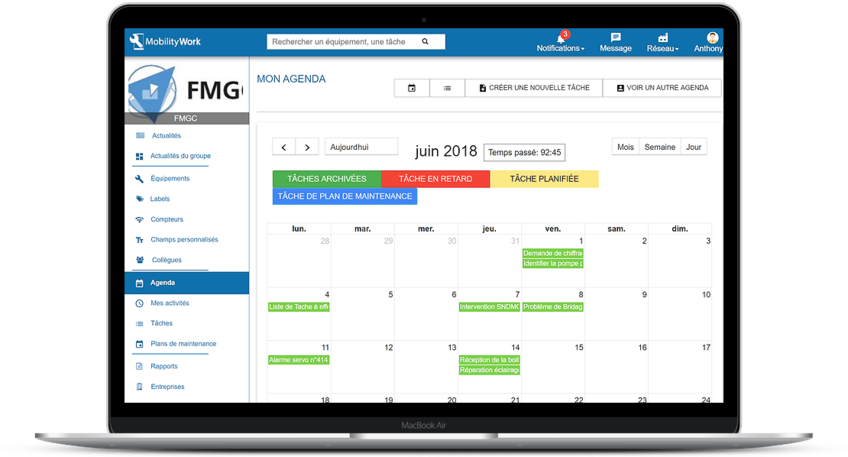
At Mobility Work, we believe that well-performed maintenance starts with good communication and correct data entry in an easy to use solution. Our GMAO New Generation allows you to eliminate unsuitable maintenance actions that may lead to accidents, additional costs and production stoppages.
Preventive maintenance
The main objective of the Scheduled maintenance Is to ensure the repair or replacement of equipment before the occurrence of a failure predicted by the manufacturer or by lifetime statistics. Generally applied according to specific programs, planned maintenance involves numerous actions (such as equipment control, oil changes, lubrication, etc.), which aim to improve the availability and reliability of assets while reducing the overall failure rate.
When should a component be replaced as a preventive measure?
For certain predefined equipment, it is better to replace than to repair: this applies in particular to certain essential equipment, equipment subject to wear and tear or breakdowns, or even to equipment with a high rate of use. For the rest, whether a preventive replacement is effective or not, it must be precisely programmed. In the context of the debate between preventive replacement and corrective repair, it is necessary to take into account the following conditions:
- The condition of the component, which includes all important evaluations such as operating time, dimensional control, dimensional control, thickness measurements, clogging index, thermography, oil analysis, and vibration analysis, and which worsens over time (increasing failure rate). Thanks to Mobility Work CMMS, all this data can be constantly collected, monitored, and analyzed. The team will be immediately notified as soon as the critical threshold is reached.
- Preventive replacement (Cp) should be less expensive than a possible unplanned repair (Cu).
If these two conditions are met, the optimal component replacement time and the total cost can be calculated. According to the “Strategy T”, a component or equipment must be repaired if it breaks down before time T; if no failure occurs before time T, it will be subject to a preventive operation.
Total cost is defined as the sum of corrective replacement costs that increase over time and preventive replacement costs that decrease with increasing interval time. This means that the less preventive maintenance you perform, the more your corrective maintenance costs will increase; and the longer you wait to perform a preventive maintenance intervention, the less corrective maintenance costs you will have. However, if you schedule scheduled maintenance interventions too often, your costs will still increase. You can only calculate an optimal replacement time and find a balance between costs and risks by combining the relevant data.
Calculate the optimal replacement time

CPUT is the cost per unit of time
- R (t) is the reliability of the component at time T.
- T is the optimal time to replace the component.
Other Factors Must Also Be Taken Into Account in Order to Make a Choice Between Planned or corrective maintenance operations. If a component is brand new, still under warranty, and showing signs of failure, replacing is undoubtedly the best decision. Depending on the cost and availability of the component, a comparison with the labor cost is essential for decision making. Sometimes, a component that keeps breaking down after several repairs and that obviously needs to be replaced offers a good reason to upgrade and adopt newer technology.
Most maintenance professionals agree that replacing equipment or components as a preventive measure is more economical than waiting for a failure to do so. The obvious advantages of preventive replacement include optimization, profitability and the reduction of the risk of accidents.
Preventive replacement model based on age
This type of preventive model, in which the age of each part is taken into account and where each part is changed once it has reached a predefined age, is widely used in industrial manufacturing.
The lifespan of a component covers three main stages:
- Decreasing failure rate, or early stage of equipment;
- Constant failure rate, or useful stage of equipment;
- Increasing failure rate, or wear stage, also known as the most critical or deteriorated condition that increases the frequency of failures.
Preventive replacement always occurs during the third stage of the component's life, and its main purpose is to reduce maintenance costs and production losses. It is clear that if it is not replaced, equipment in a state of degradation will cause critical and unexpected machine downtime.
The new generation CMMS and the first social maintenance network Mobility Work helps you optimize your preventive maintenance program. This solution allows you to analyze your data, and provides you with accurate information concerning the management of spare parts and connects all the departments of your company. Mobility Work helps you in your decision-making by providing you with a global vision of the condition of your equipment.

All the news relating to current interventions are available from the Mobility Work application news feed
Direct benefits of preventive maintenance
- Planned maintenance is more cost effective than corrective maintenance over the long term;
- Planned maintenance reduces unexpected equipment failures and thus optimizes production time;
- Planned maintenance extends the life of the production system as well as the reliability of the equipment;
- Planned maintenance improves the management of spare parts inventory.
In some cases, preventive repair of a spare part with an increasing failure rate is much more cost-effective than corrective replacement when a failure occurs. The challenge is to determine whether an expensive replacement is appropriate, and if so, to identify the best time to do so based on the optimal age of replacement mentioned earlier.
Mobility Work brings together all the data collected by sensors, readings and the history of interventions in order to assess the rate of deterioration of equipment when necessary. Data analyses also complement the established preventive maintenance program by minimizing overall costs and meeting desired reliability goals.
Any questions?
Contact us to discover the first CMMS that can be deployed in 3 weeks.