Innovation, the new purchasing playground?


Far from the image of the cost-killer, the Purchasing function is increasingly tending to establish itself as a strategic function in the industry. Purchasing management is now one of the main drivers of business performance. By optimizing the activities of your teams, you can thus hope to improve your margins, not only by reducing your operational costs, but also by breathing new life into your production chain.
Indeed, this function plays a significant role in the continuous improvement and innovation process of your organization. In doing so, it guarantees the sustainability of the company in an increasingly competitive environment.
Facilitate product design
Long associated with the concept of cost reduction (cost-killing), the Purchasing function seemed, by extension, to oppose the guarantee of production quality or even the development of new products. However, by integrating innovative digital solutions, the teams managed to automate a large number of operations with low added value.
More flexible, they are now in a position to focus on the continuous improvement of the value chain. This includes optimizing their sourcing strategy, better cost management, or reducing time to market. By acting on these factors, the procurement function can reduce uncertainty and support business innovation efforts.
Cost Management
Gone are the days of cutting costs at all costs. Businesses today aspire to the optimization of expenses, a trend that is more favorable to development and innovation. However, the cost of raw materials, equipment or industrial maintenance can strongly influence the design of a product. Depending on the strategy displayed by the company, too high production costs can hinder the R&D process of a product.
At this stage, the role of the Purchasing function is decisive. By eliminating the level of uncertainty associated with production costs as early as possible, it is part of a global process of continuous improvement. To do this, the teams act at two levels:
- Internally. Thanks to powerful calculation algorithms, modern costing tools allow Purchasing teams to save time in an analysis phase of the offer. By turning to an approach of predictive costing, i.e. by estimating costs as accurately as possible using cutting-edge digital tools, they help the company make the best decision at the right time.
- Externally. Once the market analysis has been conducted, the teams can use their expertise and negotiate the best prices with suppliers. This discussion phase is fully in line with the company's SRM strategy.
To know everything about SRM strategies, do not hesitate to consult This article.
Managing deadlines
One of the most effective ways to improve the profitability of a product without compromising its quality is to act on deadlines. As the product life cycle decreases, time to market becomes a major strategic factor in that it allows the company to significantly improve its profitability. This also gives it a competitive advantage and strengthens its position in the market.
Industry 4.0 and IoT (Internet of Things) are also full of innovative solutions for businesses looking for efficiency. Installing smart sensors on your equipment, for example, allows you to align the pace of your orders with the real needs of your production chain.
When a critical level is reached, these sensors send notifications to maintenance teams. They then send the Purchasing Department a request to order the spare parts and maintenance products necessary for the smooth running of operations.
Thanks to its IoT connection, Mobility Work Hub, the first platform open to equipment manufacturers and consumable manufacturers, even allows you to report this information directly to your industrial supplier. Eventually, users will be able to automatically trigger orders with their supplier.
Reducing the time to market also requires redefining your sourcing approach. Finding suppliers and handling tenders are time-consuming processes. Today, solutions such as Mobility Work Hub open up new sourcing opportunities for Purchasing departments.
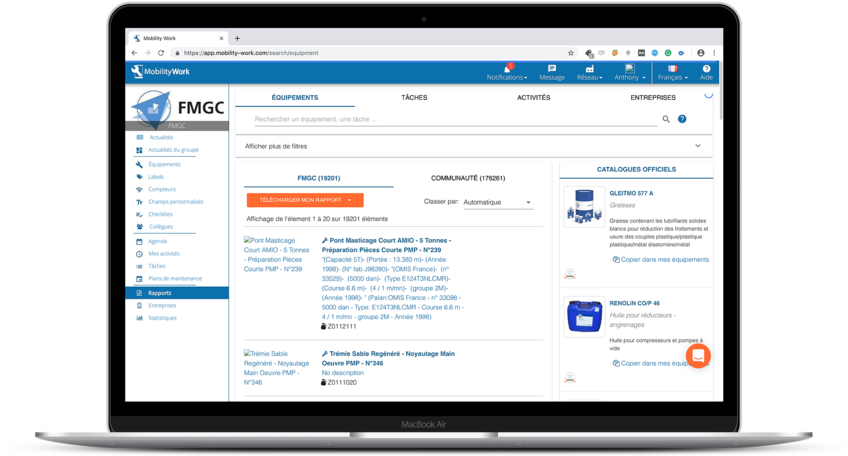
Discover new players in your market from Mobility Work CMMS
By bringing together supply and demand on a single platform, Mobility Work Hub facilitates exchanges between supply chain actors.
Purchases are committed to innovation
Purchasing not only facilitates interactions within the company, but also constitutes a privileged intermediary between supply chain actors. As such, they are driving a new form of innovation.
Improving sourcing
The rise of marketplaces and collaborative platforms has led to a strategic alliance between suppliers and customers.
At present, companies still most often use specialized websites to search for industrial suppliers. They then report the results of their research into an Excel spreadsheet and carry out emailing operations as part of their sourcing process. In this context, the multiplication of tools leads to an increased risk of data loss.
The growing number of flexible and centralized solutions is opening up new paths for innovation. SaaS applications hosted on the Cloud, such as Mobility Work Hub, make it easier to access and analyze relevant supplier profiles. Purchasing teams have access to a large amount of data (sector of activity, official catalog, ratings, etc.) and can contact them directly.
Thus, the company has easy-to-use tools to capture the players in its ecosystem and measure the complementarity of their skills for future collaboration.
The rise of co-innovation
Traditionally, innovation is seen as the exclusive preserve of R&D and Marketing functions. The first designs and develops the product, the second assesses its relevance and customer support. What if we told you that innovation was primarily driven by consumers?
For several years now, big names in the clothing and food industries have been engaging in an open dialogue with their consumers. That's where the Purchasing function comes in. The company is no longer a passive partner; on the contrary, it actively contributes to the improvement and design of products. Their feedback is taken into account by the suppliers and integrated into the activities of the R&D teams.

Thanks to the Mobility Work Hub platform, access a set of data on the use of their products by the Mobility Work community.
Although it is not a question of sourcing per se, this approach nevertheless has great advantages for companies. This co-innovation method allows organizations to identify, capture and manage supplier innovation according to their needs.
And everyone comes out on top. First, the supplier, which has a test field for its innovation and an assured customer base at the time of marketing. The customer, then, who benefits from an exclusive supply contract, often at an advantageous price, and strengthens its supplier relationships.
Any questions?
Contact us to discover the first CMMS that can be deployed in 3 weeks.