Purchasing, an actor in the production chain?

Between the search for performance and cost reduction, industrial production activities are often caught up in headwinds. At the heart of this dynamic, how can the Purchasing department benefit from its expertise? It must meet an overall objective of constantly improving margins. Responsible for procurement operations, she ensures the availability of raw materials, components and subcontracting necessary for the development of finished products.
Because of their function, its members are in constant contact with the other departments of the company. Each of their actions has a direct impact on the flow and quality of production. Their in-depth knowledge of the market, its players and its workings makes them able to make the best decisions for the company. This makes them a valuable ally in the continuous improvement of production processes and, in the long term, a growth driver for the organization.
Purchasing & risk reduction
With recent changes in the industrial landscape, The Purchasing function is gradually taking on new responsibilities at each stage of the value chain. The management of supply and supplier relationships is central to the satisfaction of price and quality requirements.
As consumers turn to personalized products, the organization must rely on the responsiveness and flexibility of its supply chain to maintain its competitive edge. In this context, purchasing management can become a real headache for some businesses. However, solutions exist.
Quality, costs, deadlines: the golden triangle
Both risk and competitiveness factors, quality, costs and deadlines directly influence the efficiency of the production chain. At its level, the Purchasing department can contribute to the optimization of production by focusing on these three points:
- Quality. It goes without saying that the quality of your raw materials has a direct impact on the life cycle of your finished products. So don't neglect the choice of your suppliers! To do this, conduct a thorough analysis of the market and then evaluate the suppliers. Today, there are many tools that allow you to collect information about your suppliers: sector of activity, customer satisfaction, legal conditions... The Mobility Work Hub platform helps you identify potential partners, based on the opinions of our community, and to contact them directly via your CMMS.
- Costs. The role of the Purchasing teams is here to regulate the costs associated with supply and distribution networks, to obtain industrial equipment and consumables at the best price. Inventory management has a real impact on a company's working capital. Stock shortages are likely to hinder the smooth running of production activities. Excess inventory will not only create additional costs for the business, but also expose it to the risk of obsolescence. Thus, by regulating the flows and stocks of consumables and industrial equipment, Purchasing contributes to the overall reduction of production costs.
- Deadlines. Meeting deadlines is one of the key criteria in selecting your suppliers. The slightest delay in delivery and the production chain may experience unexpected downtime. By streamlining their management processes, procurement teams synchronize supplies at the pace of production.
However, all of these elements share one thing in common: the supplier relationship. Faced with the automation of an increasing number of supply chain processes, collaboration between supply chain actors is becoming crucial.
Optimizing supplier relationships
Company data is the subject of regular exchanges between supply chain actors: from industrial suppliers to production teams, including the Purchasing Department. In the years to come, supplier relationship management will be of new importance. Exchanges will be more frequent and more diverse, and collaboration will be closer.
At the same time, expectations from suppliers are therefore increasing: price, quality, compliance with deadlines, but also social and environmental impact... All criteria to be analyzed by the Purchasing teams. Also, they often choose to use mass data analysis in order to identify potential partners and assess their performance.
Broaden your horizons with new connected and community tools, such as the Mobility Work Hub solution. By sharing their official catalog, suppliers offer Mobility Work CMMS users the possibility of accessing detailed product sheets. Consult them, refer to the opinion of a community of maintenance experts and contact your future partners directly.
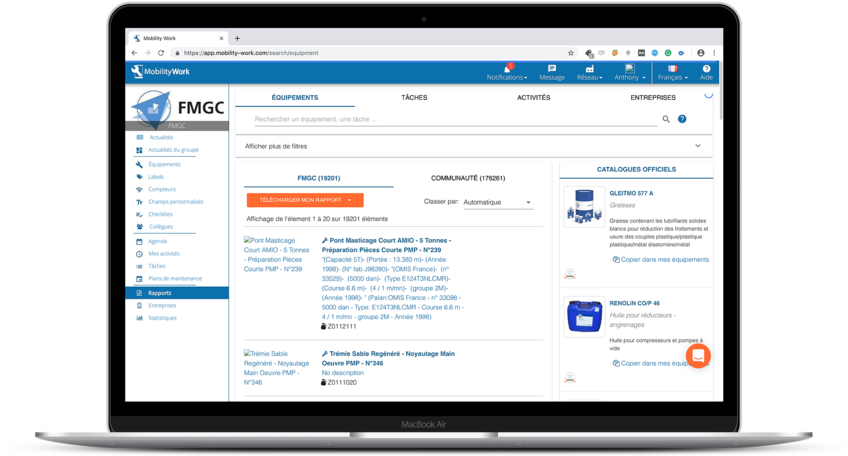
Access the official product sheets of Mobility Work suppliers
Once your sourcing operations are successful, make sure you control supplier risk from end to end. By equipping themselves with next-generation SRM tools, procurement teams now have real-time visibility into the activities of their suppliers and greater control over supply flows.
Industry 4.0: reactivity and performance
The introduction of the IIoT (Industrial Internet of Things) has led companies to reconsider their approach to the supply chain. Decentralized, more responsive, closer to production teams...
Every day, the manufacturing industry generates and collects a huge amount of data. But few organizations are still exploring its full potential. However, systematic data analysis gives an organization the ability to understand its points of friction and to automate its purchasing processes.
IoT: between operational and support
Even today, one of the major problems of Purchasing teams is to meet the needs emanating from the production chain as soon as possible. However, the lack of communication between these teams can make the task particularly arduous. Industry 4.0 solutions not only allow you to respond to production demands more quickly, but also to predict them.
IoT allows you to connect equipment, control panels, but also information and management systems at all levels of your company. This form of interconnectivity is found in the concept of smart manufacturing. This 4.0 production method promotes the streamlining of planning, production and logistics processes in the factory. Ultimately, this data management and analysis system brings new added value to the production chain.
Optimize your industrial maintenance
Get your equipment talking! Install smart sensors at every stage of your production chain. Collect real-time information on the status of your equipment. Program alerts based on a critical threshold. Plan your industrial maintenance interventions via your new generation CMMS. Plan your procurement operations according to the actual needs of your maintenance teams. This is what we call “Purchasing 4.0".
Currently, most companies have opted for a “just in time” strategy: reducing stocks, eliminating downtime... As a result, maintenance teams play a key role in factory productivity. However, the data collected by your IoT sensors are a real gold mine for deploying a predictive maintenance strategy. Data collection and analysis, as well as machine learning, lead to highly accurate measurements of overall equipment efficiency (OEE).
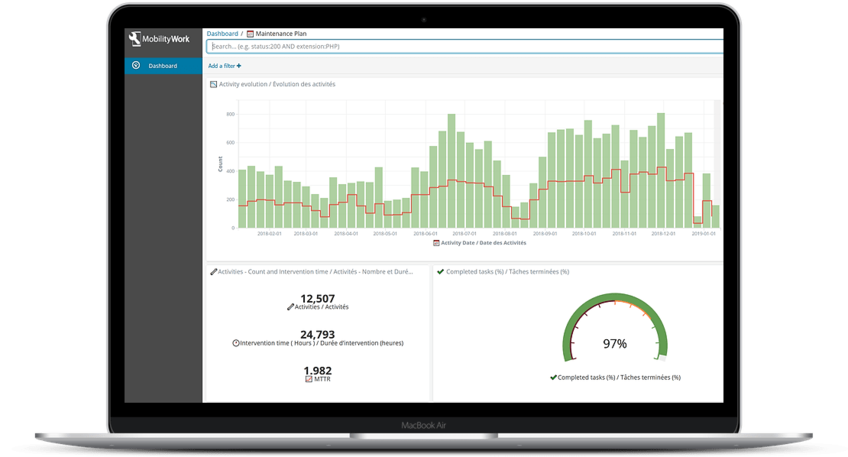
Analyze your production line data in real time
Thus, by analysing the consumption patterns of the production chain (consumables, spare parts or even equipment), but also of end customers, the Purchasing teams support operational performance while reducing company costs.
According to a study by Capgemini dating from 2016, only 5% of the companies surveyed said they were satisfied with the current state of the digital transformation of their supply chain. The authors also argue that the coming years will be decisive in this area. Organizations will therefore need to accelerate their transition and establish a true culture of change if they want to be able to exploit the opportunities of Industry 4.0 and maintain their competitive advantage.
Any questions?
Contact us to discover the first CMMS that can be deployed in 3 weeks.