Purchasing strategy: definition and application


Traditionally, the primary role of the Purchasing function is to ensure the availability of raw materials, equipment and industrial consumables, as well as the services required for production. As the supply chain structure evolves, buyers are taking on new responsibilities. From supplier management to innovation, including CSR, the impact of this function is measured at the level of the supply chain. An organization's propensity to develop will therefore depend in part on its ability to develop a sustainable procurement strategy. This will in fact make it possible to achieve supply chain excellence by aligning procurement activities with company objectives and by optimizing expenses.
The purchasing function in industry
Over the last decade, the Purchasing function has undergone a profound transformation. Its teams occupy a strategic position in that they are a privileged intermediary between the company, its partners and its customers. Far from the image of the “cost-killer”, it is now one of the pillars of production, innovation and CSR within the company. The Purchasing strategy also reflects the vision of an organization with respect to its market.
The primary goal of a Purchasing strategy is therefore to provide teams with a set of methods and best practices that meet the main concerns of the company. First, it contributes to its profitability by allowing it to reduce superfluous expenses, as well as delays throughout the supply chain. In this perspective, it must offer new opportunities for improvement in terms of innovation, production or delivery, in particular through better management of supplier relationships.
The essentials of purchasing strategy
Through its strategy, a company provides its buyers with a frame of reference. It therefore goes without saying that it transcribes the main missions of the function. By integrating the following elements during the reflection phase, you will be in a position to develop a concrete strategy and give your teams the elements they need to achieve their goals.
The cost, time, quality triangle
Sourcing, outsourcing, negotiation are all levers that Purchasing has at its disposal to act on procurement costs. In the collective mind, the Purchasing function is often associated with the need to reduce costs. In truth, this is a truncated vision. Although optimizing expenses is an integral part of their business, the impact of their activity is also measured on the production chain. They must be reactive to deal with unforeseen logistical flows. By developing privileged relationships with industrial suppliers, they in fact contribute to the good respect of deadlines, as well as to continuous quality improvement.
Supplier relationships
It is now up to the Purchasing Department to identify the industrial suppliers most suited to the needs of the company. Sourcing requires adopting a proactive approach to market analysis, auditing the various industrial suppliers and streamlining the panel. In fact, this is a complex exercise involving a multitude of factors: price, technical nature of the products sought, risk, competitive environment, etc. When identifying its supplier panel, the organization primarily seeks the adequacy of their respective strategic visions.
Next-gen tools, such as Mobility Work HUb, improve the relationship with your industrial suppliers. From their Mobility Work CMMS, maintenance experts can consult official catalogs and company sheets.
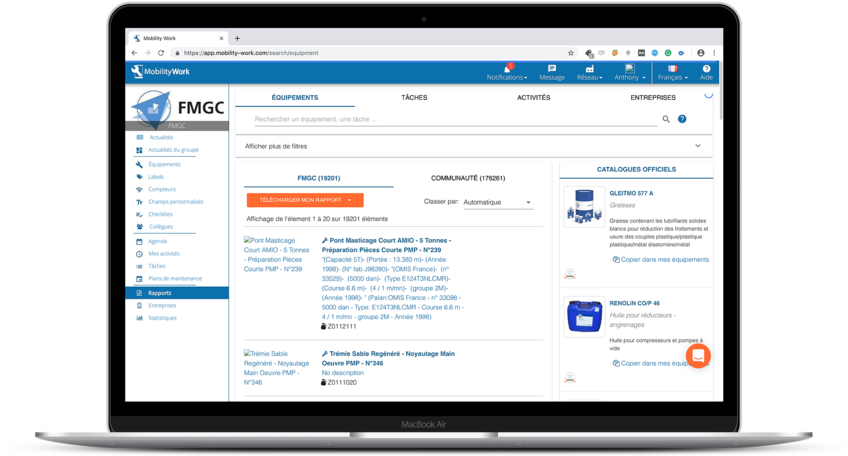
Consult the official catalogs of Mobility Work Hub suppliers from your CMMS
In a second step, the teams rationalize the panel to keep only the key partners. To do this, it is sufficient, for example, to study the volume of orders over a given period and to identify the suppliers that the company requested the least. On the other hand, it will be possible to establish real partnerships with the most recurrent suppliers. This approach can give the buyer an advantageous position when negotiating supply contracts. In particular, this allows them to benefit from preferential rates and to reduce supplier management costs.
Innovation
In recent years, a growing number of companies have chosen to integrate the problem of innovation into the prerogatives of Purchasing. Indeed, their strategic position allows them to detect the innovative potential of their partners. They are thus in a position to match internal needs (renewal of the machine park, reduction of industrial maintenance intervals, etc.) with the expertise of suppliers, who in turn have a test environment for the development of their project. In particular, this new form of partnership allows stakeholders to share the risks and benefits of innovation. This is the principle of co-innovation.
To guarantee the long-term success of such an adventure, it is nevertheless essential to share and nurture a common strategic vision.
CSR
Corporate Social Responsibility (CSR) is currently occupying an increasing place in Purchasing strategies. The integration of a “CSR charter” meets the double objective of compliance and reputation of the company with its end customers.
To respond to this, teams have the possibility of conducting audits of tier 1 and higher suppliers in order to check, among other things: the origin of raw materials, the modes of transport chosen, working conditions, etc. A real sourcing challenge, some companies do not hesitate to integrate this CSR charter into their supply contracts.
How to develop your purchasing strategy?
A Purchasing strategy is not built by chance. It is unique, made “tailor-made”. It is the result of a thorough reflection, of a thorough knowledge of its sector of activity. Finally, it is based on a set of data collected within the company and its possible affiliated entities, from its partners and within the market.
Ecosystem analysis
In order to develop a strategy that is as close as possible to its real needs, it is recommended to draw up a map of the company and its ecosystem.
By combining their own monitoring tools with Industry 4.0 predictive analytics solutions, operators are able to accurately measure the current state of an organization. The data collected across the entire value chain also allows them to identify weaknesses and strengths. The aim is to identify the main actors in the supply chain, their respective roles, but also the processes and protocols governing their activities. Incompressible expenses, superficial costs, sources of income: drawing up a company's cost structure is an essential step in optimizing it.
As important as this analysis is, it must always be accompanied by a thorough study of the environment in which the organization operates. To obtain a strategy that is both ambitious and realistic, it is necessary to identify market threats and opportunities. To do this, the Purchasing teams must identify the actors: end customers, potential partners, suppliers and distributors, competitors... This study may also focus on consumer preferences or the practices of competitors.
Define your priorities and goals
Priorities are often associated with the vision of the company, with its global policy. Defining your priorities means thinking about a balance between your global vision, the resources available, and the opportunities for growth and the obstacles you may face. Among the most commonly cited priorities, we find among others:
- Cost reduction
- Supply chain risk management
- Optimizing supplier relationships
- CSR
- Improving sourcing activities
- Total Quality Management (TQM)
Strategy, on the other hand, can be seen as the logical outcome of corporate policy. Even if the main objective of every company is to improve its turnover, this alone cannot constitute the basis of a sustainable strategy. It is necessary to consider objectives specific to the structure, echoing internal priorities and policies, and rooted in the reality of the market. Likewise, a Purchasing strategy would be incomplete if its only objective was to reduce procurement expenses.
There is a simple approach that allows Purchasing teams to better understand their goals: SMART. This acronym refers to a set of criteria that the elements of a strategy must meet to ensure its sustainability.
- Specific : the objectives must be detailed and correspond to the specificities of the organization. They respond to the issues raised during the preliminary analysis phase.
- Measurable : operators must be able to quantify their objectives in order to follow their evolution and to revise their trajectory, if necessary.
- Assignable : a defined number of actors responsible for achieving them must be assigned to each objective. The aim here is to structure the supply chain and to empower its operators.
- Realistic : although ambitious, a company's goals must nevertheless be realistic and achievable.
- Time-related : in order to guarantee their implementation, it is important to establish a chronological framework (start, end and key dates) for each objective.
Identify your levers of action
Once the objectives are clearly expressed, it is necessary to define the means to achieve them: process and methodology, actors, tools, allocated budget...
As part of a Purchasing strategy, for example, we will seek to define a set of criteria for selecting suppliers. To do this, it is recommended to proceed by category of Purchases. By applying Pareto's law, it is possible to prioritize purchases into three categories A, B and C. Although the latter represents only a small part of the total volume of purchases, it is however often made from nearly half of suppliers. These purchases are considered to be “non-strategic.” Without neglecting them, they should be streamlined using successful processes. In the same way, a budget can be allocated to each of these categories.
After the selection of suppliers, comes the validation of operations. There is a growing number of agile and easy-to-use solutions on the market to optimize validation processes. Depending on the type of purchase (strategic or recurring) or the supplier profile, some procurement operations can be automated. Smart sensors, CMMS software and next-generation procurement management are all Industry 4.0 tools for automating the supply chain. Integrating into the strategy an order schedule, the conditions and the delivery rate of certain consumables, for example, allows teams to gain in reactivity and efficiency, but also to focus on more strategic purchases.
Mobility Work is the first platform dedicated to connecting industrial suppliers and maintenance experts. Mobility Work Hub was designed as a real platform for collaboration between supply chain actors.

Simplify interactions with your industrial suppliers thanks to Mobility Work
In this perspective of performance, the importance of good supply management software should not be overlooked. This reduces the risk of errors, delays, and payments, but also simplifies the sourcing process and automates orders. From the first contact to payment, operators have control of every step of the process.
Identify key indicators
Regular monitoring of activities will ensure the success of the strategy. It is essential that each team, each operator has key performance indicators (KPIs) to refer to. Whether it is the evolution of costs, the average time it takes to process an order or the level of stocks, these must be defined in advance, in order to measure the success of operations.
While it used to be a time-consuming activity, monitoring indicators is now easier thanks to emerging technologies, predictive analytics, and big data.
As Industry 4.0 progresses, procurement strategies will continue to evolve. The main thing is to stay as close as possible to the needs of the organization, to understand its vision as well as the environment in which it operates. A good strategy cannot be thought of in isolation: it must be designed with the teams concerned, with its partners and for its end customers. Mobility Work Hub is the first tool dedicated to relationships between industrial suppliers and their customers.
Any questions?
Contact us to discover the first CMMS that can be deployed in 3 weeks.