How to reduce production downtime thanks to CMMS?


Limiting the number and duration of production shutdowns is one of the main missions of maintenance teams. By relying on a powerful CMMS, they can be more efficient and make the company more productive.
The consequences of production stoppages
Whatever their cause, production stoppages have a considerable impact on industrial activities. Each production stoppage can impact production and maintenance costs, customer satisfaction, and inventory management.
A substantial cost
The first visible impact of a production stoppage is financier. The True Downtime Cost (TDC) is therefore a key indicator of industrial performance.
Direct loss from the sale
This is the worst case scenario: equipment that breaks down is a “bottleneck machine”. Its cessation immediately leads to a total halt in production, which has a direct financial impact on the activity.
In addition, to this shortfall, we must add:
- the cost of fixed expenses (rental of buildings, salaries payable, taxes...) );
- possible late payment penalties;
- corrective maintenance costs.
Corrective maintenance costs
In the best case scenario, if the broken equipment can be replaced almost instantaneously (at least temporarily), the production stoppage will then be limited to a disturbance.
The downtime costs are then limited to the costs of corrective maintenance., which can however be high depending on the equipment.
The impact on customer satisfaction
Apart from the direct financial impact, a production stoppage is also synonymous with delay, lack of visibility and therefore customer dissatisfaction.
Delays in production and delivery
A production stoppage that causes delivery delays to push a customer to go elsewhere, at least temporarily.
In addition, if you do not know when the failure will be repaired, theuncertainty in terms of deadlines can then push your customer to go elsewhere, often permanently.
The impact on inventory management
Production stoppages often have a impact on stocks. For example, in the event of a machine failure in the packaging line, unpackaged products accumulate and increase inventory, without it being possible to send them to the customer.
If these products are perishable goods, the accumulation of stocks then quickly turns into an accumulation of waste, which also generates treatment costs, which are sometimes significant.
Finally, operating in degraded mode also has an impact on this “storage” aspect, since this less optimal way of producing risks generating more waste and waste.
How to reduce production downtime thanks to CMMS?
The use of a CMMS is the main way to limit the frequency and duration of production shutdowns as much as possible.
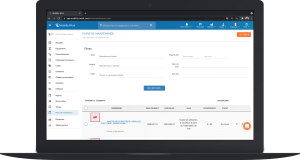
Easily create maintenance plans in Mobility Work CMMS
Develop preventive maintenance
The main way to avoid production stoppages is to develop the preventive maintenance. This allows, through the maintenance and review of a company's assets, to maintain optimal operating conditions in order to reduce the probability of an unexpected failure. While production shutdowns may be necessary from time to time, they are less expensive when properly planned.
The implementation of planned maintenance involves creating and implementing preventive maintenance plans adapted to each machine. To do this, the best solution is to have a CMMS software that offers a Functionality: maintenance plans easy to use and flexible.
Anticipate your spare parts needs
Production shutdowns sometimes last longer than they should due to a lack of spare parts available. To avoid this type of situation, the use of a CMMS integrating a spare parts inventory tracking function is necessary.
The Mobility Work application thus allows technicians to fill in the spare parts they have taken out of stock for each intervention, including on a smartphone.
Purchasing and store departments can thus follow the evolution of stocks, be alerted when a minimum threshold is reached, and restock before the parts run out.
Any questions?
Contact us to discover the first CMMS that can be deployed in 3 weeks.