Increasing productivity thanks to industrial IoT: potential and challenges

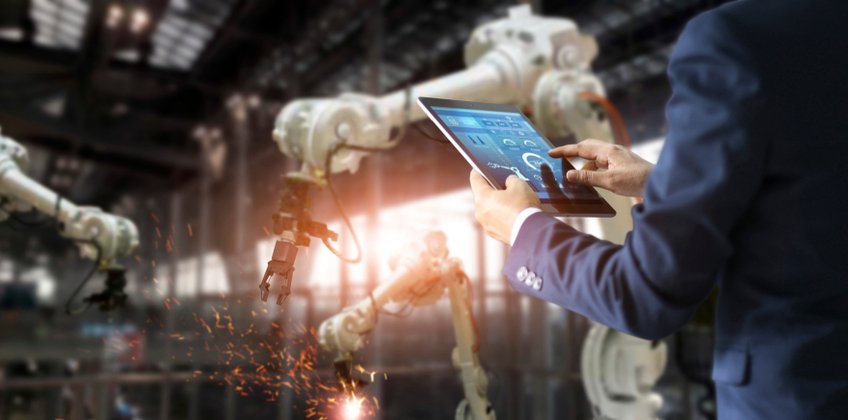
Industrial IoT is a new tool available to businesses to improve their productivity. To make the most of its considerable potential, it is important to understand the challenges involved in its implementation and the crucial steps to the successful deployment of the Industrial Internet of Things.
Committed to a process of deploying IoT within its industrial group, Didier Henry, who directs Setforge Engineering, shows us the different steps he followed and the main obstacles he had to remove in order to prepare for the deployment of IoT in factories.
Could you tell us about your business and the roles you occupy?
Setforge Engineering, which I manage, is the support company of Setforge Group, a subsidiary of Farinia Group, a specialist in forging, foundry and machining. As such, we are responsible for supporting theindustrialization of ranges in support of our sites and to carefully study all the new technologies And the innovations that could be of interest to Farinia Group.
The group's turnover is around 180 million euros with a dozen companies located in France. Approximately 50% of our activity remains devoted to the automotive industry, but we also work for all other sectors: “off highway”, aeronautics, oil, textiles, etc.
What is the concrete status of the use of IoT in your group's industrial activities?
For about 2 years we have been actively preparing the IoT deployment at our industrial sites, and we really launched it on a large scale a few weeks ago. Several sites have started work to connect the machines and we are in the process of setting up the communication platform.
What were the main preparation steps before deploying IoT on sites?
At first we took care of securing our industrial networks, before any machine connection, And as I was telling you, we are now moving on to the deployment stage on the sites.
What prompted you to develop IoT in your industrial group?
We are constantly looking to improve and optimize our ranges, a good part of our work being to improve processes to use machines to the best of their abilities.
Today, if we want to improve productivity, we need to find new spaces, because the variables in our known processes are under control, thanks to our long experience (some of our sites are nearly 100 years old).
To find these new spaces, we must therefore get to know our machines and processes better and therefore capture more parameters and associate them with real activity throughout the process.

Track your counters in Mobility Work CMMS
It is in this context that IoT is a valuable tool that connects space-time, production and machine data, including those we are not monitoring today, for discover the new spaces that I was talking about.
For example, it may be data that is already captured today by a machine but that is only used for internal functioning: vibrations, temperatures, environmental data such as humidity... We need to be able to associate fairly fine data with a scrap rate, a TRS (Synthetic Rate of Return) or productivity, to be able, either in real time or off, to carry out analyses and find ways to improve.
What do you think are the main obstacles to unlock for the implementation of IoT?
The first lock is that of the cost : contrary to popular belief, this IoT approach is on a Long ROI, the initial investment can be significant and the gains are worth exploring and based on improved future control. It is therefore important to structure the process well..
The second lock is that oforganization and security of networks : with IoT, we connect anyway In fine our Internet machines, which represents a certain challenge in terms of computer security. It also highlights the flaws associated with old automatons that are still in service. The human factor must also be taken into account, as maintainers are generally very skeptical about the idea of connecting a machine.
As for the third lock, it is technique. Indeed, it is not always easy to connect machines, automatons and sensors, of different generations and different brands, in an industrial environment, especially with wireless connections : there are pits, metal walls, etc.
Could you tell us more about the issue of the costs associated with the implementation of IoT?
There is 3 main cost factors :
- Theinterpreting data, dashboarding, etc.: for this we use the Diapason tool developed by our IT company SAFIR, which suits us very well;
- The game Lift protocol, storage, also via SAFIR, which we know quite well today;
- The game sensors and connection to PLCs, which we are still working on.
While the ROI to be expected from IoT is generally long, as I mentioned, there are still use cases with quick wins, for example on connected lines, we now have a real-time vision, shared by both operators and managers, including on smartphones. This allows us to have a high reactivity for maintenance, changes in tools, the anticipated production of support services: we quickly won a few TRS points.
Another example is the installation of sensors to measure energy and water consumption, allowing rapid actions to save.
What is the place of Mobility Work CMMS in your IoT strategy?
Mobility Work is our maintenance management tool. Thanks to this CMMS and IoT, we can marrying numerical data from machines with the interpretations of maintenance technicians.
In addition, Mobility Work will allow us to set up automated tasks based on sensor information and trigger inspections.

Analysis of maintenance data in Mobility Work
What advice do you have for businesses considering using IoT?
In general, I would say that it is necessary take the time to choose reliable suppliers and who offer solutions adapted to its needs.
On the other hand, what seems important to me in the link between maintenance, IoT and production is to Reconciling production data with machine data. For example, alert levels may be different on the same machine depending on the part being produced.
Finally, what do you think are the major upcoming trends in industrial IoT?
In my opinion there will be 2 major trends in industrial IoT in the coming years:
- the data will be increasingly sent back to the Cloud, therefore in a universe quite far from the field, to make fairly advanced analyses using artificial intelligence in particular;
- at the same time, some sensors will be capable of process data directly without outside help, thanks to their own calculations and their own interpretations, to allow immediate reactivity on the machine.
In my opinion, these 2 trends will develop in parallel.
A big thank you to Didier Henry for his testimony and his availability!
Any questions?
Contact us to discover the first CMMS that can be deployed in 3 weeks.