RCM: Definition and principle of implementation

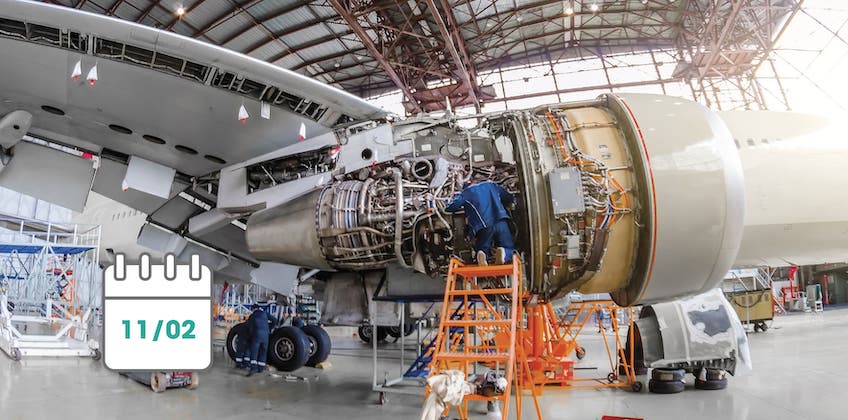
RCM: Definition and operating principle
La maintenance focused on reliability, or RCM (Reliability-centered maintenance), is an industrial maintenance technique based on the analysis of system functions, consequences and failure modes of functional assemblies or components. This method consists in looking for the most profitable maintenance technique while limiting the risks of failure in an optimal context for the operator.
Easy to set up, RCM differs from current practices and standards because it is essentially based on common sense and organization; it is in fact reflected in the constitution of a project group involving different actors from different departments, and in the use of analysis tools that are well known to maintenance departments, and by the use of analysis tools that are well known to maintenance departments. Applicability and profitability are at the heart of this approach, which tends to rationalize each maintenance decision.
Reliability-centered maintenance is more broadly part of a strategy of Lean maintenance.
Reliability-centered maintenance: Definition and implementation
Born in the aeronautical sector in the 1960s, then later generalized to the rest of the industry, the RCM method involves the use of various tools well known to maintenance professionals, including two main tools, which areFMEA (Analysis of failure modes, their effects and criticality) and the decision diagram. It also uses other tools such as criticality matrices, various process validation techniques, and a solid spare parts management strategy.

As its name suggests, RCM focuses primarily on the reliability of equipment when defining preventive maintenance activities, and on maintaining its design reliability. This concept is at the heart of the strategy for planning preventive or predictive maintenance interventions.
Before even starting the Reliability-centered maintenance analysis, the following questions should be asked:
- What are the normal operation and performance standards of the equipment?
- How does the equipment not meet these standards?
- What are the causes?
- What are the consequences?
- How can these failures be anticipated?
- What action can be put in place to make up for the lack of a proactive solution?
Once these questions have been studied, the implementation of an RCM approach consists of 7 main steps:
- System selection and information collection
- Define system boundaries
- System description, block diagram
- Definition of functional failures and system functions
- Analysis of failure mode and its effects
- Realization of a logical decision tree in order to prioritize the needs of the function via failure modes (see below)
- Selection of a suitable, applicable and effective preventive maintenance task.
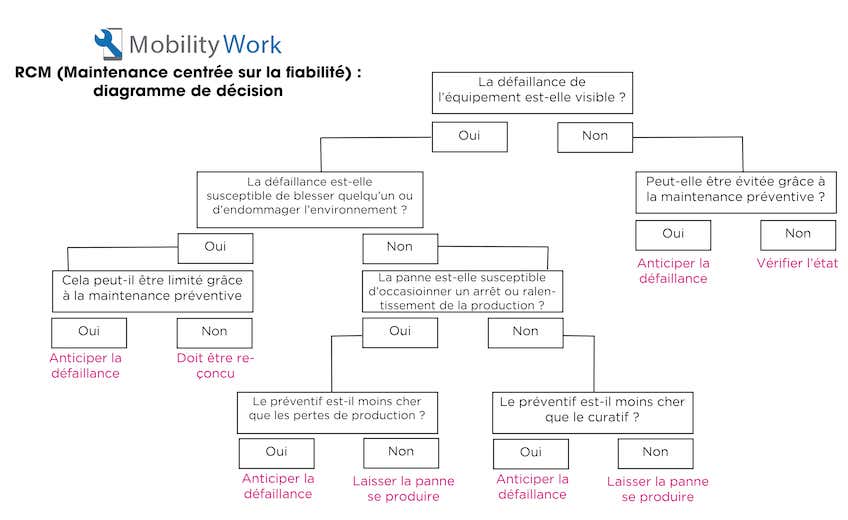
The decision diagram is an essential tool in the RCM approach: it involves defining the tasks that will protect the equipment (safety and functional capabilities).
Also to read: Use management tools to control industrial maintenance
Reliability-centered maintenance thus provides operators with a framework that allows them to monitor, analyze, anticipate and better understand their assets, in order to achieve a planned, achievable and profitable maintenance strategy. In addition to the analysis tools mentioned above, other management tools can contribute to the planning and sharing of operations, such as your computer-aided maintenance management software (CMMS). Thanks to its integrated big data tool, Mobility Work indeed helps you to determine the most critical equipment and the most penalizing of your machine park thanks to customizable indicators: equipment that breaks down the most frequently, the most recurrent problems, the most expensive equipment... the real-time analysis of all your maintenance data in the form of customizable criticality matrices helps you confirm your analyses.
Watch our video tutorial: How to analyze the criticality of my maintenance in my CMMS software?

Mobility Work's analytics tool offers a dynamic interface, and helps you make the best decisions through real-time analytics. Here; a “maintenance technician/labels” criticality matrix
The 4 principles of Reliability-centered maintenance
Maintain system function
This principle may seem surprising, because it favors the system function over the equipment itself, which is what preventive maintenance recommends: it thus makes it possible to know the expected result, and thus to consider the preservation of this result as the main objective to be achieved.
Identify failure modes
In response to this first objective, which places the preservation of the system in the first position, it is necessary to identify the specific failure modes at the origin of the loss of function or functional failure of the equipment, which are sometimes difficult to detect, and of a varied nature. It is at this stage that the various analysis tools come into play.
Prioritize functional needs
It is then necessary to determine the order or priority assigned to the budgets and resources allocated: in fact, not all functional failures and by extension their failure modes and associated components are equal. Their level of importance must therefore be assessed.
Select appropriate preventive maintenance tasks
After determining the failure mode and establishing priorities, appropriate preventive maintenance actions should be put in place. Each action must be applicable and effective, and can be planned in your CMMS. The Mobility Work maintenance management platform helps you make the transition from curative to preventive: labels to categorize tasks, sharing information about equipment within the community, task planning, rapid analysis using the analytical tool, etc.
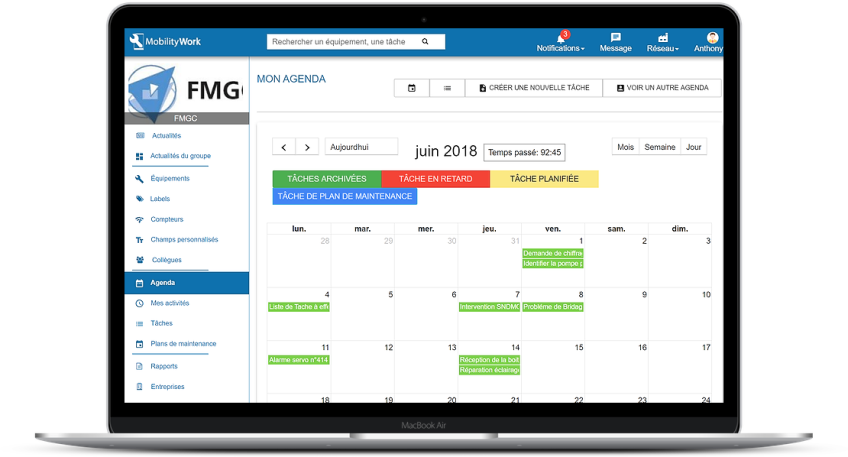
Plan your maintenance routines following an RCM analysis using the calendar feature of your Mobility Work CMMS. The tasks in yellow are scheduled tasks
The benefits of Reliability-centered maintenance
Identifying failure modes and their consequences for each critical piece of equipment contributes to ensuring its sustainability: the main objective of RCM is therefore initially financial. This strategy aims in fact to reduce the life cycle costs of the equipment as well as to increase production capacities, because it makes it possible to ensure the proper functioning of the machine in conditions of optimal reliability and availability.
Thanks to the Reliability-centered maintenance method, it is also possible to reduce industrial maintenance costs by adopting a preventive or even predictive maintenance strategy rather than a curative one: the aim is to anticipate degradation before it becomes too complicated and expensive to repair. Other ancillary expenses can also be avoided using this method (labor, energy expenses, production losses, etc.). This approach thus makes it possible to achieve a balance in the cost and efficiency of maintenance. Maintenance expenses are thus better invested.
Human benefits should also be mentioned: improved working conditions due to better organization, a less stressful environment and therefore less prone to risks, increased motivation (better understanding of processes and therefore better asset management, direct involvement of actors at several hierarchical levels, teamwork). Following the completion of the RCM analysis, all data is compiled, which makes it possible to document the requirements related to the specific design and maintenance of all key assets. Documentation can be stored directly in your Mobility Work community CMMS solution, accessible to all plant departments.
While traditional improvement approaches already deal with these types of problems, the particularity of Reliability-centered maintenance lies in the step-by-step framework it provides, which thus makes it possible to deal with all questions at the same time, as well as to involve all stakeholders.
In conclusion, an RCM approach is based on precise organization and standards: the use of a new generation maintenance management solution such as Mobility Work CMMS supports you in planning your interventions, managing your documents, the generalization of your best practices and quality standards, the generalization of your best practices and quality standards, the measurement of your KPIs and your decision-making.
Are you interested in maintenance management and want to know more in order to increase your productivity and save money?
Any questions?
Contact us to discover the first CMMS that can be deployed in 3 weeks.