History of industrial maintenance

Industrial maintenance: definition and history
Today's ever-changing marketplace is pushing businesses to adopt effective asset management strategies in order to gain a competitive advantage. The implementation of an effective maintenance program is at the heart of the proper functioning of a business. The maturity of industrial maintenance is essential and facilitates the study of performance and competition.
6 levels of maturity for a maintenance service
Each company organizes its maintenance department differently depending on the size and activity of the plant, and according to different functional and cultural guidelines. Even if these are decisions taken by management, industrial maintenance technicians are the first to be called into question in the event of a problem in their service, which proves to be problematic because it is very often neither their expertise nor their professionalism that must be questioned but the fact that the company is not sufficiently equipped. The deployment of a Next generation CMMS makes it possible to considerably improve, facilitate and streamline daily maintenance routines. The 6 levels of maintenance maturity presented in this article will help you assess the status of your daily maintenance routines.
1. Level 0 maintenance
Although in 2018, many advances such as Industry 4.0, IoT (Internet of Things) and sensor data were accepted, recognized and appreciated by many companies, many still neglect the management of their maintenance. The main problem is the total lack of traceability of maintenance, whether on paper, Excel file or asset management software. This level of maintenance maturity is characterized by the fact that no one really knows what is going on in the business and there is absolutely no information available about a failure or any other maintenance intervention. In this case, no preventive routine was carried out and no regulations were followed. Spare parts are not organized and there is no established system to control inventory. If there is no control system, it is generally an archaic and inefficient system that results in unnecessary expenses. Level 0 maintenance completely disrupts team spirit and all internal communication. And unfortunately, even in 2018, some businesses are still following this maintenance model.
2. The “paper” maintenance of the 80s
In the 1980s, maintenance and monitoring of operations were mainly carried out on paper documents. Although more advanced than level 0 maintenance, it remains very rudimentary compared to maintenance management software or Excel files, which did not exist at the time. Each maintenance intervention is recorded in the intervention book and presents a very short summary of the action. This data has nothing to do with the information available in today's asset management software and includes the date and time of the intervention, the equipment involved, the person who performed the action, the time required, and the description. In Mobility Work, the first maintenance management platform, you can also attach photos, videos, or any other document.
“Paper maintenance” is generally stored in a large cabinet in your maintenance department; it is therefore very difficult or even impossible to find or highlight an intervention.
3. Excel CMMS
Created in the early 90s, Excel CMMS are very simple and allow spreadsheets to track maintenance operations, which automatically trigger closure reports recorded in spreadsheets. Quality, ranging from a simple board to programming, depends on the level of technical skills of its creator.
Excel-based maintenance software is often the first step for a company to monitor its maintenance operations. Unfortunately, the Excel file is often limited in terms of operational planning.
4. Access CMMS
Access CMMS can be created by an IT specialist as well as by an intern. Slightly more advanced than its Excel equivalent, this maintenance software integrates databases and above all makes it possible to plan preventive and regulatory maintenance operations on a calendar basis.
The problem often lies in the size of the database, which will grow and, at some point, significantly slow down the system until it becomes unusable. Access CMMS are certainly better than an Excel file but are very difficult to maintain.
5. Industry 1.0 maintenance solutions
Industry 1.0 CMMS are the most common in businesses. This type of solution often makes it possible to manage tasks, maintenance operations, spare parts and intervention requests.
The problems with this type of old-fashioned industrial maintenance software are that they are often cumbersome to set up, difficult to use, do not have a user-friendly interface, and are not in a position to perform valid analysis based on stored data. This is also the reason why this type of maintenance solution is perceived as a burden by employees and is therefore very difficult to deploy.
6. Industry 4.0 CMMS
The best tool to manage your industrial maintenance effectively is a 4.0 CMMS solution, which offers a user-friendly and intuitive design, as well as all the functionalities necessary to facilitate your interventions. The main objective of such a solution is to add value to the company's maintenance program. Obviously, this type of industrial maintenance management application can be easily adopted, because its design is inspired by the applications we use on a daily basis. Solutions such as Mobility Work use data from sensors connected to machines to automatically trigger tasks and allow you to exchange information within the first maintenance community.
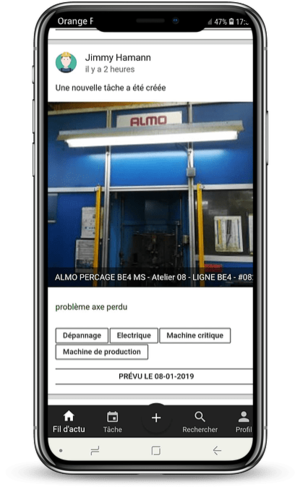
All the news relating to current interventions are available from the news feed of the Mobility Work mobile application, available on iOS and Android
Mobility Work is a simple and easy to use SaaS industrial maintenance management tool. Intelligent, our new generation solution is versatile and is placed at the heart of your business, covering all ongoing maintenance needs and allowing you to go even further. Mobility Work offers a comprehensive community platform connecting maintenance professionals, service providers, and machine and consumable manufacturers.
Are you interested in maintenance management and want to know more in order to increase your productivity and save money?
Any questions?
Contact us to discover the first CMMS that can be deployed in 3 weeks.