Maintenance: how to make the best decision?


It is not always easy to make the right decision for a maintenance service. The following few tips can help you optimize the decision-making process in your maintenance department.
Diagnosis of maintenance activities
Preventive (or systematic) maintenance
This can be divided into two parts: conditional preventive maintenance, which corresponds to maintenance conditioned by the condition of the property during a visit, and systematic preventive maintenance, which corresponds to the replacement of the property according to an hour meter/movement counter.
This approach is based on the statistical analysis of the failures of a machine or its main components. The community part of the Mobility Work next-gen CMMS allows you to have access to this data from your maintenance history, that of machine manufacturers or other members of the community.
These statistical data make it possible to calculate average values for the life of parts or an average time of good operation between two failures (MTBF: Mean time between failures). These can be automatically calculated from The Analytics tool.
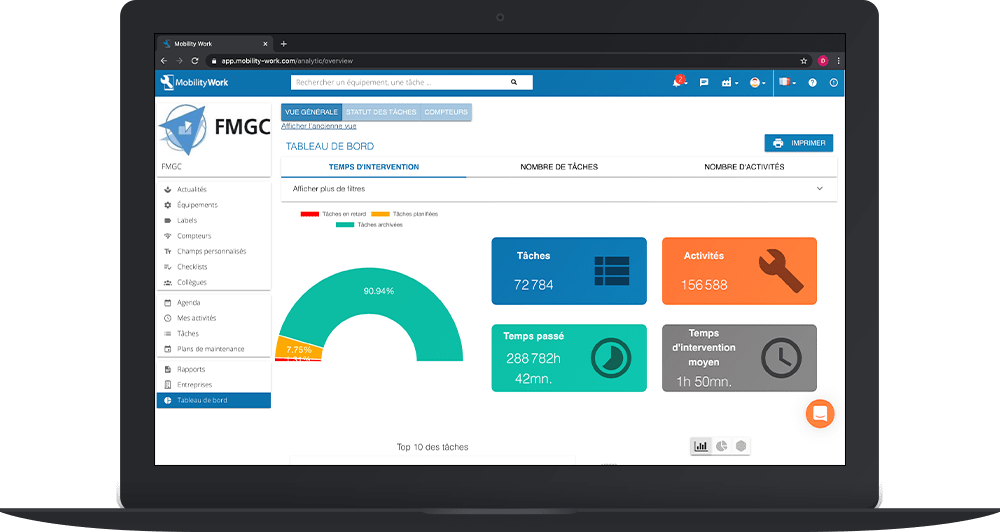
The forecasts of the Mobility Work analytics tool are based on data collected from thousands of users working on the same equipment.
In some cases, the probability of failure is independent of the duration of operation, while in others, the frequency histogram is clearly centered around an average duration with a smaller standard deviation.
Predictive or predictive maintenance
Statistical data also makes it possible to establish correlations between the probability of stopping and the evolution of a measurable operating variable (temperature, vibration, etc.). We then speak of predictive maintenance.
Vibrations, noise and heat are the warning signs of a potential problem, which is why it is important to analyze these signs. Operators are therefore of vital importance because they spend more time with their machines than anyone else. Automatic maintenance interventions can be easily planned from a value threshold in the Mobility Work maintenance application.
Curative maintenance
Above all, it is about eliminating the symptoms of a failure. Maintenance itself can take several forms. Troubleshooting is an operation that makes it possible to bring equipment back into working condition, and that takes place after stopping due to a failure.
Corrective maintenance
It's about eliminating the root cause of a failure. Systems for collecting information on failures quickly find their limits. Indeed, it is useless to have a large amount of information on failures if we do not analyze the causes of failures in order to eliminate them. It is a fundamental element. To improve the reliability of a machine, it is first necessary to know well the incidents that occur on the machine. To do this, a monitoring system must be set up. This makes it possible to combat the most frequent problems as a priority.
Definition of emergency
Communication with the various stakeholders is essential. The selection criteria should be defined in advance. The priority given to the customer seems to be a matter of course. The possibility of Tag critical machines in Mobility Work CMMS allows teams to be quickly informed about the machines that require the most attention.
Types of interventions: guide and definitions
Repair
It is the most well known form of maintenance activities.
Improvements and new works
Activities to prevent repetitive breakdowns
- piecemeal improvements to reduce repetitive failures:
The aim is to identify the weak points of the installation and participate in the development and implementation of improvement programs.
- piecemeal improvements to increase the lifespan of machines:
These improvements require the analysis of the materials used to manufacture the parts in order to identify the most resistant ones, to select better quality parts, and to design new systems or organs.
Activities to reduce repair time
- Fault diagnosis analysis:
the use of self-diagnostic devices saves valuable time on the time spent looking for the cause of the failure.
- Study of methods for replacing parts:
this may involve the replacement of sub-assemblies rather than isolated parts.
Essays
It's about testing the equipment to check its capability.
Provision
It is a question of communicating the availability of the machine and possibly giving instructions to avoid the problems encountered.
Management of spare parts store (s)
Spare parts management is a matter of inventory management techniques. However, there are some particularities:
The existence of the spare part
In some cases, the machine is no longer manufactured and the supplier no longer keeps the reference part in stock. The company must take the risk of ordering all the quantities it thinks it will need for the life of the equipment at once. When the cost of parts is high, it is possible to store mechanical parts in the form of blanks. Finishing operations are carried out only on request.
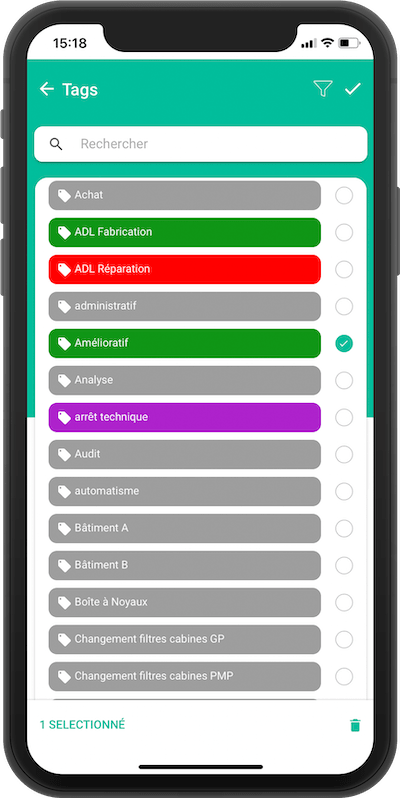
Access all the information on your spare parts from the equipment sheet in your Mobility Work application
The bottlenecks
In some cases, it may be necessary to split the equipment in order not to stop production.
Maintenance decision process
Define the 5 main roles
Each decision-making process consists of 5 different steps: advising, documenting, validating, deciding and acting.
Counsellor
Some people are in charge of providing advice on specific action plans, making proposals or finding alternative solutions.
Documenting
This stage involves consulting relevant stakeholders about proposed alternatives in order to provide relevant information, facts, and judgments from their own perspectives.
Validate
Those in charge must accept these recommendations and approve them before taking the next step. Those decision makers who have the right to veto. Their job is to determine if the action plan may be adopted, and not if he shalt to be adopted.
Decide
Then comes the final decision making. The courage that must be shown on this occasion is a virtue that is relatively uncommon, and it is on this occasion, once the decisive roles have been assigned that you can judge the courage of your collaborators!
When making difficult decisions, everyone must highlight the values that are most important to them: shareholders, employees or customers? Courage is about standing up for your point of view.
Act
Finally, it is time for action and for the implementation of the decision.
Are you interested in maintenance management and want to know more in order to increase your productivity and save money? Try our CMMS application for free for 7 days, and improve your maintenance management today!
Any questions?
Contact us to discover the first CMMS that can be deployed in 3 weeks.