Mobility Work at ID Logistics: CMMS at the service of logistics

Les maintenance management software (GMAO) are not only aimed at industrial companies. A new generation solution such as Mobility Work is thus used in other sectors of activity, and in particular in logistics and transport.
To better understand how this CMMS application improves maintenance, we met Nathalie Nerrière, Head of the company's Rouen site ID Logistics.
Can you introduce yourself and your business?
” ID Logistics is a French company of contract logistics, which was created in 2001. Its aim is to meet logistical needs of its customers by offering solutions adapted to each project. The group has 21,500 employees and 340 sites in seventeen countries.
We receive, store and prepare products on behalf of our customers. Depending on the products treated, the group makes the decision to mechanize its sites or not. So, I can say that no ID Logistics site is the same. I joined the group ten years ago and was responsible for a total of four sites. I am currently in charge of a semi-mechanized site on which a manager and three maintenance technicians operate.
How did you find out about Mobility Work CMMS?
I got to know Mobility Work through social networks. I liked the concept, so I presented it to the group during an internal innovation competition. We can ask ourselves “What is innovative about a CMMS?” The answer is very simple: the concept. I found the Mobility Work concept very innovative and the opposite of the other tools we knew.
So I contacted your teams, and a presentation of the application followed, which I found very fun. That's how we started working with Mobility Work.
How long do you estimate the time needed to set up the CMMS?
It's pretty quick. At the start, the Mobility Work team supported us and quickly presented us with the architecture of the tool. Once this first step was over, we sat down with the maintenance team and asked ourselves how we wanted to shape the tool, which in my opinion is an essential step.
Afterwards everything is very simple : the application is fun, you just need to use a regular computer, there are not a thousand options. Above all, we did not have to wait a year for all our parts in stock to be filled in to start using CMMS.
We started using the solution by entering our first few tasks; the tool is not blocking. Later, we filled in all our documents and established the connections. There are a lot of tools that remain unusable until the entire database is filled in, which is not at all the case with Mobility Work..
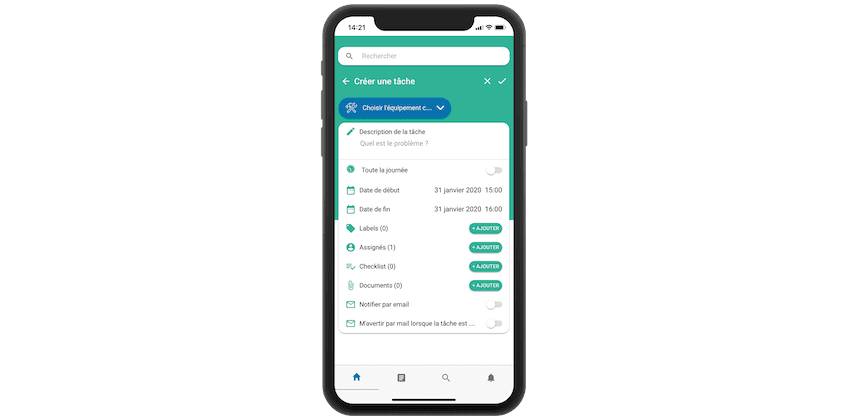
Thanks to a mobile CMMS tool, you can create your tasks in the field
What system did you use to manage maintenance before?
I have often had the opportunity to work on sites that were rather mechanized. On these sites, we used other software on the market; but not being in the pure industry, we needed a fairly flexible tool, and it is true that I have always found these solutions cumbersome, difficult to implement and not very intuitive.
How did the system change and the adoption of Mobility Work happen?
On the site in question, there was no maintenance management software yet, it was a big novelty for the maintenance team, which was quite resistant to the idea of using a CMMS. Rather, we operated the old-fashioned way, on paper, which suited them, but did not really allow access to site maintenance indicators..
In the end, to their surprise, getting started with the tool went quite well. The simplicity of the tool and its ergonomics meant that they adopted it very quickly..
What do you think are the advantages of this community platform?
On a daily basis, the community aspect does not necessarily serve me. On the other hand, I see a future within the ID Logistics group, the tool to facilitate knowledge sharing and exchanges between our various sites. In particular, this would allow us to access information in real time, to consult the stocks of parts at our colleagues, or even the troubleshooting sheets for common machines.
For example, right now, we are all experiencing significant delays on spare parts. Personally I am in Rouen, but my colleague who is in the south of France potentially has the same room in his store and it is interesting to know this thanks to the application and it makes things much easier. So I see more interest at this level and less at the inter-company level, because we are still very different from an industrial site.
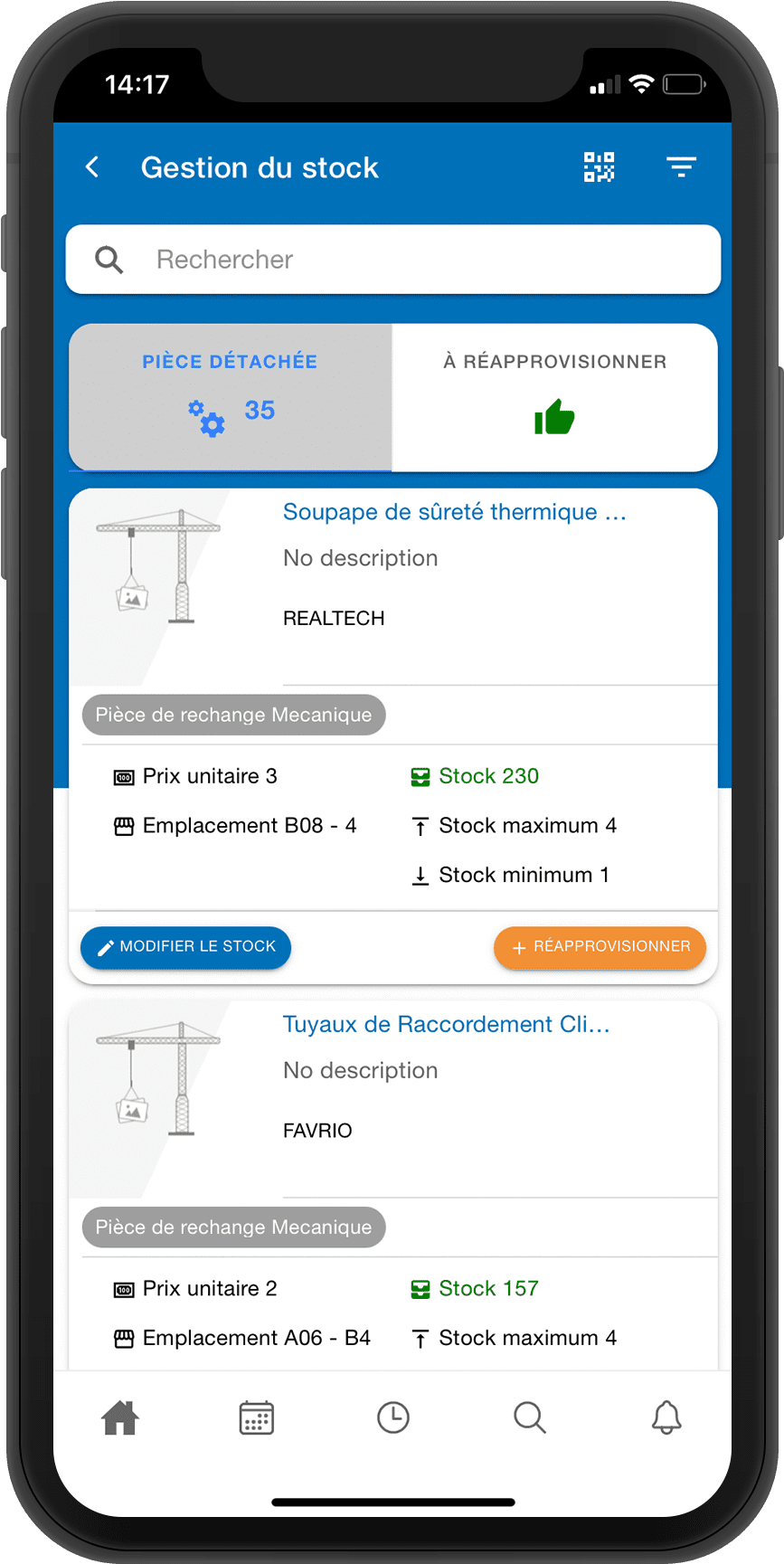
Manage your spare parts stock from your mobile CMMS
Have you been able to improve the management of your preventive strategy thanks to Mobility Work?
Yes, although I cannot necessarily talk about improvement since we were starting from scratch; on the other hand, Mobility Work allowed us to set up maintenance indicators. In a logistics warehouse, we call maintenance measure the statistical overviews of the tasks of preventive maintenance and curative or even continuous improvement, machine failure rates, etc. So it's quite interesting and we are already seeing results. If you had asked me the question a few years ago, I would not necessarily have given the same answer, even knowing my site very well.
What is the feature that you use the most and that you can't live without?
Maintenance technicians use the “task creation” function a lot, because it makes it possible to enter any intervention in real time, especially since the appearance of voice typing. This feature is a big advantage, especially as it is what frightened the maintenance team the most: when we talk about CMMS, we mean having to enter data, which can take a long time when we tend to run out of data.
Now, when a machine breaks down, maintenance technicians intervene with their telephone and, thanks to the voice input option, they can quickly describe the failure and report at the foot of the equipment.
As a site manager, do you feel like you have a better overview?
Yes, today I am, for example, in a position to say whether we are doing more preventive or curative maintenance, which is essential on a site.
Everything is entered in the CMMS: the maintenance of our production lines, but also that of our building. In logistics, building maintenance - also called “facility management” - is very important. Today, I know that 30% of my maintenance service time is taken up by the site's property management, something I would not have bet on at the very beginning.
“We are dealing with a modern tool, and it feels good.”
Tomorrow, tools like Mobility Work will allow us to know which system and operating mode is the most efficient. Today, we have the purchase cost, which is a good start, but we do not yet have the perspective to say: “We have such a high percentage of breakdowns with this system; it costs us so many spare parts every year, etc.” This will be the case later, if we deploy Mobility Work on several sites.
What are your company's future CMMS projects?
All our sites are different, and the needs of our customers are different, so we need a flexible and adaptable tool. With Mobility Work, technicians can manage their maintenance the way they want, because the tool does not require operation. The objective would therefore be to deploy Mobility Work on other sites; we are present internationally and we do not only mechanize France. A big advantage is therefore also that the application is available in several languages.
Are you satisfied with the responsiveness of our team?
I have nothing to say about responsiveness, it works well, especially the online support part that answers all our requests. During the implementation, my technicians often came to ask me, even though I did not necessarily master the tool better than they did. So I encouraged them to use the chat to contact the support team directly to ask their questions, and Indeed our requests are always taken into account quickly.
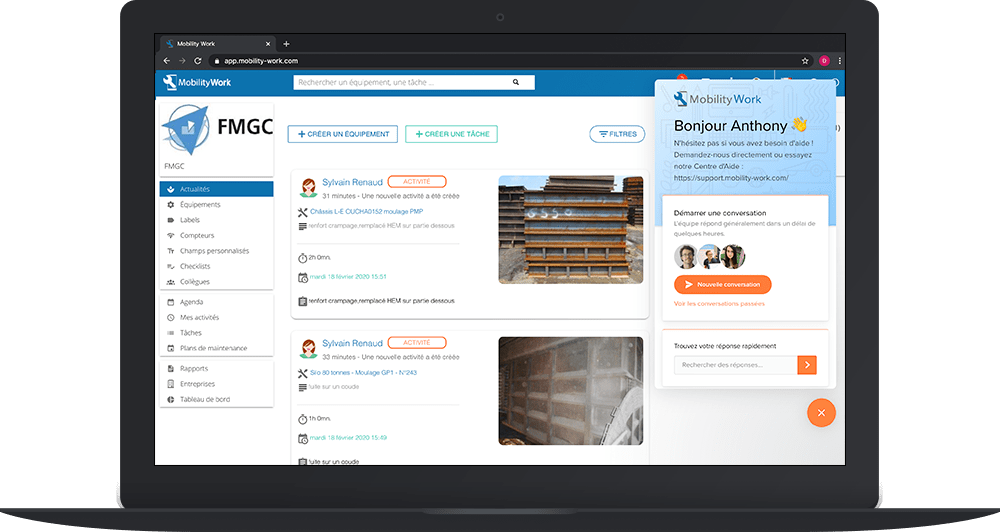
Contact our support team directly from your CMMS
I would also like to highlight the evolutions of the tool, at the initiative of customer feedback, which lead to its improvement. I am thinking of the voice input function, for example, which is probably due to a user request. In addition, news is communicated very quickly. We are dealing with a modern tool, and that feels good.”
Thank you very much to Nathalie Nerrière for once again giving us her testimony on her experience with the Mobility Work community maintenance management platform!
Any questions?
Contact us to discover the first CMMS that can be deployed in 3 weeks.