Mobile CMMS: Mobility Work at Danone

Franck Maillot, user of the GMAO Mobility Work and engineering and maintenance manager, has been working for the Danone group for eight years already. It specializes in maintenance and performance. A year ago, he joined the central engineering team in charge of maintenance issues and, more specifically, digitalization of the latter. Its field of action covers a set of no less than one hundred factories. Danone Waters, a branch of the Danone group.
Mr. Maillot, who had the opportunity to observe the GMAO Mobility Work in action has agreed to give us its testimony. He therefore explains to us how the application meets the requirements of the Danone Group, what are the areas for improvement and why large groups can also trust a start-up.
How did you hear about Mobility Work?
Maintenance has always been a major problem, placed at the heart of our thinking. Before we decided to embark on the Mobility Work adventure, I was doing a market study to scan a wide range of maintenance management solutions. We wanted to keep an open mind, so our study focused as much on classical tools, such as SAP PM or Coswin, as on the only interfaces, currently used in the group, or more innovative solutions, such as your CMMS.
We finally discovered your GMAO completely by chance, thanks to word of mouth. It was when we went to a trade show that we discovered the concept of this application and that it aroused our interest. Before we started, we wanted to observe Mobility Work at work in a company where the tool was already in place, in this case the FMGC in Loire-Atlantique, historic factory of Farinia Group.
Today, Danone continues to use SAP PM because it is the group standard, but our approach was aimed at bringing real added value to maintenance jobs, which unfortunately our current software does not necessarily allow.
Is Mobility Work CMMS already in place in your company?
Yes, we have implemented the application in two of our factories (Salvetat and Volvic), since the beginning of the year for the first and really a month ago for the second. These are our pilot factories, they allow us to verify that Mobility Work meets our expectations before we can possibly consider deploying the solution.
“What we note in the first place is obviously the ease of use. The application is very easy to learn and you can quickly get used to it.”
What are the advantages of Mobility Work in your opinion?
What we note in the first place is obviously the ease of use. La GMAO Mobility Work highlights this aspect and it is of course something that is of great importance to us. It is also just as essential for end users, who will have to use the tool on a daily basis. The application is very easy to learn and you quickly get used to it: so many points that motivated us to make this choice.

All the news relating to current interventions are available from the news feed of the Mobility Work application.
But there is something else: I would add that working with a start-up has several advantages. For example, we benefit from a very high degree of flexibility. We benefit from a solution that is constantly evolving and that has a very interesting way of operating. The objective for the Danone group is not in the end to have the GMAO for a single model, but to continue to develop this actor-contributor relationship, which makes it possible to send feedback and to continuously improve the solution. All businesses can freely contribute to this evolution and the positive effects are numerous.
How did the deployment go?
Deployment overall went very well and we had no doubts about that. The tool has been well received in the factories by our maintenance technicians, who are happy with the application. As far as pure field use is concerned, it must be admitted that the Mobility Work application represents a big advantage: the tool is mobile and very easy to use, everything is done to simplify the life of people in the field and that is exactly what we were looking for. On this side, we can say that we are very satisfied.
“It must be admitted that the application represents a big advantage: everything is done to simplify the life of people in the field and that is exactly what we were looking for.”
What is the feature that you use the most?
We mainly use the equipment management function, which I think is the most important. All the functionalities that come with it, such as creating activities or tasks, are just as essential.
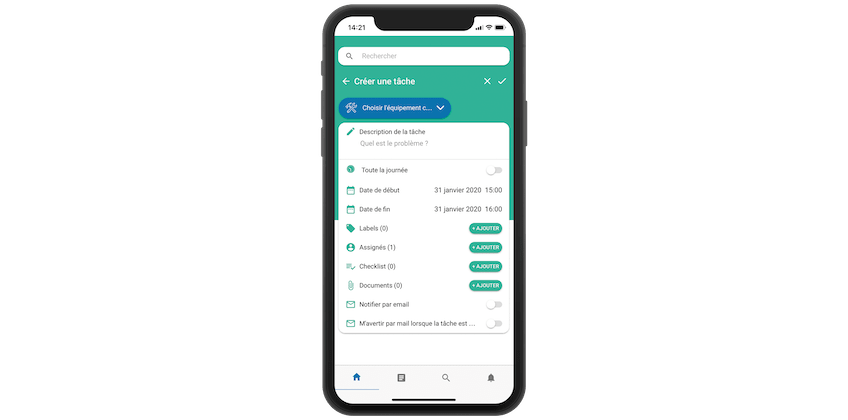
There are also functionalities that are not yet essential but will certainly become essential very quickly, such as the use of QR codes and quick access to our various equipment. These are very interesting options that save time, since the user can quickly scan a machine and find all the information he needs.
We must also talk about the analytical tool, which represents an enormous added value, as well as about The community aspect, which Mobility Work rightly highlights. This concept will make sense when the solution is deployed on more sites in a short time.
What are the future projects concerning CMMS?
Being responsible for bringing methodology to our factories, I would say that the tool is now proposed as a complement to the group's standards. We have the ambition to continue to develop the tool and to implement it in Mexico, in around twenty of our factories. We are even in discussions with our Chinese factories to go even further.
Our objective is really to convince as many infrastructures as possible attached to the Danone Waters branch and to make them aware that this tool can significantly increase their productivity. The advantage of factories in Mexico is that they are very similar in terms of operation, so the benefit of using all this community aspect is very real!
Are you generally satisfied with Mobility Work's responsiveness?
Yes, absolutely. I find Mobility Work's desire to constantly listen to the customer in order to find ways to improve the solution particularly satisfying. It is very valuable for us. We keep in mind that it is a start-up and that it is not always easy for a large group to embark on this path, each structure of course has its requirements. It is important for everyone to know their limits, and the subject must always be at least controlled, it is an essential factor.
It must be recognized that Mobility Work is based on a start-up model: agile and attentive. One of the other advantages of this tool is also its cost model, which breaks with all the GMAO conventions that businesses use today. The concept of risk remains very relative and it is an obvious competitive advantage...
My final message would be the following: large groups can be a bit cautious and reluctant to engage with a start-up. The modes of operation are indeed different and you have to learn to work together. Thanks to the ease of communication with the Mobility Work teams, we can all move forward together, remain responsive and maintain a very high level of service. We are finally in sync and everyone has something to learn from the other!”
Thanks to Mr. Maillot for agreeing to give his testimony. User feedback is at the heart of our approach and helps us improve our product on a daily basis.
Are you interested in maintenance management and want to know more in order to increase your productivity and save money? Plan A free video with our team to help you better manage your maintenance!
Any questions?
Contact us to discover the first CMMS that can be deployed in 3 weeks.