CMMS: Mobility Work at Carambar & Co

Jean-François Boudes is maintenance manager at Carambar & Co in Strasbourg, at the Suchard factory and user of Mobility Work CMMS software. The group, created in 2017, specializes in the production of candies and chocolates, and also owns the brands Carambar, Malabar, La Pie qui Chante, Krema, Pastilles Vichy and Poulain, and Poulain, spread over 5 factories in France.
Mr. Boudes is a convinced user of Mobility Work and a driving force for deploying the maintenance solution within the group; he thus agreed to review the key steps, challenges and benefits associated with the implementation of the Mobility Work next-generation maintenance management platform.
How did you hear about Mobility Work? What convinced you to test the product?
Jean-François Boudes : I joined Carambar & Co in March 2017. I had already accumulated 25 years of experience in maintenance, so I came to bring my expertise to the factory. When I arrived, I proposed a dozen projects related to maintenance, concerning the management of curative, preventive, improvised, spare parts, the training of maintenance operators, first-level maintenance, etc. Project number 8 concerned the implementation of a CMMS solution; indeed, the preventive was managed under Access at the time, the preventive part was managed under Access, the spare parts part under SAP, the curative maintenance operations were managed in a system Excel, but we didn't have a unified system to manage our work orders or analyze curative, preventive, and improvement maintenance costs. So one of my flagship projects was to deploy a maintenance solution.
The Carambar & Co group is in the process of being structured because it is still new. We thus met with the other maintenance managers of the group's factories on 11 December last, at the group's headquarters in Issy-les-Moulineaux. During this day, we attended a Mobility Work presentation. The solution was suggested to us by a person who had the opportunity to work with Marc-Antoine Talva (CEO of Mobility Work), who has now become IT manager at Carambar & Co, and who therefore proposed that Marc-Antoine Talva come and give us a presentation.
Having already identified our need to equip themselves with maintenance management software, the Strasbourg management fully followed me, and after attending this first presentation and seeing how easy it was to set up the solution, coupled with the need that other factories in the group had to equip themselves with a CMMS, three factories quickly had the solution tested: the Vichy factory (Pastilles Vichy), and that of Marcq-en Baroeuve (Carambar) and ours in Strasbourg, starting in January 2018.
I was immediately seduced by the user-friendliness of the tool, its ease of implementation, and the search engine function. The deployment costs are very low, especially if we compare them with the maintenance solution that I had to deploy in my previous company, which required very significant financial investments (the use of consultants for example) as well as very long deadlines. With Mobility Work, we succeeded in deploying a maintenance management solution in the space of 2/3 months. The deployment is certainly not yet complete, but it is really a very user-friendly tool and very easy to set up - in my opinion these are the main characteristics of this tool.
Is the Mobility Work tool already in place in your company? Can you tell us about its deployment?
Indeed, Mobility Work is already in place in Vichy and Strasbourg, and a deployment is also underway in the Carambar factory in Marcq-en-Baroeul (59). The other two factories are not yet committed to deployment at the moment, this is expected over a longer term.
Deployment within our factory was very easy: in fact, the advantage is that it is not necessary to use a very complicated machine tree, contrary to what other tools require. However, this ease of implementation partially misled us. Paradoxically, this required preparatory work to think about our machine tree, which had not been done well enough from the start, and caused us to waste time at startup. This issue has since been resolved.
All the news relating to current interventions are available from the news feed of the Mobility Work mobile application, available on iOS and Android
The second challenge we encountered during the deployment this time concerned line technicians, in particular the approach to get electromechanics to use the solution. We quickly encountered a small technical problem, which is that we are currently not equipped with mobile tools. We hesitated between the mobile phone and the tablet, finally opting for tablets in order to be able to benefit from a sufficient screen size, although these were less easy to transport. For technical and budgetary reasons, the acquisition of these mobile tools took longer than necessary, but they should arrive within 15 days. In the meantime, line technicians have already started entering their work orders on PCs, but the advantage of tablets is that they will be able to enter them wherever they are in the factory, especially at the foot of the line, and take photos, bring out associated documents, etc.
In parallel with this project to structure the maintenance service, we are also working on the implementation of standards; in fact, until now, the documentation was scattered. We therefore used the Mobility Work maintenance solution to set up standards so that technicians could easily find them from their tablets.
What kind of welcome was given to Mobility Work?
The reception was very enthusiastic from the maintenance management side; we will finally be able to combine all the functionalities of maintenance management in a single tool.
On the part of the electromechanics, we had two types of reactions: on the one hand, those who were used to handling computer tools and mobile phones, and the others. It is clear that this situation is causing a change in culture for some and that it is necessary to take the time and the means to support them. In addition, it is necessary to be pedagogical to explain the validity of CMMS, that it is not a “policing” tool. The aim is to show field users the interest they have in using this new tool to convince them definitively, for example for Find documentation better.
We made the choice to equip electromechanics with tablets. This project is an opportunity to modernize ourselves and to offer a “fun” tool. The main advantage of the tool is its fun side. The only caveat might lie in the fact that within our population of electromechanics, some people are culturally less used to handling them. In this case, support must be provided.
What is the feature that you use the most and that you can't live without?
The curative reporting without a doubt. My philosophy of maintenance - which is not a very specific philosophy - is that maintenance must achieve an ideal balance between the curative, the preventive and the improvement, and that the first key to entry is the curative.
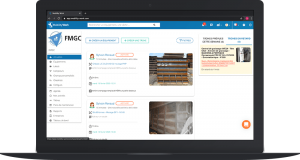
All the news relating to current interventions are available from the Mobility Work application news feed
The news feed allows you to learn about some of the work carried out by the technicians: in fact, some of our lines run 5*8, they arrive so that some technicians do not cross paths for a whole week. Mobility Work CMMS is a communication tool that allows you to communicate with line technicians who are rarely seen, and to supervise the distribution of work.
The three factories that have deployed Mobility Work are connected to a network; it is nice to know that it is possible to find information within the three entities. However, this is a feature that we have never used so far. I already had the experience with a previous CMMS that we deployed in my previous position, common to several sites. We were very excited to be able to communicate and share spare parts stocks, but in use, we realized that we were finally sharing quite a few spare parts. In addition, searches for technical information were mostly carried out by telephone. For me this networked functionality is a plus, but it is not necessarily the major asset of the product. The real added value concerns internal exchanges, between factory departments.
What are your company's future projects concerning Mobility Work?
Several projects are in progress: at first, we mentioned the idea of being able to remove parts from stock and manage our store thanks to Mobility Work, which we intend to put into practice during the summer.
The next step is to exploit the various reports, use dashboards and set up indicators - especially since the dashboards have been improved during the last update.
Maintenance in our factory is divided into 3 parts: I would like each of them to have a giant screen that includes the Mobility Work dashboards, and that we can point and navigate through the maintenance solution through indicators during the meeting with the line technicians. This is a feature that I would like to develop by the end of the year.
Finally, over the next year, with the help of an apprentice, I would like to be able to develop bridges between our field electronics (brushless motors, supervision, etc.) and CMMS. The idea is to develop all these aspects of maintenance called by some “predictive maintenance” (predictive maintenance), even if it remains preventive as we know it, but with adapted tools: how to recover the drifts in engine torque, response times that are getting longer, and thus anticipate breakdowns...
Are you satisfied with the responsiveness of the Mobility Work team?
It is going very well, the relationships are very good with the management of Mobility Work, who offers a lot of ideas and who anticipate our needs. However, be careful to structure things, to manage the rise in power of the tool well and not to make false promises.
We are well aware that Mobility Work is a tool in constant development; it is an extraordinary tool, but you have to keep your feet on the ground. I would advise paying attention to structuring at the development level. Demand is very strong, and it is a great adventure that you are living, but be vigilant as you grow.
As for the responsiveness of the support team, it is very good. The apprentice engineer in charge of the project for the implementation of CMMS has always obtained very quick answers each time they contact your team.
In conclusion...
I am a fan of Mobility Work, and I recommend this CMMS whenever I can; I had the opportunity to give maintenance license courses this year at the IUT Louis Pasteur in Strasbourg, and I made a small aside in my course to highlight Mobility Work!
It was necessary to dare to start with such a simple idea, and to promote such openness. What I liked about the Mobility Work philosophy was “let's do things simply, ask ourselves the right questions, and implement them quickly and simply”, and we can see that it pays to ask ourselves to think about how we work. Well done!”
Thanks to Mr. Boudes for agreeing to give his testimony; user feedback is at the heart of our approach, and helps us improve our product on a daily basis.
Any questions?
Contact us to discover the first CMMS that can be deployed in 3 weeks.