UX Series 15: CMMS at Vallourec

Barthélémy Longueville has been working for 12 years for Vallourec, world leader in tubular solutions. Returning to France after eight years spent in China where he was in charge of industrial and commercial operations, he now holds the position of Chief Digital Officer and oversees digital transformation issues for the Group. Manuel Pinto joined the Vallourec group at the beginning of his career in industrial maintenance. Today, he is maintenance manager at the Déville-lès-Rouen site (Seine-Maritime). They both agreed to tell us about their experience deploying Mobility Work next-generation CMMS.
Mobility Work: Can you introduce yourself in a few words?
Manuel Pinto : I joined the Déville-lès-Rouen site in 1991 as a convenience store and then as an electrical technician. In 2007, I was appointed repair team leader. I have been in the position of maintenance manager since 2012: first in the hot unit, then, two years ago, this position evolved a bit because hot tube rolling operations now take place at the Group's German sites. Thus, since 2017, I have been in charge of cold unit maintenance.
Barthélémy Longueville : It is now 12 years since I joined the Vallourec teams. I started as a quality manager, then after two years in this position, I was offered to expatriate to China where I successively occupied the positions of factory manager, industrial director, then general manager in charge of the industrial and commercial operations of the electrical energy business for China.
Since my return to Paris in 2017, I have been in charge of digital transformation issues for the Vallourec France entity. Digital transformation is deployed around three axes within our organization:
- Digital technology as a driver of innovation for our customers. In other words, our ambition is to exploit data to offer new services to our customers.
- Digital technology as a vector for improving performance. In this second chapter, we act at the operational level in order to improve production at all of our sites, to reduce costs and to optimize quality thanks to new technologies, and in particular thanks to “analytics” techniques. These initiatives also cover support functions (purchasing, management control, etc.).
- Digital technology as a vector of collaboration and communication. By introducing innovative solutions, we seek to improve communication between and within Vallourec teams.
In my opinion, Mobility Work's new generation CMMS (computer-aided maintenance management) is at the crossroads of the second and third axes, in that it allows our teams to streamline their industrial maintenance operations while offering technicians new opportunities for exchange and communication.
What convinced you to test CMMS?
Barthélémy Longueville : Our decision to adopt Mobility Work next-generation CMMS was initially motivated by the prospect of integrating into our tools a solution of our time, which is easy to deploy because it is hosted in the Cloud.
We needed an innovative tool to affirm our strategy of TPM (total productive maintenance) but also to strengthen the relationship between maintenance operators. Mobility Work CMMS is a practical application, focused on use, on maintenance technicians, which obviously represents an immediate benefit for our teams.
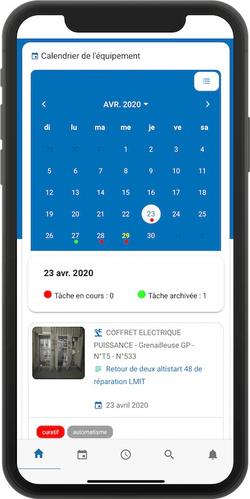
The approach therefore appealed to me and I was convinced of the usefulness of such a tool. But what finally convinced me and pushed the project forward were the first two weeks of testing that we carried out with Mobility Work.
We therefore deployed the application on the Déville-lès-Rouen site; adoption by maintenance technicians was very easy. It is true that it is a modern and dynamic team, which has therefore put up no resistance. But it is very rare to see a computer tool be adopted so easily. In two weeks, the uses were there: almost all technicians with identifiers used Mobility Work CMMS. It worked right away, which is a very good sign.
How did the initial thinking process take place?
Manuel Pinto : During the presentation, I was also seduced by Mobility Work CMMS. A first impression that was confirmed later, once the application has been deployed and the organization charts, equipment and spare parts created. As Barthélémy said earlier, the teams immediately adopted the tool: when we saw the maintenance technicians doing their activity reports on Mobility Work and detaching themselves from our old tool, we understood that it was a win.
Barthélémy Longueville : There was also a period of improvement during the summer, if I remember correctly, during which you took photos of the equipment to make the tool more visual.
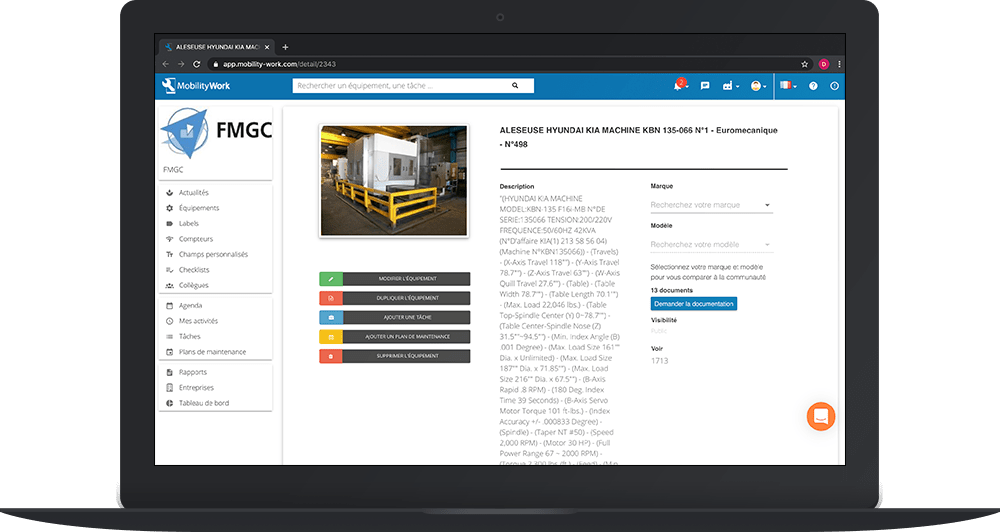
Identify your equipment in the blink of an eye thanks to Mobility Work's next-gen CMMS
Manuel Pinto : Indeed, we did not immediately launch all the functionalities of Mobility Work. We started with the simplest one, the business report, and focused on that. We presented the advantages to our teams: accessibility of the activity report, simplified communication, availability of interventions. Thanks to this feature, there is a real exchange between the maintenance manager and the teams.
We recently started to photograph the 2,000 machines that make up our fleet. We have gradually adopted some features.
How long has Mobility Work CMMS been in place?
Barthélémy Longueville : We implemented Mobility Work CMMS in May 2018 at the Vallourec factory in Déville-lès-Rouen. The development of activity reports was a starting point in integrating Mobility Work into the factory, since they allow teams to monitor industrial maintenance operations.
How was the deployment experienced?
Manuel Pinto : Several generations live together on the Déville-lès-Rouen site. The youngest adopted the application right away. For most, the Mobility Work application is a bit like what they know, like social networks. The adoption may have been a bit more complicated for the others, but within a week everything was settled. Today, no one would go back.
To prevent possible concerns, we organized training courses. Here we have a technician, usually responsible for the structure and spare parts, who is dedicated to training. He therefore organized three training sessions for our thirty users, each lasting 30 minutes for about ten participants. From the first fifteen days, we already had nearly 1000 or 2000 activities.
How does this fit into Vallourec's digital transformation?
Barthélémy Longueville : In terms of IT project management, this is truly a change of model. Usually, we buy licenses and then run a run every year. This process requires the intervention of a team for deployment, training, etc.
In the case of Mobility Work next-generation CMMS, getting started is very simple. We have a paid service hosted on the Cloud. We are also here in an approach of continuous improvement, Mobility Work is a start-up in perpetual evolution. We can also influence the functionalities that we want to see developed.
As is often the case, the Déville-lès-Rouen site is a bit ahead of the others. Faced with the success we met there, we decided to deploy the CMMS tool in other factories in the Vallourec group to allow them to benefit from the same advantages and create a community of users. Maintenance professionals will thus be able to exchange best practices on a common machine, compare industrial maintenance strategies or even the use of spare parts, without geographical constraints, and thus improve our industrial tool globally.
In your opinion, what are the advantages of Mobility Work CMMS?
Manuel Pinto : In my opinion, the main advantage is being able to consult the application wherever you are : at work or at home. I am constantly connected, I always know what is happening in the factory, which was not possible with our old CMMS software or with an Excel activity report.
I think this is also of interest to maintenance technicians: they now have a way of knowing what happened during their absence before even arriving at the factory. For example, this has facilitated relationships between operators and convenience stores as well as between convenience stores and preparation.
What's more, the deployment of Mobility Work has saved the teams a real amount of time. We work on the three-eight model, every morning we have a maintenance meeting during which we go through all the past activities. Mobility Work simplified this meeting for us.
But the real added value of this new generation CMMS for operators is to be able to consult the history of failures of the equipment on which they operate. They can thus know if the failure is recurrent, if a solution already exists or if it is a new problem.
How did that translate at the operational level?
Barthélémy Longueville : This added value that Manuel was talking about will begin to be translated into the operational performance of the site. Maintenance technicians are valuable resources, so it is important to give them the means to focus on their maintenance interventions, on improving equipment rather than wasting their time with a tool that is complicated to use.
There is a real gain in efficiency, that is to say, we reduce the time spent by maintenance technicians on administrative tasks, so that they can transmit reliable information to production, so that they are able to manage their maintenance activities more effectively, and that they optimize their active time. Ultimately, this results in the overall improvement of equipment maintenance.
Manuel Pinto : We are indeed seeing a trend in this direction. You still have to wait a few months before you see the fruits. As Barthélémy said, we have seen a certain gain in time that allows us to focus on improving equipment and processes. Thanks to the history of failures, we are now in a position to better analyze them and thus reduce downtime significantly.
Barthélémy Longueville : Mobility Work CMMS indeed opens up new horizons for us in terms of continuous improvement. As part of this global approach to improving quality, we may be required to discuss with maintenance technicians on the problems they encounter with the equipment. By combining task history and statistics, we quickly find out which technician worked the most on the machine we are interested in.
What is the feature that you use the most?
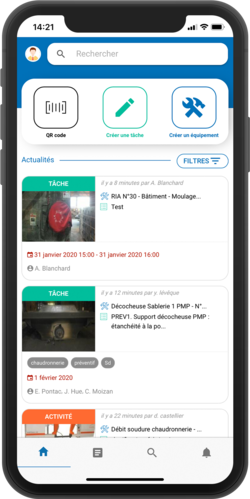
Manuel Pinto : I would say the News feed. Throughout the day, I watch the progress of industrial maintenance interventions on the application. This gives me a trend in the activity of my teams.

Follow the activity of your site in real time from your Mobility Work CMMS
Next, I would mention the tasks. Every morning, during our maintenance meeting, we select the relevant tasks to create an activity report. In fact, I am very happy with the new version of the news feed, because it now shows the tasks and activities associated directly with it.
What are your development projects now?
Barthélémy Longueville : Our ambition is to deploy Mobility Work CMMS on our sites abroad, in Indonesia, in Saudi Arabia, but also in France in particular. The Vallourec group is present in more than 20 countries around the world.
To do this, we rely on a partnership with Mobility Work in a completely agile approach. As we see user satisfaction and performance increases, we plan to deploy Mobility Work within the group.
Are you satisfied with the responsiveness of our teams?
Barthélémy Longueville : Compared to other software publishers, the collaboration with Mobility Work was quite easy: support, integration of the first data... In addition, I have the impression that our teams have a very favorable point of contact with the Mobility Work teams. Our feedback is taken into account.
Manuel Pinto : I am in contact with the Mobility Work teams via the online chat. They are very responsive. The team listens well when raising certain problems or possible areas for improvement. In fact, I participated in a user workshop for this purpose.
Thanks to Mr. Pinto and Longueville for this testimony with two voices. User feedback is at the heart of our approach and helps us improve our product on a daily basis.
Any questions?
Contact us to discover the first CMMS that can be deployed in 3 weeks.