CMMS in the plastics industry: Mobility Work at Sarplast

Hervé Vourron is production manager at the company. Sarplast, specialized in the injection of technical thermoplastics in Sarreguemines in Moselle (57) and Manages two maintenance departments (tools and machines), the injection workshop, the assembly workshop and a methods department. Witnessing the beginnings of the application and a convinced customer, he tells us about his vision of the evolution of the product: “We hijacked the GMAO Mobility Work to make it an internal project management tool”
How did you hear about Mobility Work?
Hervé Vourron: I got to know Mobility Work through an email sent to me by our CEO, Mr Guindon. At the time, maintenance services were managed “the old fashioned way”, with failure reports in paper format. When I arrived in April 2016, I developed a management of these services with an Excel table. At the time, there was no question for me to talk about real CMMS, which in my opinion was much too expensive for our SME. The Excel document was generally satisfactory, but did not meet all my expectations. So your product arrived at the right time: I tested it, and I was immediately convinced.
I was surprised by the presentation of the site, its usability, its very intuitive use inspired by online sales sites and by the search function that is very easy to use. She immediately seemed to me very easy to set up compared to the solutions I have encountered in the past; the purchase decision was therefore quick. The cost of the investment was decisive, because this solution is much more affordable than conventional CMMS.
We therefore very quickly embarked on the CMMS adventure thanks to Mobility Work, otherwise we would still not have one.
Is the Mobility Work tool already in place in your company?
The implementation really started in the summer of 2017, and this mission was entrusted to a BTS computer science student. For two months, he took photos of all the equipment, set up the machines and spare parts, and thus carried out 90% of the work during this period of time when he was completely unfamiliar with our company. My maintenance managers and I helped him, and all of that was done very quickly and very easily.

All the news relating to ongoing interventions are available from the news feed of the Mobility Work mobile application (equipment, tasks, activities).
Indeed, all the CMMS implemented do not necessarily work as quickly. In my industrial past, I have thus experienced CMMS that are very expensive and difficult to set up., and which, after a few years, no longer worked because they required additional resources that maintenance services were no longer necessarily in a position to provide. Mobility Work's approach is totally different, that's why it's interesting.
Anecdotally, some of our maintenance technicians were not used to working with computer tools. I was therefore afraid of running into this technological barrier, and yet, they quickly understood the usefulness of making a transition from the paper format to the 4.0 format. They quickly picked up the subject.
On a daily basis, we use tablets, smartphones, and PCs. We also added a few WiFi terminals in the factory to get a better connection, and it works very well.
What are the advantages of Mobility Work CMMS in your opinion?
The very easy implementation, the daily management, the cost of the solution and the search engine: by typing the machine name, you can obtain the entire course of interventions and trace its history.
Among the main benefits of the application, I would mention in particular the rapid feedback, which was previously managed on paper. At the time, we had an employee assigned full-time to transcribe intervention orders and to archive them. We repositioned her in a position with higher added value. Now, all the declarations are made by the technicians, which represents a significant gain in terms of manpower.
We can also mention a gain in terms of reactivity: we can know which machine is broken, when, why, how, and add numerous documents (videos, plans, sketches, etc.). Above all, it is possible to create real links between failure requests and interventions that we did not have before.
What is the feature that you use the most?
As head of the production department and maintenance services, the most interesting features offered by Mobility Work are the failure declarations and interventions. CMMS is particularly interesting for me because it allows me to monitor all the team's work, and to know how both maintenance and production react: when a machine is stopped, who has intervened, do I have to order a part, do I have to order a part, analyze intervention times, etc.
In addition, we are also very interested in the indicators of the dynamic dashboard, which we want to develop soon: which mold or which machine is the most expensive, which machine is stopped the most, how to guide our preventive maintenance, etc.
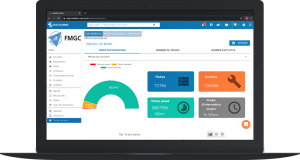
The Big Data tool in the Mobility Work application helps you make better decisions thanks to dynamic indicators
In our opinion, the main advantage of the application remains the declarations of failures, activities and tasks.
What are your company's future projects concerning Mobility Work?
First of all, stock management, especially with regard to spare parts that were previously managed in an Excel table and without a link between machines and spare parts. It is now possible to create connections between the machine and the spare part, to manage stock costs, minimum stocks, the number of parts in stock...
The novelty that interests us the most in the coming months is the monitoring of maintenance indicators. We didn't have any until now, and now we're starting to collect more and more reliable data, which is automatically calculated!
We are also starting to manage our technical projects internally, especially at the level of the methods team: automation, process optimization, continuous improvement, etc.
We have thus diverted Mobility Work to make it a project management tool: instead of creating equipment, we create a project, and the stakeholders in the methods department feed it through their actions using the “tasks” and “activities” functions. It is thus possible to follow the evolution, costs and achievements over the days or months. This saves us from managing an Excel table that would take up a lot of our time. We have everything “at hand” in one system.
Are you satisfied with the responsiveness of the Mobility Work team?
So far, yes. The Mobility Work team knew how to manage our requests for interventions, and your company has developed well since our first contacts.
Any questions?
Contact us to discover the first CMMS that can be deployed in 3 weeks.