UX Series 22: CMMS at the APEI in Dieppe


Three years ago, the APEI of the Dieppe region chose a new generation, mobile and community CMMS. Since then, communication between the various sites of the association has been more fluid than ever.
Founded in 1966,APEI of Dieppe (76) supports people and families with children, adolescents or adults with disabilities and encourages them to participate actively in community life. It also works with elected officials or public authorities to defend the moral, material and financial interests of the people it hosts.
There we met Gabriel Foucart, who has been employed by APEI for six years. Recruited as an electrician, his position gradually evolved: today, he is one of the three maintenance managers of the association. The latter has in fact several sites and structures, whose objectives vary. THEmaintenance management application Mobility Work has been deployed at three sites, each now with a maintenance manager and an average of three maintenance technicians.
“Mobility Work: in what context did the idea of deploying a CMMS solution emerge?
Gabriel Foucart : At the beginning, we used cards, which were on each machine and which we filled out in turn. Except that, of course, there comes a time when the form disappears.
So our quality manager started doing some research and he came across the GMAO Mobility Work. The management, the quality manager, the IT manager and the maintenance managers consulted and we decided to give it a try.
Being able to test the application really gave us confidence in our choice - we wanted to see if your software could match what we expected when setting up our hardware.
Following our trial period and based on the conclusions we drew, we spoke with management: based on our demonstration, they immediately decided that Mobility Work should be deployed throughout APEI.
Secondly, what elements supported you in your choice?
Initially, we did not go on a GMAO, so we asked for a second trial period. This second test period allowed us to better project ourselves. The Mobility Work sales department has always taken good care of us, they have always been available.
How long did it take to deploy the solution?
On my site, we needed a little over three months to be sure that the tool was a perfect fit for us. For three weeks, one of our employees took care of filling in the GMAO, to retrieve all the documents and to allow us to use the application as we wanted.
Once the equipment was listed, the equipment and the maintenance plans created, it took us two weeks to get the tool in hand and to be operational.
In your daily work, what are the advantages?
Before, we spent an infinite amount of time on the phone, exchanging information that we didn't remember because we were caught up in something else. We were unable to hold meetings and communicate effectively between maintenance managers.
“This year, I was even able to take three weeks off in a row, because the person who replaced me was able to fend for themselves thanks to the CMMS.”
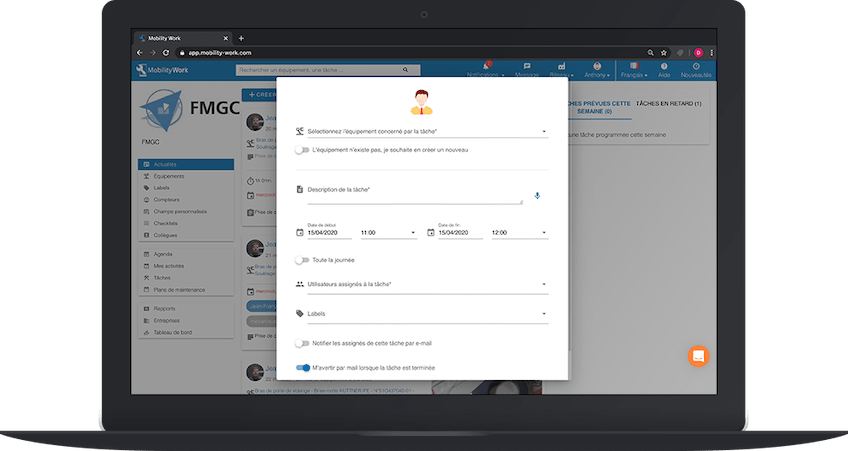
Today, we only communicate with Mobility Work. Workshop instructors, for example, have a lot of equipment. Today, when they have a problem, they know how to request a task. It's all mapped out.
This year, I was even able to take three weeks off in a row, because the person who replaced me was able to fend for themselves thanks to the GMAO. Everything is listed, everything is marked: past interventions, what remains to be done, maintenance plans etc. It is a really very interesting tool for us.
What is the feature you use the most?
Above all, we use all the functionalities that revolve around prevention.
The second feature that we can't do without is that of requesting intervention. If there is a failure on another site, they create a task that is scheduled immediately, in order to be able to intervene as quickly as possible. We also know who is going to the site, since we are all equipped with a tablet, on which the Mobility Work application is installed. In this way, we practically no longer waste time calling each other for information requests.
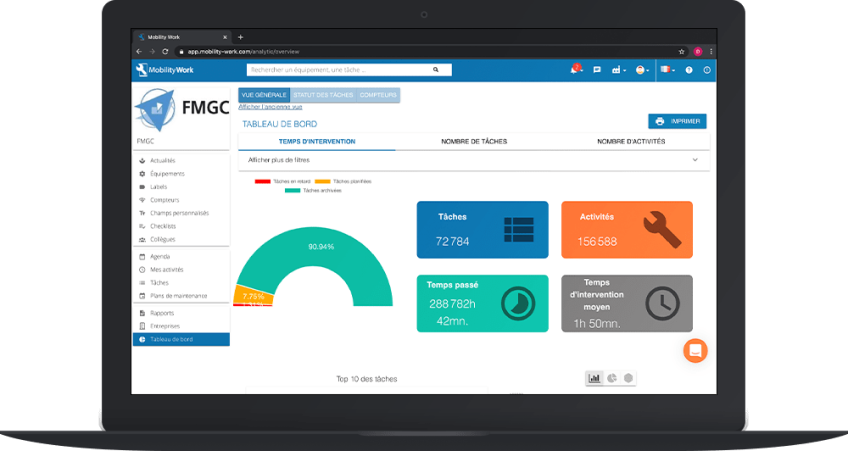
Finally, as far as our quality manager is concerned, he loves the dashboard, to know how much time we spend per site and to know the profitability and reliability of our equipment.
On your site, for what type of intervention do you use CMMS most often?
We use a lot of GMAO for everything related to troubleshooting. Instead of sending emails to each other, everyone uses the application. We filled in the tool with photos of buildings and equipment.
All users found the operation to be very simple and the vast majority are completely satisfied with the GMAO. If they need something, they go to the app and ask, for example: “Heating failure in the office. Request for intervention”. 90% of the time, it's how we use the application. As maintenance managers, we use it for everything preventive.
What do you think of the mobile version of our maintenance management application?
All of our priorities are handled on mobile. Otherwise, we spend time in the morning and time in the evening on the classic web version checking our tasks (preventive), what happened on the other sites and what we need to deal with urgently.
The mobile version is a very strong argument: all the deputy directors of APEI, the director general and the administrators have downloaded the mobile application.
Are you satisfied with the responsiveness of our team?
For my part, I have nothing to complain about. Whenever I had technical questions, needed help filling out tables, or needed updates that I sometimes didn't understand, the Mobility Work teams always took the time to explain to me.
I can assure you that it was not easy at the beginning, because we are technicians at the core: disassembling and reassembling a machine entirely is fine, IT is a bit more complicated for us.
Each time I made a request to retrieve information on material that I had already saved as an archived task, your teams took the time to answer my phone and make sure I understood correctly. Sometimes they even called me back a few weeks later to ask me if I was satisfied with the set-up we had done together.
What are your company's future plans for the solution?
We want to deploy the GMAO Mobility Work throughout APEI, on all sites. Three of our networks already communicate together, via Mobility Work, but our future objective is to develop GMAO on our last site, a shelter.
We also want to organize a training with the deputy directors of the establishments that use the Mobility Work application, my maintenance colleagues, the people who work with maintenance managers as well as all the APEI workshop instructors, so that the GMAO Mobility Work is becoming the main tool, common to all.”
Thank you very much to Mr. Foucart for giving us his testimony on his experience with the Mobility Work community maintenance management platform! If you want to read more user stories and follow our news: subscribe to our newsletter and follow us on our social networks !
Any questions?
Contact us to discover the first CMMS that can be deployed in 3 weeks.