UX Series: Mobility Work Hub at FUCHS

Loïc Bébin joined the FUCHS Lubriant France teams 6 years ago as a Grease Product Manager. From technical support to industrial maintenance teams to Research & Development, he tells us about the importance of establishing a relationship of proximity and trust with his customers.
Mr. Bébin agreed to share his experience with us with Mobility Work Hub, the first maintenance management platform that connects suppliers and industrial maintenance experts.
Mobility Work: can you tell us about your background?
My name is Loïc Bébin, I am the Fat Product Manager at FUCHS Lubricant France.
After a mechanical IUT and then a degree in business, I turned to the industrial sector. In 2012, I therefore joined the FUCHS Lubriant France teams as a product manager for greases, industrial applications and automotive original equipment.
What does the position of grease product manager at Fuchs Lubriant France consist of?
The position of product manager at FUCHS Lubriant France focuses on three main areas.
First of all, we provide the marketing unit with technical information for communication through e-mailing campaigns, the website, press releases, etc. In short, product managers are responsible for enriching a content base that the marketing team then uses.
This obviously requires, at the outset, a good knowledge of the market. To do this, the product manager will collect statistical data according to the types of products and sectors of activity. He will analyze the use of products by market in order to know which ones can be the most beneficial for the company. From there, a pitch is built for the promotion of the product.

Get statistics on the use of your products with Mobility Work Hub
Second, product managers have a technical support role. Our job is to provide salespeople in the field with the information and training they need. To do this, we rely precisely on our market analyses. If we determine that a given market requires specific targeting, we provide sellers with all the necessary elements - the arguments -, both on the market in question and on the products they are looking for.
There is also a support dimension associated with this function, a dimension for which we play the role of technical “expert” on our product lines. The product manager may be required to accompany a salesperson to the customer to help him with a given problem and provide the arguments and the necessary technical approach. This need for technical support is often felt in cases of particular applications for which the expert eye is essential.
Finally, the product manager is involved in the development process of new products, by positioning himself at the R&D and field interface. For my part, for the Fat part, I am in direct contact with the main R&D center in Germany.
Our role is to determine the exact needs of the market based on the feedback from our customers and the problems encountered, then to transcribe them to R&D. We hold regular meetings during which we decide whether it is necessary to work on the development of a new product, if we feel that it is missing from our range or that existing products no longer meet the needs of the market. Thus, the development of our products is based on accurate information, collected directly from our target audience. Once the development is successful, we present the product to the customer in order to carry out tests with him and to validate it technically. This validation confirms and confirms the creation of the product in the range. Then comes the market launch phase.
Do you encounter specific problems related to your profession?
We currently have a very wide range of greases: we offer 400 references, subdivided into packaging, at the rate of 3 to 5 different packagings per reference (barrels, kegs, cartridges, cartridges, jars or aerosols, for example). However, we must meet the supply needs of customers. This makes inventory management complex. Obviously, we cannot have 2,000 references in stock at the same time, but we must know how to manage large volumes while being able to guarantee the availability of our products to all our customers.
From a technical point of view, in raw industrial maintenance, we do not really encounter any particular problems. The greases targeted by our customers in these markets remain fairly standard. However, the trend is to increase the lifespan of components or machines by better taking into account the maintenance aspect. This has involved a steady improvement in the characteristics of fats with the use of oils from different synthetics, more complex or innovative thickeners, more appropriate additives, for example. However, the price remains very decisive in this sector of activity. Today, we are experiencing a transformation of the entire industrial sector with the emergence of e-mobility and what this means for factories on the supply chain, in terms of automation or reliability, for example. So, I think that this trend of using more efficient greases will continue for a few more years.
We will therefore have to continue to innovate and offer improvement solutions, but this is far from being a problem for us. Rather, it is our core business.
How do you see customer relationships?
I am constantly looking for data and customer feedback on the use of our products: the framework of application, but also the cases in which our products are not used for the benefit of others, volumes, etc. This is an essential step that allows us to know if a product should be launched or not, and if it is suitable for the need expressed. In this, the Mobility Work Hub platform can have a real advantage in collecting field data.
Our customers give us feedback on specific needs or requests in two major cases:
In the first case, the customer is already a user of our products and wants to be reassured about the use they make of them. He contacts our company to share specific questions with us. This ties in with the support role, which we were talking about earlier. The customer needs to manage the risk (or the absence of risk, in this case), to receive accurate information on the point raised.
The second point concerns prospects. They want to know which product from the FUCHS range to use in their application, often by simple equivalence to the product in place. It is actually more complex to engage in this case, since all client applications are different. So the information he will give us from the application is essential in choosing the solution. It is then thanks to his experience and his feedback that we will be able to know if the product works.
In terms of support, FUCHS Lubriant France also employs application engineers. These rely on FUCHS experience and expertise to respond to customers. If the problem is more complex, they turn to the product manager. The topics are very variable: it can be compatibility between products, compatibility between a grease and elements related to the application (plastic, elastomer, cutting oil, etc.).
Our approach is then very simple: either we already have answers that we provide to the customer, or we carry out laboratory tests to verify compatibility with the application. In the second case, if we do not have the possibility to carry out the test ourselves, we are committed to a customer relationship based on trust. We invest alongside the customer and support them during the tests.
How do you use the data collected?
Concerning complaints, they allow us to obtain global visibility on issues in the field. When a customer encounters a problem, we record their complaint using a dedicated tool. After a given period of time, we gather this information and analyze trends, recurring problems, for example. Then we act accordingly internally.
However, outside of this complaint system, we do not have a specific tool to collect information. We don't always know how our customers use our products. With the right tool, we could be in a position to warn our customers about the inappropriate use of our products and avoid problems for them.
On the other hand, some customers may make ingenious use of our fats, which we would not necessarily have thought of. This is the type of information that could be used for prospecting or development. Of course, we can collect them on a case-by-case basis by calling customers directly, but that would be too time-consuming.
What we are ultimately looking for is a global overview of how our fats are used. Although I do manual monitoring myself, this is only a small part of the reality. The problems that I am told are not always representative of what is happening on the ground.
In your opinion, to what extent is the Mobility Work Hub platform part of this approach?
I think that the Mobility Work Hub platform could simply be used as an interface for us. Your tool would allow us to centralize data relating to equipment, our products, their applications... In this respect, Mobility Work Hub greatly simplifies the task by saving a certain number of trips back and forth with customers; all the data is already filled in on the platform, all you have to do is send a simple message to the teams to solve a given problem.
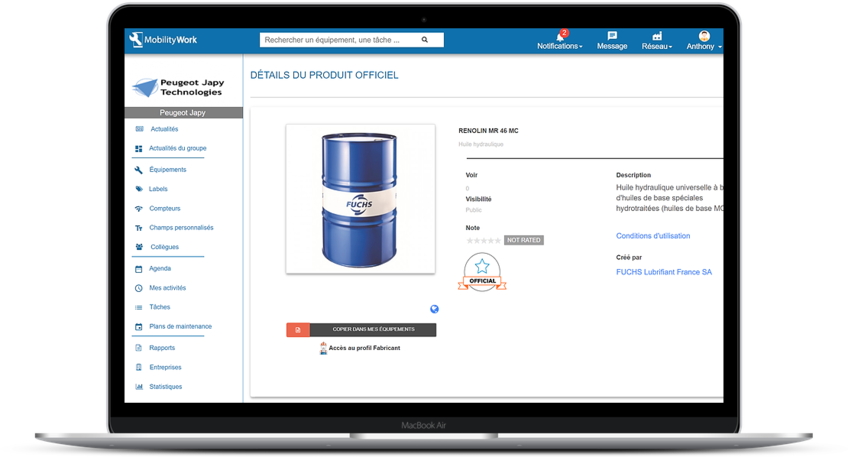
Share your product information with Mobility Work next-gen CMMS users
Earlier we were talking about feedback. Again, I think that Mobility Work Hub represents an asset in collecting information and exchanging best practices. Even if at the moment we still lack data on the platform, I am convinced of the usefulness of its statistical tool.
And in terms of customer relationships?
I think it can work, as long as there is more data volume. The customer relationship will always be direct, it is more in the analysis of their feedback that I see the importance of the Mobility Work Hub platform. It would probably help us to be finer or faster in collecting information.
The community aspect of Mobility Work CMMS is also an advantage. Already internally, users are exchanging with each other. Then, for example, we can redirect potential customers to other members of the network to prove to them that our products work on their applications.
I think that being represented on the Mobility Work Hub platform will allow FUCHS Lubriant France to maintain a better relationship with its customers. I don't know what this could mean in terms of development, but it will be beneficial for the image and visibility of FUCHS Lubriant France among its users.
Thanks to Mr. Bébin for this first testimony on Mobility Work Hub, the first platform dedicated to equipment manufacturers and suppliers of consumables. Find us on social networks for more content on industrial maintenance jobs.
Any questions?
Contact us to discover the first CMMS that can be deployed in 3 weeks.