WCM, CMMS and self-maintenance: the winning trio?

World Class Manufacturing (WCM) is a concept that emerged in the 1980s, making it possible to identify the factors that led certain groups to achieve tremendous success to finally establish themselves as major players in the global industry. This WCM principle is used to describe the various steps that will gradually allow a company to optimize all its production: the place of the individual is paramount and determines the success of the adoption of such a strategy.
What are the secrets of companies that have succeeded thanks to this concept, like Toyota or FIAT?
Scope of WCM in industry
World Class Manufacturing is a comprehensive management system designed to improve the performance of a company by eliminating industrial waste (excess stock, production waste, etc.), in the direct line of lean production. The whole approach is in fact focused on significantly improving quality, productivity, significantly reducing failures and customer satisfaction. To carry out this strategy successfully, all teams must be involved and be in possession of all the means at their disposal.
Management must also take this path by remaining attentive to the new techniques put in place, by taking a critical look at its processes and by maintaining a certain open-mindedness. Finally, managers should establish clear goals to lead their teams to success and to motivate them. The whole point of WCM ultimately lies in the development of a collective spirit focused on progress.
Even if the WCM process seems relatively long to set up, it is important to follow it step by step, never neglecting the potential of teams: they are the ones who ensure the success of an entire company. As part of such an approach, TPM (Total Productive Maintenance) and RCM (Reliability-centered maintenance) are also closely linked.
For more information on the subject:
Optimizing industrial maintenance thanks to TPM
RCM: definition and principle of implementation
The 10 pillars of WCM
Before any implementation, companies should know that the WCM approach is based on two main components.
Initially, it is crucial for structures to focus their attention on the method they are going to apply and on the results they want to obtain from it. It is essential to employ rigorous methods based on the ten pillars on which this method is based.
In the second phase, this strategy will remain ineffective if it does not respect the company's culture or the management in place. Here, the principles and values supported by the structure take the first place and condition the spirit in which everyone will subsequently be required to work. Without a well-established corporate culture that is adopted by everyone, the WCM method cannot work.
Pillar 1 - Health and safety
This first pillar concerns the environment in which operators operate. It must of course scrupulously respect the standards in force in order, ultimately, to guarantee optimal working conditions and eliminate the risk of accidents.
Pillar 2 - Logistics
Here it is a question of repeating point by point The principles of lean manufacturing, which consists in progressively eliminating all forms of waste at all stages of the production chain.
Pillar 3 - Cost Deployment
This component refers to the ability that a structure must have to always associate a cost to the various problems it identifies on its production chain, in order to better deal with them and become aware of their impact.
Pillar 4 - Targeted improvement
As for this fourth pillar, it covers all points Kaizen method and therefore aims to set up targeted improvement projects by constantly involving each employee. The adoption of this approach will result in creating know-how with high added value within the teams, which will be able to rely on a certain number of management tools.
Pillar 5 - Quality Control
This pillar echoes the Logistics pillar and is again based on the principle of lean manufacturing, which is decidedly decisive in the strategy that companies must put in place. Quality must be at the forefront of the manufacturing process to ensure optimized production, without defects or wastes.
Pillar 6 - Autonomous Activity
The importance here is to encourage employees to strengthen or acquire skills. Under WCM, it then becomes essential to adopt autonomous maintenance in areas with high capital intensity and to organize the workplace accordingly.
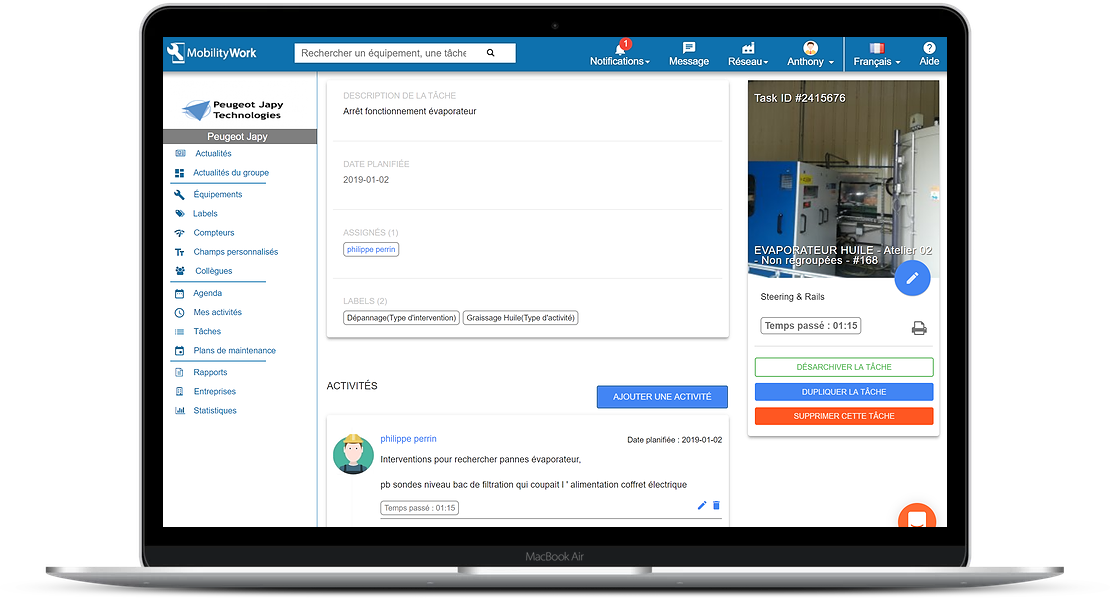
Mobility Work CMMS allows operators and technicians to be autonomous: creation of tasks, maintenance plans, notifications for each new activity...
TRY OUR MAINTENANCE APP FOR FREE
Pillar 7 - Professional maintenance
The objective is then to set up an efficient maintenance model in order to gradually increase the availability of equipment. This reduces costs and then keeps them up to date.
Pillar 8 - Customer Satisfaction
Of course, WCM implies that businesses must guarantee total customer satisfaction at all times. For example, the turnaround time must be optimized and the complaint rate reduced to a minimum. To work in this direction, companies must clearly identify the needs of their interlocutors in order to respond appropriately.
Pillar 9 - Team Development
Based on the premise that the success of the strategy depends on an entire group, the people who make up the group must be trained. Everyone must find their rightful place in the chain: employees must become aware of the methods and standards in force and acquire the necessary skills. To ensure a smooth adoption of World Class Manufacturing, the human component is absolutely essential, so businesses must inevitably devote time to training their teams.
Pillar 10 - Environment and Energy
Although this aspect is all too often overlooked, it is nevertheless an essential component of WCM. To take a more responsible approach and thus perfect their strategy, companies must indeed take measures to preserve the environment and achieve significant energy savings.
Self-maintenance as a complementary factor of success
Si This form of industrial maintenance echoes at WCM, it is because its objective is to give more autonomy to operators and maintenance technicians, thus recalling the pillars 6 and 9 mentioned above.
Self-maintenance will make it possible to empower teams: in essence, machine operators and technicians (maintenance or production) must be in a position to quickly detect anomalies in the equipment and to make diagnoses before a malfunction that is too serious that could lead to a failure occurs.
This method should also allow them to understand all the functionalities and to know all the components of the machines on which they operate in order to detect the causes of anomalies. The person must therefore be able to formulate forecasts in the event of a malfunction in order to intervene as quickly as possible. The objective of self-maintenance is therefore to empower the people who work on the machines, technicians or not, to perform first-level tasks as quickly as possible if they detect a problem.
To do this, the factory must give these teams the means to acquire this autonomy by equipping them with CMMS software (computer-aided maintenance management). The Mobility Work mobile application, for example, is designed as a real social maintenance network. Technicians, for €30 per month, fill in their tasks and activities, view their equipment sheets, plan their working days using the agenda, share information so that it is not lost.
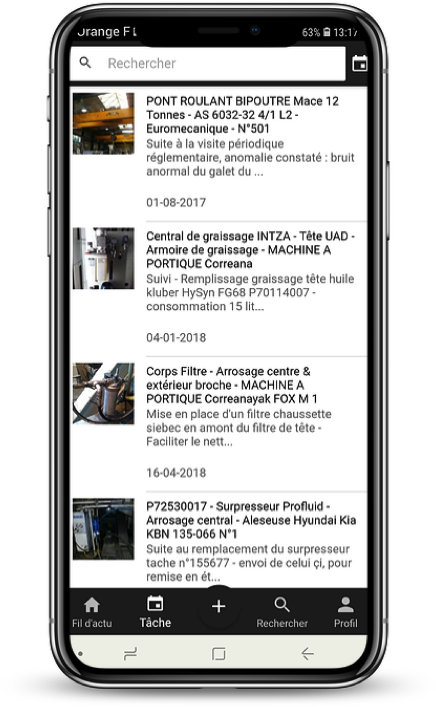
Create your equipment sheets in the Mobility Work maintenance management application, then trigger tasks and activities
Thanks to such a CMMS solution, teams are assigned to tasks that fall within their competence and can intervene quickly, avoiding generating excessive financial losses. In the application, workers even have the possibility to communicate directly with their colleagues and to access a free analytics tool that presents all maintenance data in the form of graphs and other diagrams. Mobility Work CMMS allows factories (belonging to the same industrial group or not) to exchange best practices and advice when they encounter the same problems.
More pragmatically, you can equip your machines with QR codes or NFC chips to scan them and thus access the corresponding files in the CMMS software, or even sensors linked to your application to find, in one click, all the data you need. The sensors in fact measure precise indicators (engine temperature, oil levels, etc.) and transmit this information to the Mobility Work tool, allowing the technician who is involved in a self-maintenance approach to visualize all the key information necessary before intervening.
Thanks to World Class Manufacturing, self-maintenance and the deployment of a CMMS, companies can optimize their processes to improve their production chain, train their staff to increase their autonomy or even reduce industrial waste to guarantee the satisfaction of their customers. Test the Mobility Work CMMS application now for 7 days for free and improve your industrial maintenance!
Are you interested in maintenance management and want to know more in order to increase your productivity and save money? Schedule a free video with our team to help you better manage your maintenance!
Any questions?
Contact us to discover the first CMMS that can be deployed in 3 weeks.