Women and industrial maintenance

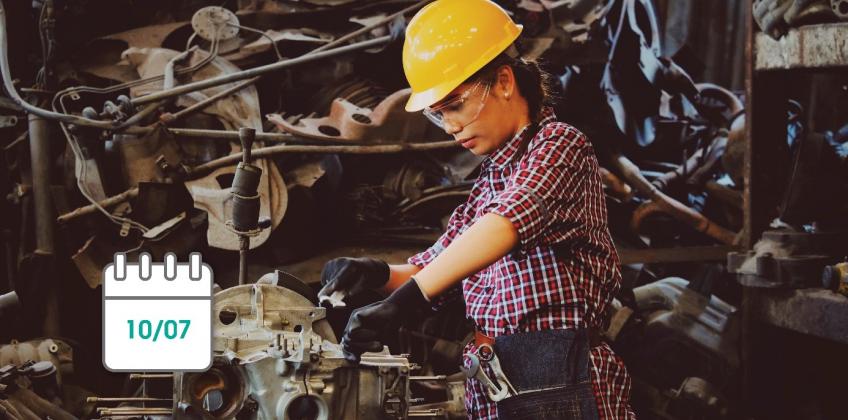
According to INSEE figures, only 30% of positions in the industrial sector are occupied by women. This field is among those considered to be more “masculine”, so women have traditionally struggled to find their place in it. However, over the last few decades, they have gradually established themselves in certain branches, including in the world of industrial maintenance.
We will note that women's rise to positions of responsibility is still too slow, while highly specialized industrial sectors are still almost essentially male. We therefore wanted to give a voice to the women who work in these environments on a daily basis in order to understand their work environment, to allow them to present their profession to us and to know their feelings. Although cliches often last a long time, they all convey a very positive message!
A fairly successful integration in business
While integration into an almost exclusively male environment could be expected to be very difficult, the reality is quite different. A large majority of them do not feel any difference in treatment from their male colleagues and were very quickly accepted into their team. Integration would even be easier than with women!
When the people interviewed talk about the differences they observe, they all talk about them in positive terms, like Christelle Lorillou, currently on a temporary assignment at Vinci Facilities: “Men tend to be nicer to me than to each other. They are also more gallant, more respectful in the way they speak, and less vulgar.” Some employees will tend to be more attentive, others on the contrary will remain quite indifferent, proof that gender differences are not an obstacle.
Some of the women interviewed explain that they sometimes adapted their behavior at the beginning to integrate well into the team and be accepted, as this Nespresso employee testifies: “When I arrived at the company, and without really wanting to act like a tomboy, I wanted to remain very firm about the working environment, the inappropriate jokes, the flirting... I myself pay attention to my words to avoid them being misinterpreted. Once you know your colleagues better, you can relax, but you have to remain vigilant.”
Angélique Barbedette, a maintenance technician at Sanofi, specifies that she “often pays attention to what she says or does because some men may interpret it as a drag.” Christelle Lorillou adds: “I am just being myself, even if I am serious at the beginning. Once integrated and my skills are proven, I come back to my natural self a little more and exchange a lot with my colleagues.” Another woman interviewed even jokes: “Now, those who bring in croissants in the morning even get me extra grape breads, because that's my sweet spot! ”.
Who said that industrial jobs were men's jobs?
Women may be in the minority in the industry, but they are nonetheless passionate about what they do. Among those interviewed, the majority discovered their interest in maintenance during their studies, both in middle school and high school or later. Whether they wanted to understand why a machine could fail, dismantle and reassemble equipment to see what was inside and understand the mechanisms, or whether they were always manual and tinkerous, they all continued in this direction and ignored the difficulties potentially related to their gender.
In fact, a survey carried out in 2016 by the association Elles Bougent with 1000 young girls and in partnership with the CSA, proved in particular that they were more interested in the medical, paramedical, luxury or even media sectors than in those of robotics, digital technology, automotive or aeronautics, preferred by boys.
However, the women interviewed are living proof that industrial maintenance is not just a man's business. Better presented and highlighted to young girls, these vocations can be revealing, as the survey conducted by the association proves, since 63% of the female students surveyed consider that companies in the industrial sector do not value women enough. Interest in a given field or subject does not depend on the gender of the person and there are as many reasons to love these jobs as there are individuals.
The women interviewed evoke the unpredictable nature of their profession (no two days are the same), the relationships with their colleagues and the cohesion of the group (essential for doing quality work), the fact of being able to bring a vision different from that of men... One of them even illustrates her point: “By repairing what is broken, we are a bit like machine superheroes! In the end, by providing a service to people in this way, you feel extremely valued.”
Why the presence of women in industrial maintenance is essential
The women interviewed are unanimous: having a female presence in an industrial maintenance team has a large number of advantages. One of them, an employee at Sandvik, affirms that “relationships are better with men, it especially allows an exchange on ways of thinking, creating and proceeding that are complementary”.
An employee at Nespresso, this technician says: “In general, men are more thoughtful, they talk more easily about their feelings about their work and allow themselves fewer differences in language or behavior. In all the teams I have worked with, it has been recognized that a female presence on a men's team helps to channel the spirits. Any doubts that may have been raised about my skills disappear as soon as I have proven myself.”
Mentalities are ready to change, as this former employee of the Electrolux group wishes to recall: “The men I worked with have always considered me to be one of their own, a bit as if I were a man but bringing a different approach to industrial maintenance”. A testimony corroborated by Christelle Lorillou: “Over the years, maintenance men increasingly appreciate the fact that women are finding their place. Times are changing, and you only need to prove yourself to understand that this cooperation is just happiness. I encourage all young women to assert themselves and to go into these jobs. Motivation must be our only driver: we must not listen to the wrong people, it is up to us to choose our path.”
Sexism that is still deeply rooted in mentalities
Although all the people surveyed express their enthusiasm about the evolution of mentalities that they see on a daily basis in their companies, some still temper their words and deplore the ambient sexism that they often feel in their surroundings or in the wider professional world. Myriam Marzolf, maintenance methods technician at Fédéral Mogul Valvetrain (67), explains: “Sometimes people comment on my choice of profession, which is considered to be masculine. It is mainly employers who allow themselves this. When looking for a job, we still encounter a lot of rejections simply because of our gender.”
Anecdotes flourish and are sometimes quite distressing: “One day, I went to a job interview for a technician position. The boss, with a well-advanced career, welcomes me. He did not expect the candidate to be a woman: he was very embarrassed and explained to me that he had not taken care of the pre-selection, before offering me the position of secretary rather than technician. My two week trial ended up being inconclusive. I could not stand the atmosphere.” This other testimony is symptomatic of preconceived ideas that tend to persist: “Once, a client asked me, very seriously, what could possibly be the dysfunction of my paternal relationship for me to come to do this work... Impossible to make her understand that it was a choice! It was a bit insulting.”
These realities are unfortunately commonplace, as shown by the following figure published in the survey conducted for the association Elles bougent: 61% of the female engineers interviewed have already been victims of discrimination in the world of work because of their gender, and 56% of female students are convinced that they will be discriminated against when they work in a company just because they are women. How can we make them want to access careers traditionally reserved for men if we do not broadcast a positive and caring message to this audience?
Restoring the image of industrial professions among women
We have already seen that young girls instinctively prefer certain specific sectors, such as the medical or paramedical sector, luxury goods or even the media. To encourage them and encourage vocations, it is better to present them with the range of possibilities offered by the industrial maintenance environment.
The above survey shows, for example, that 84% of female students acknowledge that they lack knowledge about these professions and do not have all the information they may need to choose their career path. All of these numbers prove the importance of having role models in order to make informed choices. If students can identify with female figures who are successful in this field and who share their experiences, they will be much more likely to make their mark in the industry.
Mentalities are changing
The survey we conducted shows that women in maintenance are making a difference and are committed to changing mentalities. Christelle Lorillou explains: “Since people are not used enough to seeing women in this profession, I talk about it a lot as soon as I have the opportunity to change the way people look at it. This is not at all surprising to people who know me well because they know that I have exactly the right personality for this job.”
Of course, it is by communicating and explaining that we normalize things and that they gradually become natural. Another woman even states: “Almost every day women thank me for moving our society forward, explain to me that they would have liked to do the same thing... Men are surprised and in general no one is indifferent. You have to know how to remain available and accept all these discussions.”
Other organizations are taking advantage of their influence to make a difference. This is the case of the Elles Bougent association, created in 2005, which seeks in particular to motivate young girls to turn to industrial jobs and to encourage vocations. She wants to prove that these jobs, which are traditionally considered more masculine, have no reason to be, but that women do have a place. Through events and meetings of all kinds, the field of possibilities is gradually expanding!
Although the industrial maintenance environment seems at first glance essentially reserved for men, the women who work in this field prove that they have just as much ability as their male colleagues to succeed and gradually make society change. The lack of employees in industrial maintenance is no secret to anyone: the sector is experiencing serious difficulties in recruiting, these jobs suffer from a fairly negative image and few young people are ready to start. The maintenance technician population is rather aging and this sector is struggling to attract new young profiles.
Even though we are aware of all these difficulties, and as the testimonies of female students deploring the sexist and discouraging remarks they have experienced are multiplying, does it really make sense to continue to encourage boys more than girls? We also know that professional sectors are very little promoted, they are all too often given an average reputation, yet they form qualified profiles who can meet the growing needs of the industrial employment market. It is time to change mentalities and move towards a more relaxed model.
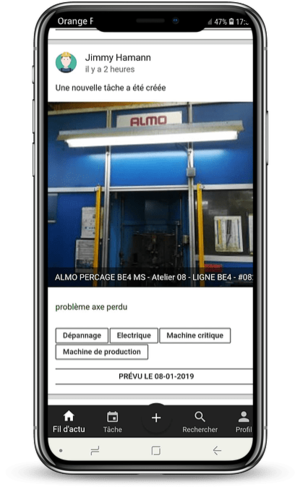
All the news relating to current interventions are available from the news feed of the Mobility Work mobile application, available on iOS and Android
To help businesses make the transition to Industry 4.0 and modernize their image, there are many tools available. The sector is changing and changing: factories now use intuitive and new generation CMMS software such as Mobility Work, proof that a new kind of maintenance is possible! It is by choosing to implement intelligent tools that the sector will attract new profiles. Mobility Work, a CMMS platform and the first social network entirely dedicated to industrial maintenance, gives companies the opportunity to revolutionize the sector and shake up preconceived ideas!
Any questions?
Contact us to discover the first CMMS that can be deployed in 3 weeks.